How Money Taught Strangers to Cooperate
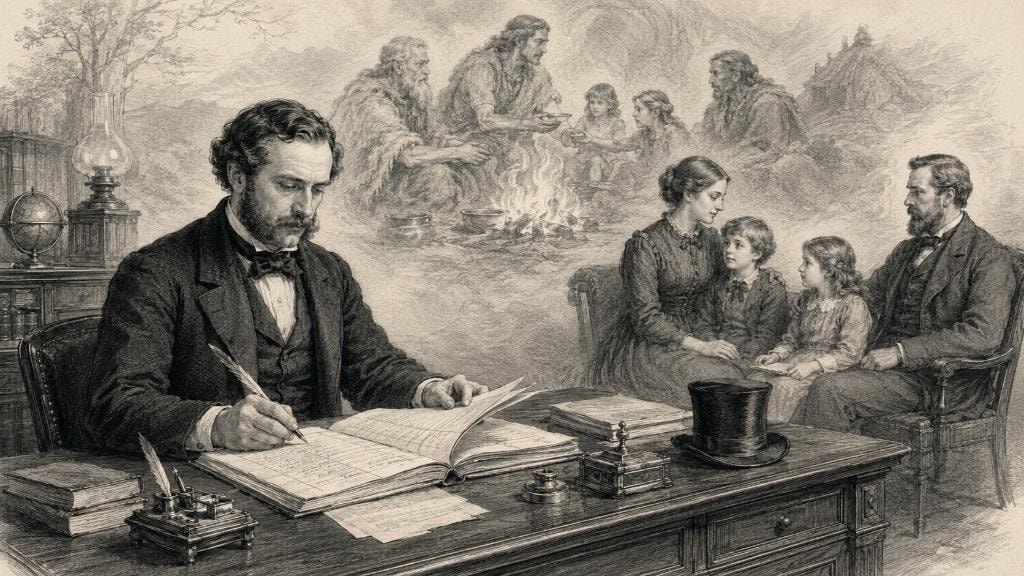
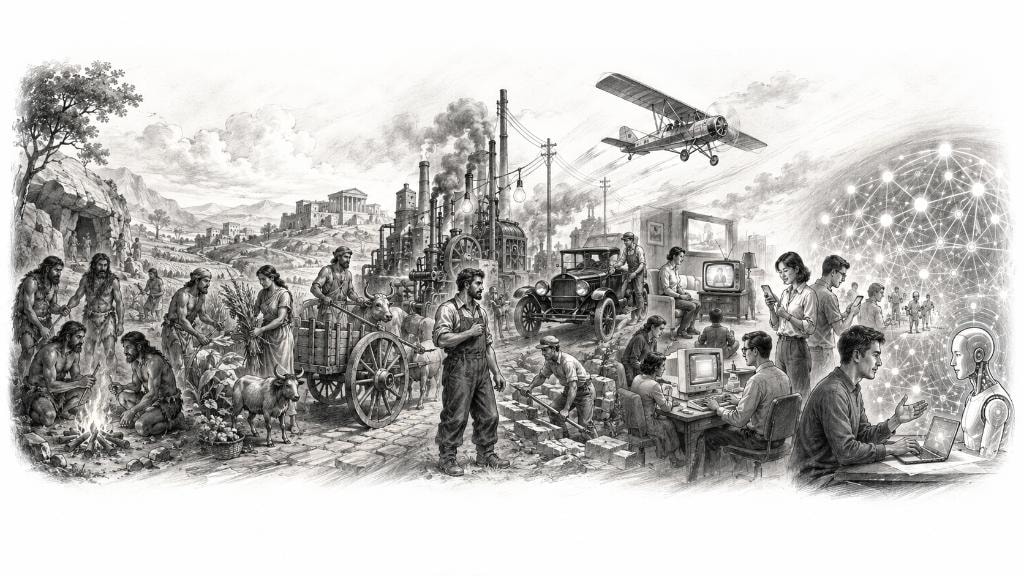
Money changed human society by turning personal obligations into transferable claims, allowing people who did not know one another to exchange, specialize, and cooperate at unprecedented scale.
How Money Taught Strangers to Cooperate
Money changed human society by making exchange possible beyond kinship, friendship, and personal reciprocity. Its power comes from a shared belief: the expectation that an unknown person will accept today what another unknown person can spend tomorrow.
You enter a store you have never visited. The person behind the counter does not know your family, your reputation, or whether you keep your promises. You pick up something you need, present a piece of paper, a plastic card, or a signal from your phone, and walk away with it.
The object you receive is useful. The payment often has little practical value on its own. A banknote cannot feed the seller. The numbers moving between two bank accounts cannot keep anyone warm. What makes the transaction possible is an expectation shared by both parties: the seller believes that other people will later accept the same money from them.
That ordinary purchase contains one of humanity's most consequential social inventions.
Money allowed cooperation to move beyond relationships. It converted a personal obligation between two people into a transferable claim on a much larger community. In doing so, it helped strangers work together across distances, generations, languages, religions, and political boundaries.
Money did not eliminate the need for trust. It relocated trust from the individual to the system.
Before Money, Exchange Was Usually Personal
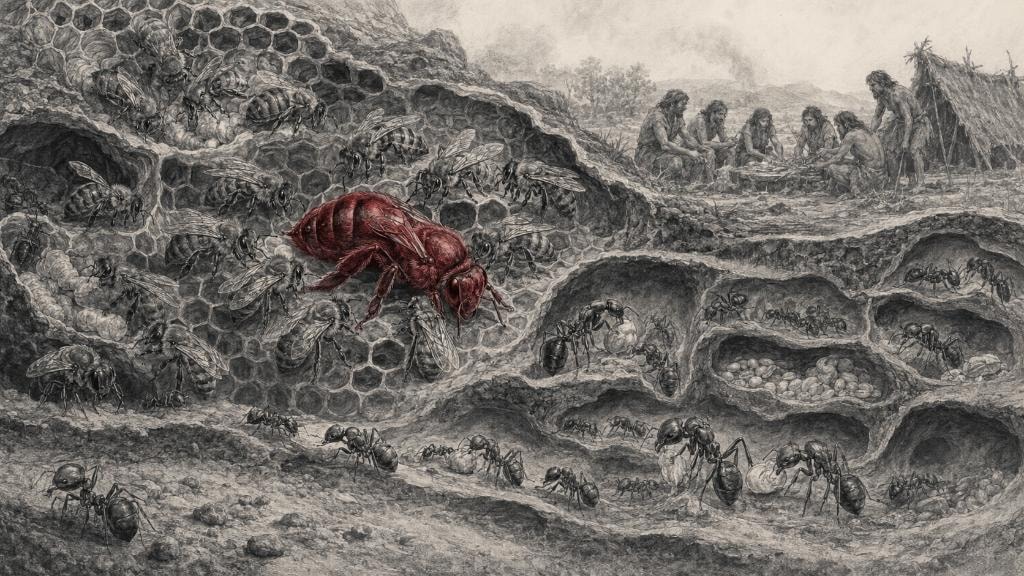
Humans cooperated long before coins, banknotes, or bank accounts existed. For most of our evolutionary history, cooperation operated inside networks of kin, neighbors, allies, and recurring partners.
If one hunter shared meat after a successful hunt, the recipient might later return food, labor, information, protection, childcare, or political support. The return did not need to be immediate or identical. What mattered was the continuing relationship.
Robert Trivers described reciprocal altruism as a system in which an individual accepts a short-term cost when there is a reasonable expectation of a later benefit (Trivers, 1971, 2005). Such arrangements become more stable when people meet repeatedly, remember past behavior, and can avoid or punish those who consistently take without giving.
John Q. Patton's research in Conambo, an Indigenous community in the Ecuadorian Amazon, shows how layered these exchanges can be. Meat transfers were associated with kinship and reciprocal sharing, but they were also directed toward political allies. A hunter could give away a valuable resource and receive something less visible in return: coalitional support in a social environment where alliances mattered for household security (Patton, 2005).
This was exchange, but it was embedded in social life. The giver needed some knowledge of the recipient. Reputation mattered. Memory mattered. Future encounters mattered.
These systems remain effective in small communities. They become harder to operate as the number of people increases.
You can remember which neighbor helped repair your roof. You cannot maintain a detailed reciprocal account with the thousands of people whose work supports your daily life: farmers, engineers, warehouse workers, truck drivers, accountants, miners, programmers, inspectors, nurses, and factory workers scattered across the world.
Money helped solve that scaling problem.
Key terms
Direct reciprocity: I help you because I expect you may help me later.
Indirect reciprocity: I help someone and later receive value from another member of the wider community.
Medium of exchange: Something widely accepted in payment for goods or services.
Unit of account: A common measure used to express prices, debts, wages, and obligations.
Institutional trust: Confidence in rules, organizations, records, and enforcement systems rather than in a particular person.
Why Would Anyone Accept Something With No Immediate Use?
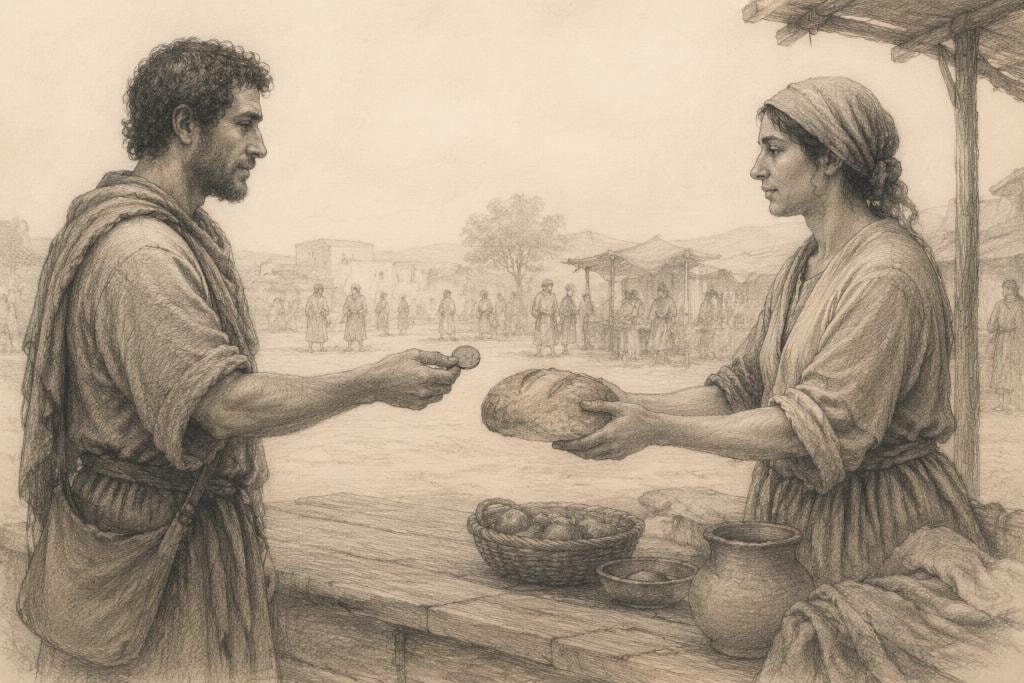
Imagine that you own a bakery. A stranger asks for bread and offers a printed banknote. You surrender something edible in exchange for something you probably will never consume or use directly.
Why would this behavior become normal?
Two broad hypotheses help explain it.
Hypothesis 1: Money Reduced the Cost of Exchange
The conventional economic explanation begins with the difficulty of matching wants. If you have grain and need shoes, you must find a shoemaker who wants grain at the same time. A commonly accepted medium removes that requirement.
Under this hypothesis, people adopt money because it is portable, divisible, recognizable, and easier to exchange than most goods.
The prediction is straightforward: objects functioning as money should become especially valuable where trade occurs frequently among people who cannot depend on long-term personal relationships. Durable commodities with widely recognized value should appear along trading routes and across social boundaries.
Recent archaeological analysis supports this pathway in some societies. Mikael Fauvelle argues that shell beads in pre-Columbian western North America and metal ingots in Bronze Age Europe could facilitate long-distance exchange among people separated by political, cultural, and linguistic boundaries. In these circumstances, personal debts were difficult to enforce because traders could not be certain they would meet again (Fauvelle, 2025).
Hypothesis 2: Money Grew From Debt, Accounting, and Political Authority
A competing explanation holds that money did not begin primarily as a replacement for barter. In many small communities, people already exchanged through gifts, credit, obligation, and delayed reciprocity. A neighbor could provide food today without demanding an immediate equivalent because both parties expected the relationship to continue.
From this perspective, money developed partly as a way to measure debts, taxes, wages, tribute, fines, and institutional obligations. Political and religious authorities could establish a unit of account, record what people owed, and require payment in an accepted form.
The prediction here is different: evidence of accounting and standardized obligations should sometimes precede widespread coin use. Money's development should be associated with recordkeeping, taxation, temples, palaces, armies, and systems capable of defining and enforcing debts.
Ancient Mesopotamia provides evidence consistent with this pathway. Cuneiform records show that barley and silver were used to calculate prices and balance accounts long before modern currency systems. Eric Cripps's analysis of Neo-Sumerian records documents systematic barley-to-silver price ratios, illustrating money's role as a measure of value as well as a physical means of payment (Cripps, 2017).
These hypotheses do not need to be mutually exclusive. Money appears to have developed more than once, in different forms, under different ecological and political conditions. Long-distance traders, state administrators, local communities, and religious institutions were solving related but distinct coordination problems.
Money Made Reciprocity Transferable
The deepest change introduced by money was greater than convenience.
In a direct reciprocal relationship, the person who receives the benefit carries the obligation. If I give you meat, I expect help from you, your household, or your coalition.
Money separates the giver from the eventual return.
A farmer sells wheat to a miller and receives money. The farmer does not need flour from that particular miller. The farmer can later use the payment to obtain medicine from a pharmacist who had no involvement in the original transaction.
The farmer provides value to the miller. The miller transfers an accepted claim to the farmer. The pharmacist later provides value to the farmer. The pharmacist accepts the claim because others will accept it again.
The obligation circulates.
Money therefore resembles a portable record of contribution. It tells the next participant that the holder previously supplied value, sold an asset, accepted a debt, or received a recognized transfer. The next seller does not need to investigate the entire history. The monetary system compresses that history into a balance.
This is how money can coordinate people who neither know nor trust one another personally.
Experimental research provides support for this interpretation. Gabriele Camera, Marco Casari, and Maria Bigoni found that monetary exchange could sustain cooperation among strangers in settings where personal monitoring was limited (Camera et al., 2013).
Later experiments by Bigoni, Camera, and Casari found that participants without a stable monetary system tended to remain in smaller partnerships. When a functioning monetary system emerged, participants became more willing to interact in larger groups of strangers, where the potential gains were greater (Bigoni et al., 2019).
Evidence: Monetary exchange can reduce the uncertainty involved in cooperating with unknown partners.
Interpretation: Money allows people to rely less on a particular partner's future generosity because the return can come from elsewhere in the network.
Speculation: Monetary systems may be understood as a formal extension of older human capacities for reciprocity, reputation, accounting, and coalition-building. The psychological machinery is ancient. The scale of coordination is historically unusual.
The Trust Is Real, but It Is Distributed
Calling money "pure trust" captures something important, but the phrase needs precision.
The shopkeeper does not necessarily trust you. They may know nothing about you. They trust that the payment is authentic, that the bank will complete the transfer, that the currency will retain enough purchasing power, and that other people will accept it later.
Modern payments depend on several layers of confidence:
- The currency will remain recognized.
- The bank or payment provider will honor the balance.
- The transaction record will be accurate.
- Counterfeiting and fraud will be controlled.
- Contracts and property claims will receive legal protection.
- The political system will avoid destroying the currency's value.
- Enough people will continue using the same monetary network.
The Bank of England describes modern money as a kind of "I owe you," whose usefulness depends on public confidence in its value (Bank of England, 2020).
Most money today is even less tangible than a banknote. It exists as bank deposits and electronic records.
When you tap a phone at a checkout terminal, no valuable object passes between buyer and seller. Several institutions update their records. The transaction works because both sides accept the integrity of those records.
Money is visible in one sense and invisible in another. The note, coin, or digital balance can be observed. The social agreement supporting it cannot. Yet the agreement is the more important part.
A coin without a community of acceptance is metal. A banknote without confidence is decorated paper. A bank balance without a functioning institution is a disputed database entry.
From Villages to Anonymous Economies
Personal reciprocity works best where behavior can be remembered and future interaction is likely. Money becomes especially useful when mobility, specialization, and population size make those conditions less reliable.
As societies expanded, individuals increasingly depended on people outside their immediate relationships. Urban residents consumed food grown by farmers they had never met. Armies required supplies from distant producers. Merchants crossed linguistic and political boundaries. Specialized craftspeople needed a way to exchange their narrow expertise for a wide range of necessities.
Standardized money reduced the amount of personal knowledge required for each transaction.
This did not make markets free of social relationships. Merchants still built reputations. Credit still depended on information. Families, guilds, ethnic networks, and trading communities continued to enforce agreements. Historical commerce usually combined money with reputation, contracts, collateral, witnesses, and political protection.
Money nevertheless changed the minimum relationship required. Two people could complete a limited exchange without first becoming friends, relatives, allies, or long-term partners.
That development had enormous consequences for the division of labor. A person could specialize in making one component of a product because money provided access to everything else. The worker did not need to negotiate separate reciprocal relationships with every food producer, landlord, tailor, physician, and toolmaker.
Money joined millions of partial contributions into a common system of claims.
Money Also Changed the Meaning of Exchange
Every coordination technology creates new incentives.
Money made cooperation with strangers easier, but it also made relationships more measurable and, in some settings, more impersonal. A favor can carry gratitude, loyalty, or ambiguity. A paid transaction defines the obligation more narrowly. Once payment is complete, both parties may consider the account settled.
This can be useful. Clear payment protects people from indefinite social debts and reduces dependence on powerful patrons or relatives. A wage can provide more autonomy than an obligation to a household leader.
The same process can weaken other forms of cooperation. In Camera and colleagues' experimental work, the introduction of monetary exchange supported cooperation among strangers but reduced unconditional giving. Participants shifted from helping as a gift to helping in exchange for tokens (Camera et al., 2013).
Money can therefore change the norm governing an interaction. Activities once organized through duty, solidarity, prestige, or reciprocity may become priced transactions. That change can expand access, but it can also crowd out motivations that markets do not measure well.
Money further creates opportunities for accumulation, exclusion, taxation, exploitation, counterfeiting, financial control, and extreme inequality. A transferable claim can circulate widely, but people do not enter monetary systems with equal bargaining power.
Those who control land, credit, currency issuance, payment infrastructure, or enforcement can influence the terms under which everyone else participates.
Money scales cooperation. It can scale hierarchy as well.
What Money Actually Changed
Money did not transform selfish humans into cooperative ones. Humans were already capable of sharing, reciprocity, punishment, alliance-building, and collective action.
It changed who could participate in an exchange and how long the chain of reciprocity could become.
Before standardized money, much cooperation depended on knowing who had contributed, who owed whom, and whether the relationship would continue. Money made part of that information transferable. It allowed a contribution made for one person to generate a return from someone else, somewhere else, at a later time.
That is what happens at the store.
The stranger accepts your payment because the transaction is embedded in a community far larger than the two of you. Behind the banknote or electronic balance sits a network of workers, businesses, banks, laws, technologies, regulators, and public expectations.
The cashier does not need to know your history. The money arrives with a socially recognized history of its own.
What Would Change My Mind?
- Archaeological evidence showing that early monetary objects were used mainly inside close kin groups, with little connection to accounting, taxation, debt settlement, or external trade.
- Cross-cultural evidence showing that money does not increase the feasible scale of exchange once legal enforcement, reputation, and communication are controlled.
- Experiments finding that equally portable nonmonetary records of contribution consistently support cooperation among strangers as effectively as money.
- Historical cases showing stable, large-scale anonymous exchange without currency, transferable credit, centralized accounting, or a comparable institutional substitute.
Key Takeaways
- Humans cooperated before money through kinship, reputation, alliances, gifts, credit, and reciprocal obligation.
- Money made obligations transferable: one person can provide value while another person supplies the eventual return.
- Money enables strangers to transact because trust shifts from the individual to a shared currency and institutional system.
- Archaeological evidence suggests multiple pathways to money, including long-distance trade, debt accounting, taxation, and political administration.
- Monetary exchange can expand cooperation while weakening gift-based or relationship-based forms of reciprocity.
- Money's benefits depend on credible institutions, stable value, fair access, and confidence that the system will continue working.
References & Further Reading
- Bank of England. (2020). Why does money depend on trust? bankofengland.co.uk
- Bigoni, M., Camera, G., & Casari, M. (2019). Partners or strangers? Cooperation, monetary trade, and the choice of scale of interaction. American Economic Journal: Microeconomics, 11(2), 195–227.
- Camera, G., Casari, M., & Bigoni, M. (2013). Money and trust among strangers. Proceedings of the National Academy of Sciences, 110(37), 14889–14893.
- Cripps, E. L. (2017). The structure of prices in the Neo-Sumerian economy (I): Barley:silver price ratios. Cuneiform Digital Library Journal, 2017(2).
- Fauvelle, M. (2025). The trade theory of money: External exchange and the origins of money. Journal of Archaeological Method and Theory.
- Graeber, D. (2011). Debt: The First 5,000 Years. Melville House.
- Humphrey, C. (1985). Barter and economic disintegration. Man, 20(1), 48–72.
- Patton, J. Q. (2005). Meat sharing for coalitional support. Evolution and Human Behavior, 26(2), 137–157.
- Simmel, G. (2004). The Philosophy of Money (3rd ed.). Routledge.
- Trivers, R. L. (1971). The evolution of reciprocal altruism. The Quarterly Review of Biology, 46(1), 35–57.
- Trivers, R. L. (2005). Reciprocal altruism: 30 years later. In C. P. van Schaik & P. M. Kappeler (Eds.), Cooperation in Primates and Humans. Springer.
Written by Farzin Espahani
Editor in Chief, The Hominid Post
Farzin Espahani writes about human behavioral ecology, evolutionary anthropology, cooperation and the institutions humans build around biological and social risk.