Who Owns Culture When Artificial Intelligence Learns From It?
Artificial intelligence can expand cultural access, but access without consent, attribution and fair participation may weaken the human systems that keep culture alive.
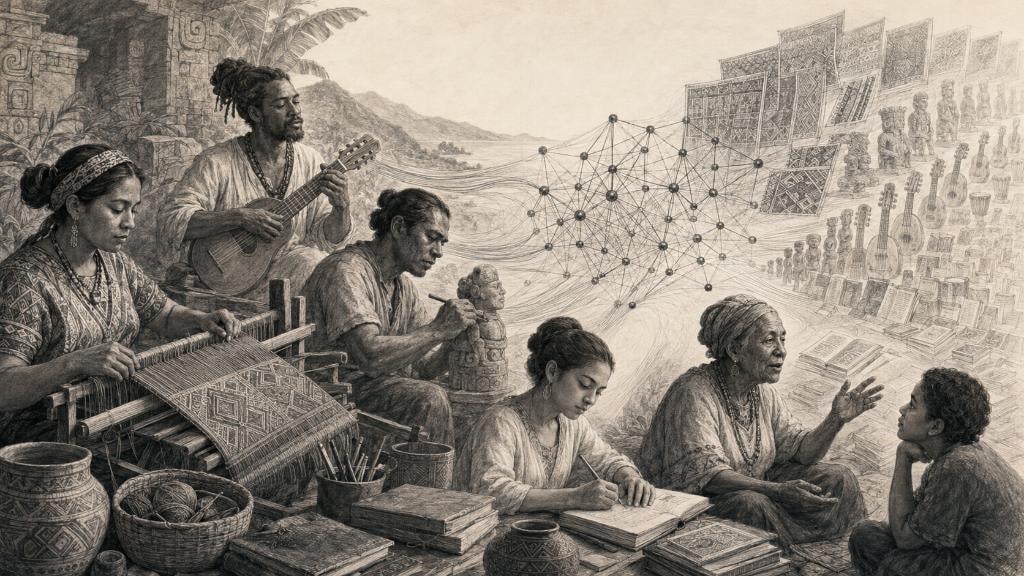
A song may belong legally to one composer while carrying rhythms developed across generations. A textile pattern may be sold by an individual artist while remaining part of a community's identity. A language model can learn from both, reproduce parts of their structure and generate thousands of variations without understanding the relationships that gave them meaning.
This creates a difficult policy question: when artificial intelligence learns from culture, who has the right to decide how that culture is used?
On July 31, 2026, the United Nations Educational, Scientific and Cultural Organization (UNESCO) and the Educational and Cultural Coordination of the Central American Integration System (CECC/SICA) released the first regional assessment of artificial intelligence adoption, impact and governance across the cultural and creative industries of the SICA region. The assessment covers Belize, Costa Rica, the Dominican Republic, El Salvador, Guatemala, Honduras, Nicaragua and Panama.
Its central warning is measured but important. Cultural institutions need the technical capacity to use artificial intelligence, while governments also need governance systems that protect creators' rights, intellectual property and the diversity of cultural expression (UNESCO & CECC/SICA, 2026).
These goals cannot be separated. A region can gain access to powerful artificial intelligence tools while losing control over the cultural material used to build them.
The cultural puzzle: culture depends on copying
Human culture survives because people copy one another.
Children learn language by listening. Apprentices learn techniques by observing skilled practitioners. Musicians inherit rhythms, scales and performance conventions. Storytellers reuse familiar characters and narrative structures. Cultural evolution depends on this accumulation: one generation retains useful knowledge, modifies it and passes it forward.
Robert T. Boyd and Peter J. Richerson described culture as an inheritance system operating alongside genetic inheritance. Joseph Henrich later emphasized how social learning allows human populations to preserve knowledge that no single person could independently reconstruct (Boyd & Richerson, 1985; Henrich, 2016).
From this perspective, artificial intelligence appears to be an extension of an ancient process. It learns statistical patterns from existing material and uses those patterns to produce new combinations.
The resemblance has limits.
Humans learn inside social relationships. A student can acknowledge a teacher. A performer can join a tradition. A community can reward, criticize or exclude someone who misuses shared knowledge. Reputation and reciprocity help regulate cultural transmission.
Artificial intelligence training can remove learning from those relationships. Cultural works may be collected at enormous scale, separated from their creators and converted into training material without meaningful notice. The resulting model may then generate products that compete with the people whose work helped make the system useful.
Copying has always sustained culture. Industrialized copying can alter who receives the benefits.
Key terms
Cultural expression: A work, practice or form through which people communicate cultural meaning, including music, literature, visual art, performance, design and audiovisual production.
Training data: Material processed during the development of an artificial intelligence model so the system can learn statistical relationships.
Creator consent: Meaningful authorization from a creator or rights holder for a defined use of a work.
Traditional cultural expression: A form such as a story, motif, dance, song or craft associated with the identity and inherited knowledge of a community.
Cultural diversity: The presence and continued production of different cultural expressions, languages, traditions and creative perspectives.
Three competing policy models
The dispute over artificial intelligence and culture can be organized around three hypotheses.
Hypothesis 1: Broad access produces wider cultural participation
Under this model, allowing artificial intelligence developers to learn from large and diverse collections produces better tools. Lower barriers may help educators, small creative businesses, museums and independent artists translate, restore, classify and distribute cultural material.
This hypothesis predicts that broader access will reduce production costs, expand audiences and help smaller cultural sectors participate in digital markets.
Some benefits are already plausible. Artificial intelligence can assist with transcription, translation, cataloguing, preservation and accessibility. A regional museum with limited staff may use it to organize an archive. A filmmaker may produce subtitles for several languages. A teacher may adapt historical material for different reading levels.
If this account is correct, excessively restrictive licensing could concentrate artificial intelligence development among the few companies wealthy enough to acquire large collections.
Hypothesis 2: Unrestricted extraction weakens creative production
This model starts with the incentives facing creators.
Writers, musicians, illustrators and performers invest time in developing skills and producing work. If commercial systems can absorb that work without permission, obscure its source and generate lower-cost substitutes, the expected return on human creation may decline.
This hypothesis predicts falling bargaining power, greater market concentration and reduced investment in forms of creative work that are easiest to imitate.
The United States Copyright Office has concluded that artificial intelligence training involves a spectrum of uses. Some may qualify as fair use and others may not. The legal analysis depends partly on the purpose of the use, how the material was acquired, the nature of the works and the effect on existing or potential markets. It specifically warned that market effects could occur at an unprecedented scale because of the volume and speed of generative production (U.S. Copyright Office, 2025).
This does not establish that every act of training is infringement. It establishes that "the model learned from it" is not a complete legal or economic answer.
Hypothesis 3: Artificial intelligence will narrow culture through unequal representation
The third model concerns diversity rather than ownership alone.
Artificial intelligence systems tend to perform best where abundant, well-labelled digital material exists. Large languages, commercial media industries and extensively digitized archives therefore receive greater representation. Smaller languages, local traditions and oral knowledge may remain absent, poorly represented or interpreted through outside categories.
This produces a paradox. A system may contain material from many places while repeatedly generating the styles, languages and assumptions that were most prevalent in its training data.
The UNESCO and CECC/SICA assessment identifies cultural diversity as a governance concern alongside technical capacity and intellectual property. That connection matters. The policy question concerns which cultures artificial intelligence can reproduce accurately, who defines that accuracy and which communities participate in the resulting economic value (UNESCO & CECC/SICA, 2026).
Legal ownership and cultural authority are different
Copyright law generally protects original expression created by identifiable authors. It may cover a recording, photograph, book, film or illustration. It usually does not grant ownership over a general style, an idea, a language or an old tradition whose individual author cannot be identified.
That distinction is necessary, but incomplete.
A traditional design may fall outside ordinary copyright protection while retaining cultural significance for a particular Indigenous or local community. A ceremonial song may be legally accessible but socially restricted. An archive may possess a recording without holding the moral authority to authorize every new use of the knowledge inside it.
Cultural authority can therefore exist without conventional intellectual-property ownership.
This is where national copyright laws, Indigenous rights, contracts, data governance, privacy protections and institutional ethics begin to overlap. They answer different questions:
- Who owns a particular recorded work?
- Was the copy used for training obtained lawfully?
- Does a copyright exception apply?
- Was the creator informed?
- Does the material contain personal, sacred or community-restricted knowledge?
- Can the source community refuse a use even when no individual copyright remains?
- Who receives compensation when commercial value is created?
No single copyright rule can resolve all of these questions.
National approaches already differ. The European Union allows certain forms of text and data mining when access is lawful, while permitting rights holders to reserve their rights in appropriate, machine-readable ways. The United Kingdom has maintained a narrower exception for non-commercial research. The United States relies heavily on fact-specific fair-use analysis. Other jurisdictions are still determining how their existing laws apply to artificial intelligence training.
The World Intellectual Property Organization (WIPO) describes copyright infrastructure as the organizational, technical and legal machinery needed to make rights function in practice. That infrastructure becomes more important as generative systems increase the scale of cultural reuse (WIPO, 2026).
A right that cannot be communicated, tracked or enforced offers limited protection.
An evolutionary lens: culture is a shared resource with producers
Culture resembles a common resource, but it is an unusual one.
A story can be heard by one person without preventing another from hearing it. In economic terms, cultural information is often non-rival. Yet the labor required to create, preserve and teach it remains scarce.
Human communities have long managed this tension through social rules. Knowledge may be shared widely, restricted to initiated members, exchanged through kinship, attributed to a lineage or performed in return for status and material support. Different societies establish different boundaries because cultural information can produce both collective value and individual advantage.
From a human behavioral ecology perspective, the relevant behavior depends on incentives and constraints.
Creators may share freely when sharing increases reputation, alliance value or future opportunity. They may restrict access when copying threatens income, identity or community control. Institutions may open archives to education while limiting commercial reuse. Communities may welcome documentation when it helps preserve a language but reject extraction when outsiders gain authority and revenue without reciprocal obligations.
Artificial intelligence changes the scale and speed of these exchanges. It can turn thousands of small acts of cultural transmission into a centralized commercial asset. The old mechanisms of reputation and reciprocity become weaker when the learner is a distant company and the original contributors cannot see how their work was used.
This does not make artificial intelligence inherently hostile to culture. It means the social relationship must be rebuilt through governance.
What the UNESCO convention adds
The 2005 UNESCO Convention on the Protection and Promotion of the Diversity of Cultural Expressions provides a broader framework than copyright alone.
The convention recognizes the rights of countries to adopt cultural policies, promotes participation by civil society, supports international cooperation and calls for measures that allow diverse cultural expressions to be created, produced, disseminated and accessed. Its operational guidelines explicitly address implementation in the digital environment (UNESCO, 2005/2026).
The word "accessed" matters, but so do "created" and "produced."
A system that gives audiences immediate access to synthetic cultural material while weakening the people who produce original work would satisfy only part of the convention's purpose. Cultural availability can increase while the underlying creative ecosystem becomes less diverse.
A sound policy should therefore measure more than adoption rates. It should ask:
- Are local creators participating in the economic value produced?
- Are smaller languages becoming more visible?
- Can cultural institutions inspect the provenance of training material?
- Do creators have usable consent and refusal mechanisms?
- Can communities establish restrictions for sensitive cultural knowledge?
- Are artificial intelligence tools strengthening local production or replacing it with imported synthetic content?
These are operational questions. They can be audited.
A practical cultural artificial-intelligence governance system
The UNESCO and CECC/SICA assessment calls for stronger technical capacity, specialized training and governance. Those priorities can be converted into a repeatable regional system.
1. Require training-data transparency
Developers serving cultural institutions should disclose the general composition, provenance and legal basis of relevant training datasets. Full publication of every item may be impractical or legally restricted, but meaningful categories and source documentation should be available.
Transparency should identify whether material was licensed, publicly available, obtained under a legal exception or contributed through a partnership.
2. Build consent that people can use
Consent should specify the purpose, duration and commercial scope of use. A creator should be able to distinguish between preservation, academic research, model training and commercial content generation.
Opt-out systems should be machine-readable, accessible in local languages and supported by enforcement. Placing the entire burden on individual creators would favor large rights holders with legal and technical resources.
3. Create collective licensing systems
Individual negotiations cannot efficiently govern millions of works. Collective-management organizations, cultural institutions and creator associations can develop standardized licenses for defined uses.
Revenue can then be distributed through agreed formulas, with independent audits and dispute mechanisms.
4. Protect culturally sensitive material
Museums, archives and universities should classify material before making collections available for artificial intelligence use.
A practical classification could include:
- Open public use
- Educational or research use
- Commercial use under licence
- Community consultation required
- Restricted or prohibited use
This would allow institutions to distinguish public accessibility from unrestricted computational reuse.
5. Measure cultural diversity
Governments should evaluate artificial intelligence systems across local languages, dialects, artistic traditions and historical contexts. Accuracy alone is insufficient. Assessments should also examine stereotyping, source visibility and whether outputs repeatedly collapse distinct traditions into generic regional styles.
6. Invest in local capacity
Creators and institutions need training in copyright, metadata, licensing, dataset documentation and artificial intelligence procurement. Without that capacity, rules may exist on paper while cultural organizations accept contracts they cannot properly evaluate.
7. Keep human review in consequential decisions
Artificial intelligence can assist with cataloguing, translation and restoration. Decisions about cultural meaning, authenticity, access restrictions and community representation require qualified human judgment.
Efficiency should support institutional responsibility, not replace it.
Evidence, interpretation and speculation
Evidence: Artificial intelligence is being adopted across cultural creation, production and distribution. UNESCO and CECC/SICA identify technical capacity, creator rights, intellectual property, ethical governance and cultural diversity as shared regional priorities.
Interpretation: These priorities form one connected operating problem. Technical access without rights infrastructure may increase extraction. Rights protection without access or training may leave smaller cultural sectors outside important technological developments.
Speculation: If current asymmetries persist, artificial intelligence may create a cultural feedback loop. Material from dominant languages and industries will shape more outputs; those outputs will become more visible online; and future models will learn from an even less balanced cultural record. This outcome is plausible, but it should be tested through longitudinal studies of training data, platform distribution and creator income.
What would change my mind?
- Evidence that unlicensed commercial training consistently increases creator income and bargaining power across large and small cultural markets.
- Long-term data showing that generative systems increase the visibility and accurate representation of smaller languages and traditions without targeted governance.
- Licensing systems that prove too costly for small developers while producing little measurable benefit for creators.
- Reliable technical evidence that provenance, consent and compensation cannot be implemented at useful scale.
- Cross-national evidence that existing copyright rules already provide clear, accessible and enforceable remedies for individual creators and cultural communities.
Culture needs circulation and stewardship
No person owns an entire culture. Cultures emerge from generations of borrowing, experimentation, memory and exchange.
That observation does not give every company an unlimited claim over every cultural work it can reach.
Creators can hold legal rights. Communities can hold legitimate cultural authority. Institutions can carry duties of care. Governments can protect the conditions under which diverse cultural production remains possible. Artificial intelligence developers can gain access through systems built around transparency, consent, licensing and reciprocity.
The objective should be a workable social contract: allow artificial intelligence to help preserve, translate and expand culture while maintaining the incentives and relationships that produce it.
Culture survives through transmission. It also survives because people continue to find it worthwhile -- and socially possible -- to create.
Key takeaways
- The UNESCO and CECC/SICA assessment connects artificial intelligence adoption with creator rights, intellectual property, ethical governance and cultural diversity.
- Copyright ownership and cultural authority are related but distinct. Some culturally important material may receive little protection under conventional copyright law.
- Artificial intelligence changes cultural transmission by increasing its scale, speed and commercial concentration.
- Regional policy should combine technical access with provenance, usable consent, collective licensing, sensitive-material controls and diversity measurement.
- Cultural institutions need internal governance before allowing collections to be used for artificial intelligence training.
- The appropriate policy test is whether artificial intelligence strengthens the long-term production and diversity of human culture.
References and further reading
Boyd, R. T., & Richerson, P. J. (1985). Culture and the evolutionary process. University of Chicago Press.
Henrich, J. (2016). The secret of our success: How culture is driving human evolution, domesticating our species, and making us smarter. Princeton University Press.
United Nations Educational, Scientific and Cultural Organization. (2005). Convention on the Protection and Promotion of the Diversity of Cultural Expressions. UNESCO.
United Nations Educational, Scientific and Cultural Organization. (2021). Recommendation on the ethics of artificial intelligence. UNESCO.
United Nations Educational, Scientific and Cultural Organization, & Educational and Cultural Coordination of the Central American Integration System. (2026). Exploratory assessment on the adoption, impact and governance of artificial intelligence in the cultural and creative industries of the SICA region. UNESCO and CECC/SICA.
United States Copyright Office. (2025). Copyright and artificial intelligence, Part 3: Generative AI training. Library of Congress.
World Intellectual Property Organization. (2026). Artificial intelligence and intellectual property. WIPO.
Editorial note: This article interprets policy research, legal analysis and evolutionary social science. Evidence, interpretation and speculation are labeled separately. Policy recommendations are not presented as current legal requirements. The article should be updated when the full CECC/SICA assessment, national legislation or major court decisions materially change the analysis.
Written by Farzin Espahani
Editor in Chief, The Hominid Post
Farzin Espahani writes about human behavioral ecology, evolutionary anthropology, cooperation and the institutions humans build around biological and social risk.