Does Morality Have an Aesthetic Preference?
Kill a cockroach and you may be praised. Kill a butterfly and you may be condemned. The difference tells us something uncomfortable about how humans construct moral value.
Does Morality Have an Aesthetic Preference?
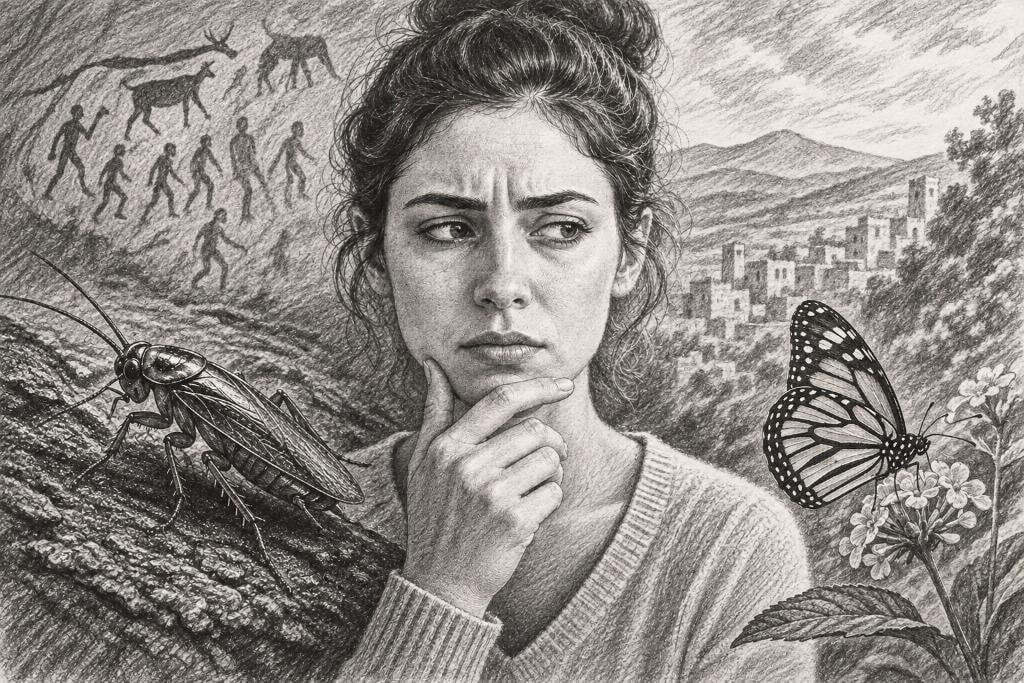
Imagine two insects land on your kitchen counter.
One is a cockroach. You crush it. Few people object. Someone may even thank you.
The other is a butterfly. You crush it with exactly the same motion.
The reaction changes immediately.
Why?
Both animals are insects. Both are alive. Both can be killed. Yet one readily enters the category of pest, while the other enters the category of beautiful living thing.
Part of the difference is practical. Cockroaches can contaminate human environments; butterflies generally do not. But that explanation does not take us far enough. Research suggests that perceived beauty itself can influence the moral standing humans assign to animals, even when other characteristics are accounted for.
This creates a behavioral puzzle: Does human morality partly follow aesthetics?
The question would have interested Friedrich Nietzsche. It also takes us into evolutionary theories of disgust, threat avoidance, cooperation, status, resource exchange, and cultural transmission.
The answer is unlikely to be that humans possess a simple instinct saying beautiful things are good. Something more interesting appears to happen. Moral judgment is assembled from older systems for evaluating the world: attraction and aversion, danger and safety, usefulness and cost, familiarity and strangeness, alliance and hostility.
Beauty can become one input into that machinery.
Nietzsche's uncomfortable starting point: Where did the value come from?
Friedrich Nietzsche's approach to morality offers a useful place to begin because he refused to treat moral categories as self-explanatory.
Rather than starting with What is good?, Nietzsche repeatedly pushed toward a genealogical question: How did particular things come to be called good?
His mature philosophy challenged the idea that moral values simply arrive from a neutral, universal standpoint. Moral systems have histories. They emerge through human valuation, social relationships, interests, psychological dispositions, and struggles over what deserves admiration or condemnation.
Nietzsche's relationship with aesthetics was equally important. Art and aesthetic evaluation run throughout his work, from The Birth of Tragedy through The Gay Science, On the Genealogy of Morality, and Twilight of the Idols. His philosophy repeatedly connects valuation with perspective rather than assuming that humans encounter a world already divided neatly into beautiful and ugly, noble and contemptible, good and evil.
We should be careful here.
Nietzsche did not develop a theory claiming that people spare butterflies because they are beautiful. Using him that way would turn an interesting philosophical framework into a quotation machine.
His contribution is methodological.
When a society treats one act of killing as trivial and another as morally troubling, Nietzsche encourages us to investigate the history and psychology behind those valuations rather than accepting the categories themselves.
So return to the cockroach.
Why does cockroach already feel different from butterfly before anyone begins a moral argument?
Evolution provides one possible layer of the answer.
Before morality, there was survival
Natural selection does not require an organism to understand microbiology before avoiding something dangerous.
For most of human evolutionary history, pathogens were invisible. Their consequences were not.
Rotting food, feces, bodily fluids, infected wounds, parasites and decomposing organisms could carry serious costs. Organisms capable of recognizing cues associated with contamination and avoiding them could gain survival advantages.
One proposed solution is the behavioral immune system: psychological mechanisms that detect possible pathogen threats and motivate avoidance before infection occurs.
Disgust is central to this framework. Valerie Curtis and colleagues argued that disgust can be understood as an adaptive system for disease avoidance, responsive to environmental information about potential infection risks.
That matters for our cockroach.
Cockroaches are strongly associated with some of the environments humans have reason to avoid: refuse, spoiled food, sewage, dark crevices and contaminated spaces. Their sudden movement may add another aversive cue.
The butterfly presents a radically different package.
Flowers. Daylight. Color. Symmetry. Delicate movement. No obvious threat.
From the perspective of immediate human survival, therefore, these animals do not enter perception neutrally.
Before someone consciously thinks, What are my ethical obligations toward this organism?, older perceptual and emotional systems have already begun sorting the situation.
Approach. Avoid. Safe. Dangerous. Potentially useful. Potentially contaminated.
That gives us our first hypothesis.
Competing hypotheses
Hypothesis 1 — Adaptive threat valuation: Humans respond differently to cockroaches and butterflies primarily because the animals historically or currently imply different costs and benefits. Disease risk, contamination and threat produce aversion.
Hypothesis 2 — Aesthetic moral valuation: Humans assign greater moral standing to organisms they perceive as beautiful, even after differences in danger, usefulness, intelligence and similarity to humans are accounted for.
Hypothesis 3 — Cultural classification: Much of the difference is learned. Cultures teach people that butterflies symbolize beauty and transformation while cockroaches symbolize dirt and infestation.
These hypotheses can operate simultaneously. The interesting scientific problem is determining how much each contributes.
Disgust can leak into morality
The survival hypothesis becomes more interesting because disgust does not necessarily remain confined to pathogen avoidance.
Experimental research has found associations between induced disgust and harsher moral judgments under some conditions. In experiments reported by Schnall and colleagues, participants exposed to disgust-inducing conditions sometimes judged unrelated moral violations more severely.
The broader evolutionary literature requires caution here. Researchers continue to debate exactly how pathogen avoidance, disgust and moral judgment relate to one another. Some evolutionary accounts explicitly warn against treating "moral disgust" as merely pathogen disgust transferred wholesale into ethics.
Still, the underlying possibility matters.
A psychological system originally useful for answering Should I touch this? can influence judgments that feel closer to Is this bad?
That distinction is enormous.
If aversion can acquire moral meaning, then the cockroach problem begins making sense. An organism associated with contamination may first generate avoidance. Culture can then provide a label — filthy, vermin, pest — that makes destruction seem permissible.
The emotional reaction arrives quickly. The justification may arrive afterward.
Then beauty enters the moral calculation
Here the evidence becomes particularly relevant to our butterfly.
In a 2021 study in the Journal of Environmental Psychology, Christoph Klebl and colleagues examined whether perceived animal beauty influences the moral standing people assign to animals.
Their findings went considerably beyond "people like pretty animals."
Across a wide range of species, perceived beauty predicted moral standing even after accounting for perceived mental capacities and harmfulness. In a preregistered second study, manipulating perceived beauty influenced moral-standing judgments independently of factors including similarity to humans, familiarity and edibility.
That is remarkably close to our original intuition.
Beauty appears capable of affecting judgments about which animals deserve moral consideration.
The effect also escapes the laboratory.
A study of more than 10,000 participants in a zoo conservation program found that people were more likely to choose charismatic species for adoption; endangered status itself did not determine their choices.
Other conservation research has documented aesthetic and taxonomic biases in funding. One European analysis found that animals received substantially more conservation funding than plants, while among plants, characteristics including flower color were associated with funding independent of extinction risk.
So the butterfly problem scales.
Our aesthetic preferences can influence which living things attract attention, sympathy and resources.
Morality may therefore have an aesthetic bias.
But aesthetics is still only part of the system.
Patton: value depends on relationships
John Q. Patton's research among the Achuar, Quichua and Zapara-speaking households of Conambo in the Ecuadorian Amazon provides an apparently unrelated example that helps explain the deeper mechanism.
Patton studied meat sharing.
At first glance, sharing meat looks like generosity. A hunter obtains a valuable resource and gives some of it away.
Evolutionary anthropology asks the less sentimental question: Why?
Giving valuable food imposes a cost. What compensating benefits might make sharing worthwhile?
Researchers had proposed several explanations: kin selection, reciprocal altruism, tolerated theft, costly signaling and status acquisition. Patton added another: coalitional support.
His data suggested that meat transfers in Conambo could not be explained by a single mechanism. Kinship mattered. Reciprocity mattered. But political alliances mattered as well. Men transferred more meat to households whose male heads were more likely to support them during conflicts. Patton argued that meat could therefore function partly as a tool for recruiting and maintaining political allies.
This matters to our discussion because the meat itself had no fixed social meaning.
A piece of meat could simultaneously be food, a gift to kin, repayment, reputation, political investment and a signal of alliance.
Its value depended partly on relationships and context.
Human moral judgments may work similarly.
We rarely evaluate an organism — or another human being — from biological facts alone. We evaluate relationships.
Friend or enemy. Kin or stranger. Useful or costly. Beautiful or repulsive. Ally or competitor. Threat or opportunity.
Patton's Conambo research provides an important warning against single-cause evolutionary stories. He explicitly argues that one act of meat sharing can serve several adaptive strategies simultaneously.
The same caution should govern our butterfly.
Morality may be built from older valuation systems
This leads to a broader interpretation.
Human morality may depend partly on psychological systems that evolved for problems that were never originally "moral" in the philosophical sense.
Kin recognition helped organize investment. Reciprocity helped stabilize cooperation. Coalition tracking helped distinguish allies from unreliable partners. Threat detection helped organisms avoid predators and hostile individuals. Disgust helped reduce pathogen exposure. Mate-choice systems influenced attraction. Status psychology helped humans navigate hierarchy and reputation. Cultural learning allowed communities to transmit rules about which behaviors, organisms, foods and people deserved particular responses.
None individually constitutes morality.
Together, however, they provide some of the machinery from which moral intuitions can be constructed.
This interpretation fits human behavioral ecology particularly well because it predicts conditional morality rather than a rigid ancestral program.
Patton's work illustrates exactly this kind of conditionality. Different ecological and political circumstances alter the costs and benefits of sharing. Where alliances are unstable and politically consequential, meat can acquire greater value as a coalitional resource.
Robert Foley makes a related methodological point when warning against imagining a single, uniform environment of evolutionary adaptedness (EEA). Human evolutionary environments varied enormously, and contemporary behavior cannot simply be read as the execution of one Pleistocene script.
Our moral psychology should therefore be expected to be flexible.
The cockroach does not trigger a "cockroach-killing gene."
Humans perceive a bundle of cues, run them through evolved and learned valuation systems, and produce a response.
Culture then teaches us what deserves affection
Biology alone cannot explain why butterflies symbolize transformation, why doves symbolize peace, why snakes can represent evil in one tradition and sacred power in another, or why some societies eat animals that others treat as family members.
Cultural evolution changes the valuation landscape.
Humans learn from parents, peers, institutions, religion, stories, advertising and one another. Once a classification becomes culturally stable, children inherit the classification without having to rediscover its ecological origin.
A cockroach becomes a pest. A butterfly becomes beautiful. A rat may become vermin. A nearly identical animal kept in a cage becomes a beloved hamster.
Biologically, these distinctions can sometimes be surprisingly thin.
Culturally, they can be enormous.
And once culture attaches symbols to organisms, the symbols feed back into emotional reactions. What began as avoidance can become disgust; disgust can become contempt; contempt can make destruction easier to tolerate.
The reverse can happen with beauty.
Attraction becomes admiration. Admiration encourages protection. Protection acquires moral language.
Evidence, interpretation, speculation
Evidence: Disgust has substantial support as part of a pathogen-avoidance system. Human conservation preferences show biases toward charismatic and aesthetically appealing organisms. Experimental evidence indicates that perceived beauty can independently influence the moral standing assigned to animals. Patton's Conambo research demonstrates that cooperative behavior can simultaneously reflect kinship, reciprocity, alliance and status considerations.
Interpretation: Human moral judgments probably draw on several older valuation systems rather than operating as an entirely isolated faculty. Beauty, disgust, threat, kinship, reciprocity and cultural classification can therefore influence what eventually feels morally right or wrong.
Speculation: The butterfly-cockroach contrast may be a small demonstration of a much larger human tendency: we may sometimes mistake the emotional output of our valuation systems for an objective property of the thing being judged. That proposition needs testing rather than acceptance.
And this is where Nietzsche returns.
Nietzsche's question survives the biology
Evolutionary anthropology does not prove Nietzsche right.
It does something more useful.
It gives us mechanisms with which to investigate a question Nietzsche made difficult to ignore: when humans call something good, evil, noble, disgusting or worthy, where did that valuation come from?
Sometimes there is an excellent functional reason. Killing an insect contaminating food may genuinely protect health.
Sometimes there is a social reason. Protecting a cooperative partner may preserve a valuable relationship.
Sometimes there is a cultural reason. We inherit categories from generations before us.
And sometimes, remarkably, the difference may partly be that one creature is beautiful and another is ugly.
The danger begins when these mechanisms become invisible to us.
Because aesthetic bias does not necessarily stop at butterflies.
Humans evaluate other humans. Faces. Bodies. Accents. Clothing. Disability. Age. Familiarity. Social status. Group membership.
Once we recognize that aesthetic perception can alter moral consideration toward animals, a harder question follows: How often does appearance quietly influence judgments about which humans deserve sympathy, credibility, protection or punishment?
The scientific and ethical stakes become much higher there.
Evolutionary explanation does not justify the bias.
Understanding why a judgment occurs and deciding whether that judgment is defensible are separate problems.
Natural selection can help explain our intuitions.
It cannot tell us which intuitions we ought to obey.
What would change my mind?
- Evidence showing that perceived beauty has no independent effect on moral standing once threat, usefulness, sentience, familiarity and cultural learning are adequately controlled.
- Strong cross-cultural evidence showing that aesthetic preference and moral valuation are largely unrelated outside contemporary Western populations.
- Evidence demonstrating that disgust and attraction operate independently from moral judgment rather than contributing to it.
- Better models showing that butterfly-versus-cockroach judgments can be explained almost entirely by rational assessments of ecological costs and benefits.
Key takeaways
- Humans do not encounter living organisms as morally neutral biological categories. Perception already contains information about threat, contamination, usefulness, familiarity and attractiveness.
- Disgust plausibly has deep evolutionary connections to pathogen avoidance, although its relationship with moral judgment remains more complicated than a simple one-to-one transfer.
- Experimental evidence indicates that perceived beauty can independently increase the moral standing people assign to animals.
- Patton's research on meat sharing demonstrates why single-cause explanations are inadequate: human behavior can simultaneously reflect reciprocity, kinship, status and coalition management.
- Culture can amplify biological predispositions by turning organisms into symbols such as pest, pet, sacred animal or beautiful creature.
- Explaining a moral intuition evolutionarily does not make the intuition morally correct.
The cockroach and the butterfly therefore leave us with a surprisingly difficult proposition.
Perhaps morality does have an aesthetic preference.
If so, the important question is no longer why we love the butterfly.
It is whether we recognize when beauty has been allowed to decide who — or what — deserves our concern.
References & Further Reading
- Curtis, V., de Barra, M., & Aunger, R. (2011). Disgust as an adaptive system for disease avoidance behaviour. Philosophical Transactions of the Royal Society B, 366(1563), 389–401.
- Klebl, C., Greenaway, K. H., Rhee, J. J., & Bastian, B. (2021). Beauty of the beast: Beauty as an important dimension in the moral standing of animals. Journal of Environmental Psychology, 75, 101624.
- Nietzsche, F. (1887/1998). On the Genealogy of Morality. Hackett Publishing.
- Nietzsche, F. (1882/1974). The Gay Science. Vintage Books.
- Patton, J. Q. (2005). Meat sharing for coalitional support. Evolution and Human Behavior, 26(2), 137–157.
- Foley, R. (1996). The adaptive legacy of human evolution: A search for the environment of evolutionary adaptedness. Evolutionary Anthropology, 4, 194–203.
- Colléony, A., Clayton, S., Couvet, D., Saint Jalme, M., & Prévot, A.-C. (2017). Human preferences for species conservation: Animal charisma trumps endangered status. Biological Conservation, 206, 263–269.
- Curtis, V., Aunger, R., & Rabie, T. (2004). Evidence that disgust evolved to protect from risk of disease. Proceedings of the Royal Society B, 271(Suppl. 4), S131–S133.
Written by Farzin Espahani
Editor in Chief, The Hominid Post
Farzin Espahani writes about human behavioral ecology, evolutionary anthropology, cooperation and the institutions humans build around biological and social risk.