When Ideas Become Cheap: What AI Changes About Human Work
Artificial intelligence is lowering the cost of producing ideas and executing knowledge work. That gives people extraordinary new capacity, but it also changes what organizations need from people.
When Ideas Become Cheap: What AI Changes About Human Work
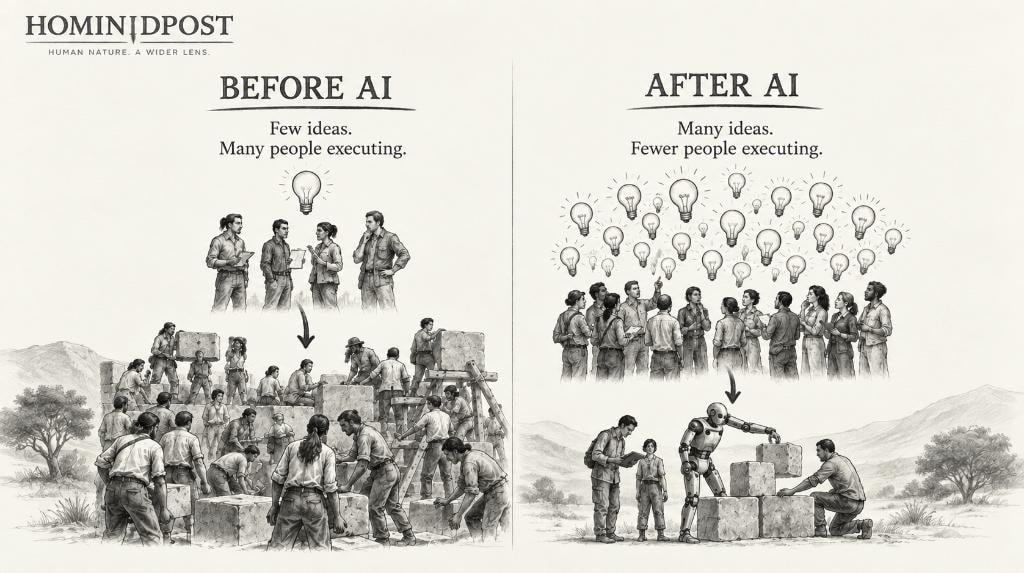
For most of organizational history, producing a good idea required considerable work. Someone had to understand the problem, gather information, analyze it, discuss possible answers, prepare a recommendation, and persuade other people to act. Once a decision was made, another group of people usually had to execute it. Human time limited how much of this could happen.
Artificial intelligence (AI) is removing some of that constraint. One person can now generate dozens of strategies, analyze large amounts of information, produce designs, write software, develop marketing campaigns, and prepare an executive presentation in the time it once took to get a project started.
Organizations have spent decades trying to improve their ability to generate ideas and increase the productivity of the people executing them. AI gives them more of both. The number of possible answers can now grow much faster than an organization’s ability to determine which answers are useful.
When the Cost of an Idea Falls
Imagine a company trying to understand why customer conversion has declined. A decade ago, answering that question might have involved analysts, marketers, researchers, designers, and managers. They would examine data, interview customers, debate possible causes, and eventually develop a small number of recommendations.
Today, one person working with AI can generate 50 possible explanations in minutes. Ask again and it can produce 50 more. It can organize them, propose experiments, estimate possible effects, and turn everything into a presentation.
Research suggests that some of this additional capacity translates into measurable productivity. In a study of 5,172 customer-support agents, Erik Brynjolfsson, Danielle Li, and Lindsey Raymond found that access to a generative AI assistant increased productivity by about 15 percent on average, with particularly strong gains among less experienced workers (Brynjolfsson et al., 2025).
Producing possible answers and understanding the problem are different activities. Suppose the company asks, How can we improve conversion? AI suggests better landing pages, personalized offers, different pricing, automated follow-up, new audience segments, improved calls to action, and predictive lead scoring.
But suppose customers are leaving because they no longer trust the company. The 100 ideas may simply be derivatives of the wrong question.
More answers will not repair a poorly framed problem. They may make it harder to see. A long, polished list of recommendations can create the appearance of substantial analysis when the original assumption was never tested.
Ideas Become Abundant. Attention Does Not.
Generating possibilities used to consume meaningful amounts of labor. That scarcity imposed a crude filter. There were only so many reports a team could write, campaigns it could design, products it could prototype, or strategies it could model.
AI weakens that filter. A marketing team can create hundreds of campaign variations. Engineers can prototype more approaches. Analysts can investigate more scenarios. Executives can request another strategy without waiting two weeks for someone to prepare it. The number of possibilities can expand much faster than the human capacity to examine them carefully.
Human behavioral ecology offers a way to think about this shift. Humans allocate effort partly according to constraints, opportunities, and expected returns. When something becomes easier to obtain, effort can shift toward whatever remains difficult or scarce.
AI is making portions of writing, coding, analysis, research, design, and planning easier to obtain. Attention remains limited. So does judgment. Deep knowledge of a business takes time to acquire. Trust cannot be generated on demand. Accountability cannot simply be handed to a model. And every answer still depends on the quality of the question that produced it.
Key Terms
Idea abundance: A condition in which generating plausible concepts, strategies, analyses, or alternatives becomes inexpensive enough that producing additional options is no longer the primary constraint.
Tacit knowledge: Knowledge developed through experience that is difficult to fully express as written rules or instructions.
Judgment: The ability to evaluate incomplete or conflicting information, understand context, weigh tradeoffs, and decide what deserves action.
The Workforce Question Is Larger Than Job Loss
Most discussion about AI and employment begins with the number of jobs that might disappear. Jobs, however, are bundles of activities.
A lawyer researches, writes, negotiates, advises, interprets, persuades, and accepts professional responsibility. A marketer analyzes markets, develops campaigns, manages vendors, interprets customer behavior, allocates money, and defends decisions. A software engineer writes code but also decides what should be built, how systems should interact, and what risks are acceptable.
AI will affect those activities differently.
The International Labour Organization (ILO) reviewed emerging evidence in 2026 and found meaningful but uneven productivity improvements from generative AI. The evidence so far does not establish economy-wide mass displacement, although the review raises concerns about younger workers, inequality, worker autonomy, job quality, and changes in how work is organized (Merola et al., 2026).
Companies will still face a straightforward economic calculation. If ten people working with AI can produce what previously required twenty, why employ twenty?
The answer depends partly on what the other ten people were doing besides producing measurable output. Some carried institutional knowledge. Some maintained customer relationships. Some caught mistakes. Some trained younger employees. Some provided redundancy when things went wrong. Some were learning the business themselves.
Headcount is easy to measure. Those functions are harder.
Who Becomes Experienced if Beginners Stop Doing Beginner Work?
Organizations have always developed expertise by giving inexperienced people work they were not yet very good at. Junior analysts gathered data and built models. Young lawyers reviewed documents. Entry-level marketers prepared reports and campaigns. New programmers wrote relatively simple code. Customer-service representatives handled ordinary cases before moving to difficult ones.
AI is increasingly capable of doing exactly this kind of work. Removing those tasks can lower costs, but those tasks also served as training.
The Brynjolfsson study is particularly relevant here because less experienced workers gained the most from AI assistance. AI may shorten the path toward competence when people use it while doing the work.
A company could give a junior employee AI, supervise the employee’s decisions, and gradually increase the difficulty of the problems assigned. Or it could eliminate the junior position because AI can perform much of the work. Both approaches can improve productivity today. Only one continues producing experienced employees.
We do not yet have enough evidence to know how serious this problem will become. The incentive to cut junior positions will arrive much sooner than the consequences of having fewer experienced people.
Experience Changes in Value
AI is very good at producing a credible first answer. Experienced people often recognize why that answer will fail.
A veteran insurance executive may see a compliance problem buried inside an attractive growth strategy. A physician may recognize that a recommendation supported by population-level evidence does not fit the patient sitting in front of her. An experienced engineer may recognize a failure mode that does not appear in the specification.
Some of this knowledge can be documented and incorporated into AI systems. Some comes from having watched decisions produce consequences repeatedly. Researchers often call this tacit knowledge: knowledge acquired through experience that is difficult to reduce completely to explicit rules.
Its economic value could increase as explicit knowledge becomes cheaper to retrieve and synthesize. When everyone can produce a polished 30-page analysis, producing another polished 30-page analysis becomes less impressive.
Recognizing the assumption on page three that makes the remaining 27 pages irrelevant is different.
More Ideas Require Stronger Filters
AI dramatically increases the number of alternatives an organization can consider. A company that once evaluated three product concepts might evaluate 30. Marketing teams can test hundreds of messages. Software teams can prototype approaches that previously would not have justified the engineering time.
Generating alternatives therefore solves only part of the problem. Before committing money, people, or reputation, teams still need to establish what problem they are solving, what evidence supports their explanation, what competing explanations exist, how the proposed solution can be tested, and what evidence would justify abandoning it.
A useful review process can begin with a few basic questions:
- What problem are we trying to solve?
- What evidence tells us that this is the problem?
- What other explanations could produce what we are seeing?
- How can we test the proposed solution?
- What evidence would cause us to abandon it?
- Who makes the final decision?
- Who is responsible if the decision is wrong?
AI can contribute to every part of that process. Ownership of the decision still matters because organizations eventually have to act. Someone has to put capital, reputation, customer relationships, patient safety, regulatory standing, or careers behind the answer.
Evolution offers a useful analogy, provided we keep its limits in mind. Variation alone does not produce adaptation. Selection acting on variation determines which variants persist under particular conditions.
AI can produce enormous intellectual variation. Organizations need mechanisms that expose those ideas to evidence, customers, economics, regulation, competition, and consequences.
In business, reality performs the selection.
Smaller Teams May Control Much More Productive Capacity
A small company can already access capabilities that once required specialized departments. Research, software development, design, financial analysis, marketing, customer support, and administrative work are becoming accessible through increasingly capable AI systems.
The same change is beginning inside larger companies. An employee may eventually manage several specialized AI agents instead of sending pieces of work to several departments. Information that once traveled upward through managers and downward through teams may move directly between systems and the people making decisions.
Some organizational layers will probably shrink. Management will remain necessary wherever people need direction, development, incentives, conflict resolution, trust, and accountability. Positions whose main function is collecting information from one group, summarizing it, and passing it to another face greater exposure when machines can perform much of that coordination themselves.
Career paths will have to adjust with the structure. If companies employ fewer junior workers and fewer middle layers while giving individual employees far greater productive capacity, the familiar organizational pyramid begins to change shape.
That affects more than payroll. It changes how people enter professions, acquire experience, gain status, become managers, and eventually become the people trusted to make difficult decisions.
Evidence, Interpretation, and Speculation
Evidence: Generative AI can improve productivity substantially in some kinds of knowledge work. The gains differ by task, worker experience, and implementation. Current research does not establish that AI is already causing broad economy-wide unemployment (Brynjolfsson et al., 2025; Merola et al., 2026).
Interpretation: As generating and executing work becomes cheaper, organizations will need to place greater value on deciding what work should be done, whether the underlying question is correct, and whether the resulting work is good enough to act on.
Speculation: Smaller teams may eventually produce what much larger organizations produce today. Some management layers may shrink. Career paths may change substantially. Companies that eliminate too much entry-level work may discover years later that they also eliminated part of the process that creates experienced employees.
The technology is moving faster than the evidence about how organizations will ultimately restructure around it. Claims about the final shape of the AI workforce should therefore remain provisional.
Why I Am Optimistic About AI
AI gives a small business access to capabilities previously affordable only to a large company. A junior employee can work with expertise that once required constant access to senior colleagues. Scientists can investigate more hypotheses. Programmers can build and test faster. Entrepreneurs can try ideas whose development costs previously made experimentation impossible.
It can also take over work that people have spent decades trying to automate because it is repetitive, administrative, or tedious.
Companies will decide how to use the capacity they gain. Some will convert productivity improvements into lower headcount. Others will use them to serve more customers, develop products that were previously uneconomic, reduce errors, improve service, train employees faster, or lower prices. Many will do some combination of these things.
The outcome will depend on incentives and decisions inside organizations as much as on the capability of the technology. AI can make a company more efficient without telling its leaders what that efficiency should be used for.
What Would Change My Mind?
- Evidence that increasing the number of AI-generated options consistently improves decision quality rather than simply increasing output.
- Evidence that companies can eliminate substantial amounts of entry-level knowledge work without weakening the development of future experts.
- Sustained labor-market evidence showing that AI replaces whole occupations more often than it changes the tasks within them.
- Evidence that AI systems can reliably handle ambiguous problems involving competing human interests and accountability without substantial human oversight.
Key Takeaways
- AI is making ideas and many forms of knowledge work much cheaper to produce.
- More ideas can improve exploration, but they can also create noise.
- One hundred answers have limited value when they are derivatives of the wrong question.
- Judgment, problem definition, verification, trust, and accountability matter more when production becomes easier.
- Companies need to pay attention to how inexperienced employees become experienced ones as AI absorbs more junior-level work.
- AI gives individuals and organizations much greater productive capacity. What they do with that capacity remains a human decision.
The Question Becomes More Valuable
AI makes it increasingly easy to produce an answer. That changes the value of the question.
People who do well in this environment may be those who can identify what deserves attention, recognize assumptions that do not hold, distinguish an interesting idea from a useful one, test it against reality, and accept responsibility for what happens next.
We should welcome the increase in human productive capacity. Giving people tools that allow them to accomplish more with less time and fewer resources opens possibilities that were previously too expensive, too slow, or simply unavailable.
Abundance has costs as well as benefits. If we can generate 100 ideas before lunch, the achievement is no longer having 100 ideas.
It is knowing which one deserves the afternoon.
References & Further Reading
Brynjolfsson, E., Li, D., & Raymond, L. R. (2025). Generative AI at work. The Quarterly Journal of Economics, 140(2), 889–942.
International Labour Organization. (2025). Artificial intelligence adoption and its impact on jobs. International Labour Organization.
Merola, R., Ernst, E., Samaan, D., del Rio-Chanona, M., & Teutloff, O. (2026). The impact of GenAI on jobs, productivity and work organization: A review of the empirical evidence. International Labour Organization.
Tooze, J. (2026). Commentary and original visual concept on the changing relationship between idea generation and execution in AI-enabled organizations. LinkedIn.
Image concept credit: Jonny Tooze. The original illustration that inspired the Hominid Post graphic was created and shared by Tooze. The Hominid Post illustration is an independent interpretation of that concept.
Written by Farzin Espahani
Editor in Chief, The Hominid Post
Farzin Espahani writes about human behavioral ecology, evolutionary anthropology, cooperation and the institutions humans build around biological and social risk.