Stop Fixing Problems. Build the Ecosystem.
Why businesses organized around connected systems may outperform companies trapped in a cycle of patches, vendors, projects and emergency fixes.
Stop Fixing Problems. Build the Ecosystem.

A customer acquisition problem appears, so marketing buys another tool. Sales conversion falls, so management adds a dashboard. Retention weakens, so a retention team is created. Compliance becomes harder, so another vendor is hired. Artificial intelligence arrives, so someone buys an artificial intelligence platform.
Six months later the company has more technology, more vendors, more meetings, more data and more operating expense. The original problems are often still there.
This failure is common because each decision makes sense on its own. The problem sits one level higher. A business is a system of interdependent people, incentives, information, capital, customers, suppliers and institutions. When management treats interconnected problems as isolated events, every local solution changes the environment around everything else, and the company ends up running on patchwork.
There is a different way to approach the problem, which is to build an ecosystem. That does not mean buying a platform or assembling a long partner list. A working business ecosystem is an architecture in which different participants contribute specialized capabilities under rules, incentives, interfaces and information flows that are clear enough for the pieces to reinforce one another. A patch solves today’s problem. An ecosystem changes the conditions that keep producing it.
Why humans build systems in the first place
Long before corporations, software platforms and supply chains, humans faced a basic economic constraint: an individual could rarely produce everything a household needed. Specialization created advantages, and it created dependence. A skilled hunter could bring in more meat than one household could eat before it spoiled. Someone else could offer food later, childcare, political support, information, protection or access to a resource the hunter lacked.
Once specialization appears, exchange becomes valuable. Once exchange becomes valuable, relationships matter. Once relationships repeat, rules and reputations start to matter. The same logic that makes eusocial insect colonies and cooperative primate groups stable, that individuals gain from contributing to a system they cannot run alone, applies to human households (Nowak et al., 2010), though humans layer culture, kinship and negotiated alliances on top of it in ways no other species does.
John Q. Patton’s research among households in Conambo, in the Ecuadorian Amazon, is a useful illustration. Patton asked why hunters transferred meat to other households. A simple answer would have been food redistribution. His findings were more complicated. Meat transfers tracked reciprocity, kinship and political alliances, which means one resource was moving through a network that carried several kinds of value at once (Patton, 2005). A piece of meat could be food, a repayment, support for a relative, maintenance of an alliance and a contribution to reputation, sometimes all in the same transfer. Patton cautioned against reducing any single transfer to one motive, since the same act could serve overlapping strategies depending on ecological and political circumstances.
That observation translates well to modern organizations. Money is rarely the only thing moving through a business relationship. Information moves. Trust moves. Customers, reputation, risk, expertise and bargaining power all move. A company that sees only the immediate transaction can miss the system that is producing its economic value.
Two competing explanations for how businesses should organize
There are at least two reasonable hypotheses, and each makes predictions.
Hypothesis 1: Specialization and modular purchasing are more efficient. Under this model, companies should solve problems individually. Hire the best advertising agency for advertising, buy the best customer relationship management (CRM) system for sales, use a separate vendor for compliance, find a specialist for analytics, and replace components as better ones appear. The economic case is real. Specialization reduces cost and improves expertise, competition among suppliers prevents complacency, and modularity keeps a company from becoming dependent on one provider. If this hypothesis dominates, fragmented systems should perform well whenever problems are largely independent and the interfaces between them are simple.
Hypothesis 2: Interdependent problems require ecosystem coordination. This hypothesis starts from the dependencies. Marketing affects sales. Sales practices affect compliance. Product design affects conversion, conversion quality affects retention, retention affects customer lifetime value, and lifetime value determines how much the company can rationally spend acquiring the next customer. Data quality affects all of it. Under these conditions, optimizing each component separately can produce a poorly performing whole, and the central problem becomes coordination rather than component quality.
Research on business ecosystems by Michael Jacobides, Carmelo Cennamo and Annabelle Gawer describes an ecosystem as a set of independent organizations that create value through complementary activities coordinated through common roles, standards and interfaces (Jacobides et al., 2018). The definition is useful because it strips away most of the corporate fashion around the word. An ecosystem does not require one company to do everything. It allows specialized participants to stay specialized while making their contributions compatible with the larger system.
The discriminating test between the two hypotheses is the strength of the dependencies. Where a customer’s outcome depends on one function, Hypothesis 1 should win. Where it depends on several functions or organizations working in sequence, Hypothesis 2 should win. Most regulated, trust-heavy businesses sit closer to the second case than their org charts suggest.
The hidden cost of the patch
Reactive problem solving starts with a reasonable question: what can fix this quickly? It becomes expensive when nobody asks the next one: what caused this, and what else changes when we fix it?
Consider a company struggling with customer acquisition cost. Marketing buys cheaper leads, and cost per lead improves on the marketing dashboard. The cheaper leads convert poorly, so sales increases call volume. Complaints rise, compliance monitoring expands, and agent productivity falls because agents spend their day contacting people who were never likely to buy. Management responds by purchasing a sales automation tool. The company now appears to have five problems. In practice it may still have one: the acquisition system rewarded marketing for generating inexpensive leads rather than economically valuable customers. A local metric produced rational local behavior and an irrational system outcome.
This is how fragmented organizations accumulate software and vendors. Each department can defend the logic of its own purchase while nobody owns the economics of the complete customer journey. The cost surfaces somewhere else: duplicated technology, integration work, reconciliation, extra headcount, compliance exposure, slower decisions or worse customer experience. The ledger records these as separate line items. Operationally, most of them are coordination costs.
Ecosystems change the unit of optimization
An ecosystem approach replaces the question “how do we make this department perform better?” with “how do we improve the economics of the whole system?”
Take acquisition again. A fragmented model optimizes traffic, leads, calls, sales and retention as separate stages with separate owners. An ecosystem model treats them as one connected sequence that runs from customer need through acquisition, qualification, recommendation, transaction, service and retention, and then back to the beginning, because a sale carries information. Which customer converted? Which advertisement produced them? Which product matched the need? Was the customer satisfied, did they stay, did the company make money, did they complain?
Without those signals flowing back upstream, marketing keeps buying customers on incomplete information. The system only learns when outcomes return to the participants making the earlier decisions, and feedback that improves allocation is the main economic advantage a connected system has over a set of disconnected ones.
The ecosystem should be modular, not monolithic
There is a serious objection here. Integrated systems can become bureaucratic. They create vendor lock-in. A dominant platform can extract excessive rents, partners can end up dependent on rules they do not control, and centralization can suppress experimentation. Ecosystem research does not wave these problems away. Jacobides and colleagues’ more recent work explicitly recognizes that platforms and ecosystems can generate their own functional and distributional failures after they solve earlier coordination problems (Jacobides et al., 2024).
So the alternative to fragmentation should not be a giant vertically integrated machine. The better architecture is usually modular integration. The Lego comparison is imperfect but useful: standardized studs let independently made pieces connect, and any piece can be swapped without rebuilding the model. The analogy breaks at incentives, since bricks do not negotiate, game each other or leave for a competitor, and that is precisely where most ecosystem design fails.
In practice, modular integration means each component has a defined purpose, interfaces are standardized, data is portable where practical, responsibilities are explicit, participants understand how value is created and how they are paid, and weak modules can be replaced without destroying the whole. That combination is what makes ecosystems economically interesting: independent organizations coordinate without a single hierarchy controlling every activity.
Key terms
Fragmented architecture: Independent solutions optimized around individual problems, departments or metrics.
Ecosystem: A set of interdependent participants whose complementary capabilities combine into a broader value proposition.
Modularity: Designing components so they operate independently while connecting through defined interfaces.
Feedback loop: Information from downstream outcomes that returns upstream and improves future decisions.
Coordination cost: The time, money and organizational effort required to make separate actors and systems work together.
Why ecosystems can become economically stronger over time
A patch depreciates. An effective ecosystem can learn.
Suppose a company connects acquisition data, customer behavior, sales outcomes, product performance, service records and retention. The first year of data improves the second year of decisions. Better decisions improve customer selection, better selection improves unit economics, and improved economics creates room to invest in service, technology and distribution. Those investments generate more information, and the system begins to compound.
None of this is automatic. Data without governance produces confusion faster than insight. Partners with conflicting incentives will game one another. Network effects can concentrate power rather than distribute value. But when incentives and information are aligned, the company stops buying isolated capabilities and starts accumulating system capability.
That distinction matters more as artificial intelligence lowers the cost of individual tools. If every competitor can buy similar software, the software stops being a source of advantage. What stays hard to reproduce is the architecture around it: proprietary workflows, customer relationships, trusted partners, operational data, distribution, regulatory knowledge, institutional memory and the feedback loops connecting them.
Evidence, interpretation and speculation
Evidence. Strategy research increasingly treats ecosystems as a distinct organizational form for coordinating complementary but independently controlled activities (Jacobides et al., 2018), and identifies ways ecosystem strategies create value through expanding core businesses, adding complements and building end-to-end customer propositions (Jacobides, 2022). The anthropological record shows a much older version of the same coordination problem. Patton’s Conambo research found that resource transfers were embedded in reciprocity, kinship and political alliance at the same time, and could not be adequately explained by any single mechanism (Patton, 2005). Supply chain research adds that connected systems must be stress tested for the shocks that propagate through them (Ivanov & Dolgui, 2022).
Interpretation. Modern companies face a structurally similar problem at a different scale. Economic value emerges from interactions among specialized actors. Optimizing those actors independently works when dependencies are weak; as dependencies strengthen, coordination becomes the scarce input. Ecosystem thinking is most useful when a customer outcome depends on several organizations, technologies or functions working together. One caution from the evolutionary literature applies here: human coordination did not evolve for a single ancestral environment, and the range of successful arrangements has always been wide (Foley, 1996). No single ecosystem design is the “natural” one.
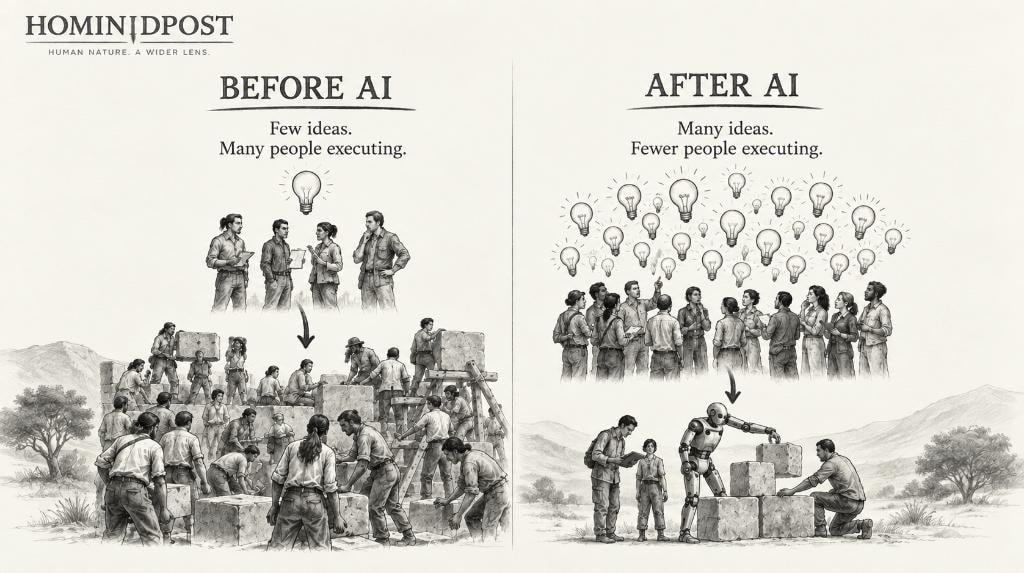
Speculation. Artificial intelligence may accelerate this shift. As specialized capabilities get cheaper to produce, advantage may move toward companies that can assemble, govern and continuously improve networks of those capabilities. The scarce resource may become coordination of intelligence rather than access to it. That proposition has not been tested and should be treated accordingly.
Do not start by building an ecosystem
This sounds contradictory, but companies should resist announcing an ecosystem strategy before they understand the economic problem. Start with the customer or economic outcome and work backward.
What does the customer need? Which capabilities produce that outcome? Where does information break? Where do incentives conflict? Which participant benefits while another absorbs the cost? Where is the same work being repeated? Which decisions require information that is trapped somewhere else? Which components need integration, and which should remain independent?
Architecture follows those answers, not the other way around. A workable operating sequence is: outcome, capabilities, dependencies, incentives, interfaces, data, feedback, governance. Technology comes last. Reverse the order and the organization builds a more sophisticated patch.
What would change my mind?
- Evidence that highly fragmented organizations consistently outperform coordinated architectures when customer journeys contain substantial cross-functional dependencies.
- Evidence that the coordination costs of ecosystems systematically exceed the value created by shared information and complementary capabilities.
- Evidence that modular architectures cannot meaningfully reduce lock-in and concentration risk.
- Evidence that downstream customer and economic outcomes provide little usable information for improving upstream decisions.
Key takeaways
- Fragmented fixes can be individually rational while producing poor system-level outcomes.
- Ecosystems earn their cost when economic problems are strongly interdependent, and not before.
- Vertical integration is the wrong target. Strong ecosystems preserve specialization while adding common interfaces, incentives and feedback loops.
- Customer outcomes, not departmental metrics, should be the unit of optimization.
- Information flowing backward through the system is what allows an ecosystem to improve with use.
- As artificial intelligence makes individual tools easier to acquire, the architecture connecting people, technology, data and partners becomes the more defensible asset.
- Ecosystems create new dependencies and concentrations of power, so governance, portability, competition and consumer protection belong in the design from the start.
Value has always come from relationships
Modern business language makes ecosystems sound new. They are not. Human economic life has always run on networks of specialization, reciprocity, reputation and exchange. What changed is the scale and speed at which those relationships can be coordinated.
A hunter transferring meat, a merchant extending credit, a manufacturer coordinating suppliers and a digital platform connecting thousands of producers operate in radically different economies with one shared constraint: value rarely exists in isolation. Businesses that take this seriously can stop treating every problem as another hole to patch, identify the recurring relationships underneath the problems, and design an architecture where information, incentives and capabilities reinforce one another. That will not eliminate problems. It will produce a system that learns from them, which is a different and more durable capability than getting faster at fixing the same problem twice.
References & Further Reading
- Foley, R. (1996). The adaptive legacy of human evolution: A search for the environment of evolutionary adaptedness. Evolutionary Anthropology, 4(6), 194–203.
- Ivanov, D., & Dolgui, A. (2022). Stress testing supply chains and creating viable ecosystems. Operations Management Research, 15, 475–486.
- Jacobides, M. G. (2022). How to compete when industries digitize and collide: An ecosystem development framework. California Management Review, 64(3), 99–123.
- Jacobides, M. G., Cennamo, C., & Gawer, A. (2018). Towards a theory of ecosystems. Strategic Management Journal, 39(8), 2255–2276.
- Jacobides, M. G., Cennamo, C., & Gawer, A. (2024). Externalities and complementarities in platforms and ecosystems: From structural solutions to endogenous failures. Research Policy, 53(1), 104906.
- Nowak, M. A., Tarnita, C. E., & Wilson, E. O. (2010). The evolution of eusociality. Nature, 466, 1057–1062.
- Patton, J. Q. (2005). Meat sharing for coalitional support. Evolution and Human Behavior, 26(2), 137–157.
Editorial note: This article interprets business strategy research and evolutionary anthropology. Evidence, interpretation and speculation are labeled separately. It reflects the author's analysis and should not be taken as specific business or legal advice.
Written by Farzin Espahani
Editor in Chief, The Hominid Post
Farzin Espahani writes about human behavioral ecology, evolutionary anthropology, cooperation and the institutions humans build around biological and social risk.