The History of Life Insurance and Its Evolutionary Benefit
From religious mutual aid and nineteenth-century reform to modern actuarial risk pools, life insurance formalized a responsibility humans had carried for thousands of years: protecting dependents when a provider dies.
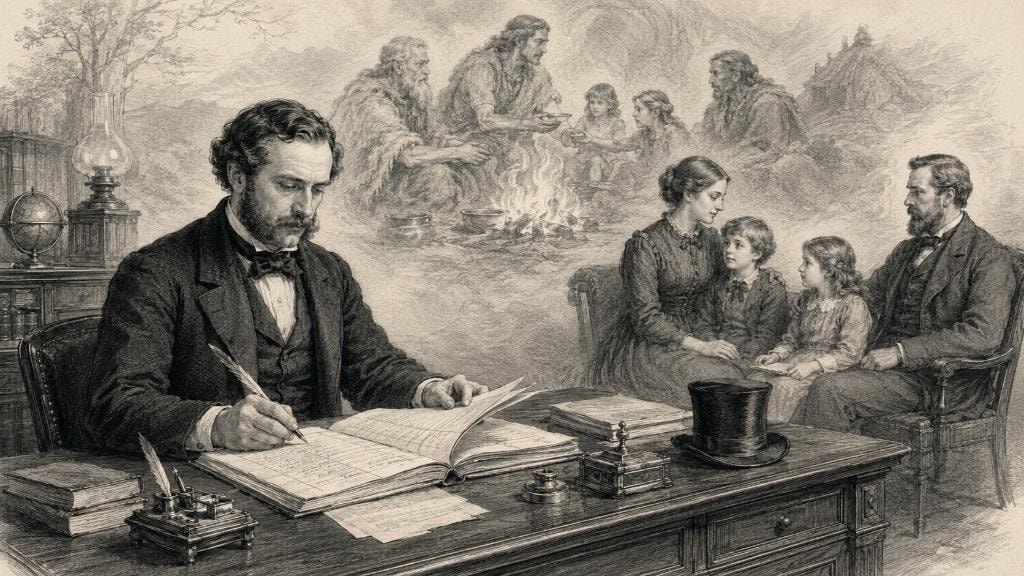
A Presbyterian minister dies in colonial America. His household loses more than a husband or father. It may lose its income, housing, social position, and ability to care for children who remain dependent for years.
Before commercial insurance, families managed such losses through relatives, congregations, guilds, neighbors, and reciprocal obligations. These arrangements could be generous, but they were rarely predictable. Support depended on who was available, what resources they controlled, and whether they felt obligated to help.
Life insurance changed that arrangement. It converted an uncertain social expectation into a funded contract.
The policyholder pays while alive. Someone else receives the benefit after the policyholder dies. Viewed narrowly, the exchange seems strange: the purchaser will never personally spend the principal benefit. Viewed through human behavioral ecology, it makes considerable sense. Humans invest heavily in children, partners, kin, households, and reputations that continue beyond their own lives.
Life insurance belongs to financial history. It also belongs to the much older history of human cooperation.
Direct answer: Why does life insurance have an evolutionary benefit?
Life insurance can provide an evolutionary benefit by protecting dependent family members from the financial consequences of a provider's death. It extends parental and kin investment beyond death, reduces the risk that one mortality event will destroy a household's accumulated resources, and spreads unpredictable losses across a larger group.
Humans did not evolve with insurance companies or actuarial tables. They did evolve in social environments where survival often depended on food sharing, reciprocal assistance, parental investment, kin support, and collective responses to illness, injury, and death.
Modern life insurance formalizes parts of those older risk-sharing arrangements through contracts, premiums, underwriting, reserves, regulation, and enforceable claims.
Before insurance, death was a household economic emergency
Human children develop slowly. They require food, protection, teaching, and material support for much longer than the offspring of most other mammals. That long developmental period creates an unusual economic problem: children may remain dependent long after one parent has died.
Life history theory examines how organisms allocate limited time and energy across growth, maintenance, reproduction, and caregiving. In humans, raising a competent adult involves years of investment in physical development, knowledge, skills, and social learning.
John Bock and Sara Johnson describe these investments through the concept of embodied capital: the physical and learned capacities accumulated during development. These include growth, strength, health, coordination, knowledge, memory, and specialized skills. Parents can support that development through direct care, access to resources, and financial provisioning.
A parent's death can interrupt that process. The immediate effects may include lost income, poorer nutrition, reduced schooling, forced relocation, debt, or pressure on surviving relatives. The consequences depend heavily on ecology, wealth, household structure, public support, and the availability of dependable kin.
This does not mean every ancestral child who lost a parent died, or that modern insurance directly increases biological fitness in every case. Humans have always used several overlapping systems of support. The evolutionary point is narrower: mechanisms that protect dependents and preserve accumulated family resources can reduce the severity of catastrophic loss.
Life insurance is one such mechanism.
The first American life insurer grew from a religious community
The early history of American life insurance shows how formal coverage emerged from recognizable communities of obligation.
In 1759, a life insurance organization was established in Philadelphia for the benefit of Presbyterian ministers and their families. Its full name was the Corporation for Relief of Poor and Distressed Presbyterian Ministers and of the Poor and Distressed Widows and Children of Presbyterian Ministers.
The name would challenge a modern marketing department, but its purpose was clear.
The organization was created around a defined social problem. Ministers could die before their families had accumulated enough resources to support themselves. Members belonged to a shared religious and professional community. The beneficiaries—widows and children—were easily understood as legitimate recipients of collective assistance.
This was more than charity. It represented a step toward organized, pre-funded protection. Rather than waiting for a death and then asking the community to respond, participants contributed to an institution designed in advance to manage the loss.
Early insurance therefore sat between two systems:
- informal mutual aid based on relationships and shared identity;
- formal risk pooling based on contributions, rules, and institutional continuity.
As markets and cities expanded, the second system became increasingly important.
Why expanding economies increased the need for life insurance
In a subsistence economy, households may obtain some necessities through land, family labor, hunting, farming, herding, or direct exchange. In a wage-based economy, survival depends more heavily on continued cash income.
Industrialization increased specialization. More households relied on one or more wage earners whose death could remove a large share of the family's purchasing power. Urbanization also separated many people from extended kin networks that had traditionally helped absorb losses.
The economic value of a provider became easier to see, even if it remained difficult to calculate.
A worker might generate income for another twenty or thirty years. That income could support rent or mortgage payments, food, education, business obligations, and dependent care. Premature death created a financial gap between what the household had expected to receive and what it could now produce.
Life insurance offered a way to transfer part of that risk.
Instead of each household saving enough to cover the worst possible outcome immediately, many households paid smaller premiums into a shared pool. Most insured people would not die during any given year. The premiums collected from the larger group could fund claims for the smaller group that did.
This is the foundation of insurance: uncertain individual losses become more predictable when aggregated across a sufficiently large population.
From human sharing to actuarial risk pooling
The comparison between ancestral sharing and commercial insurance should be made carefully. Giving food to a relative is different from paying a premium to a regulated insurer. The institutions, motivations, and enforcement mechanisms are far apart.
The underlying problem, however, is related: resources arrive unevenly, while losses can be sudden and severe.
Anthropologists have documented several reasons humans share valuable resources. John Q. Patton's research on meat transfers in Conambo, an Indigenous Amazonian community, examined kinship, reciprocity, status, tolerated demands, signaling, and coalitional support. His findings suggest that sharing commonly serves several purposes at once rather than following one universal rule (Patton, 2005).
A hunter might share with relatives, repay an earlier transfer, maintain an alliance, avoid appearing selfish, and strengthen future support through the same act.
Life insurance also sits at the intersection of several motives. People may buy coverage because they love their families, fear leaving debt, want to protect a business, feel a parental duty, wish to preserve an inheritance, or respond to social expectations about responsible adulthood.
The institutional structure adds something informal sharing cannot always provide: a specified benefit payable under specified conditions.
A promise from relatives may be sincere but uncertain. A properly funded insurance contract creates a legal obligation.
Competing hypotheses: Why do humans buy life insurance?
Kin-investment hypothesis: People buy coverage to continue supporting children, partners, and close relatives after death.
Risk-pooling hypothesis: Households use insurance because a large group can absorb unpredictable mortality losses more efficiently than a single family.
Cultural-responsibility hypothesis: Institutions and social norms teach people that responsible providers should protect dependents against premature death.
Status and legacy hypothesis: Some policies help preserve businesses, estates, charitable commitments, or family standing across generations.
These explanations can operate together. Their strength will vary by age, wealth, family structure, culture, employment, and available public support.
Elizur Wright and the problem of promises that last for decades
Selling life insurance is easier than guaranteeing that the promise will remain good thirty years later.
During the nineteenth century, the American insurance market grew faster than many of the rules governing it. Companies made commitments extending far into the future, but consistent standards for reserves, surrender values, solvency, and consumer treatment were still developing.
Elizur Wright became one of the central reformers of this period.
Wright was a mathematician, abolitionist, inventor, and insurance regulator. His work helped establish more reliable methods for determining whether insurers held sufficient reserves to meet future obligations. He also advocated for nonforfeiture protections, which allowed qualifying policyholders who stopped paying premiums to retain some accumulated policy value rather than lose everything they had contributed.
These reforms addressed a central trust problem.
A life insurance policy may remain in force for decades. The customer cannot personally inspect the company's full financial condition. The beneficiary may not file a claim until long after the original sale. Without reserve standards and credible supervision, the contract could become little more than a long-dated promise backed by optimism.
Wright's net valuation tables helped regulators assess whether companies were financially capable of meeting their commitments. His work contributed to the emergence of life insurance as a more disciplined financial institution rather than an arrangement dependent primarily on company reputation.
From an evolutionary perspective, this is an example of cultural institutions solving a scale problem.
Small communities can enforce cooperation through familiarity, reputation, gossip, reciprocal obligations, and direct sanctions. Those mechanisms weaken when millions of strangers participate in the same financial system. Regulation, accounting standards, reserve requirements, contracts, and courts become substitutes for personal knowledge.
Trust no longer rests on knowing the other party. It rests on knowing the rules.
Rebating, sales incentives, and unequal treatment
Premium rebating was once widespread in American life insurance. An agent might return part of a commission, provide a private inducement, or offer something of value to persuade a buyer to purchase a policy.
To the customer, a rebate could look like a harmless discount. At the system level, it created more difficult questions.
Were similarly situated policyholders being treated consistently? Was the agent recommending the most suitable policy or the one that supported the most attractive inducement? Could aggressive rebating weaken pricing discipline? Were policy terms and costs becoming secondary to the immediate sales offer?
Insurance is especially sensitive to incentive problems because the product is complex, the benefit may be delayed for decades, and the customer often depends on the agent to explain what is being purchased.
The same characteristics that make advice valuable also make conflicted advice dangerous.
This tension has remained part of insurance distribution ever since. Compensation can support education, service, underwriting assistance, and ongoing policy management. It can also reward volume without adequately accounting for suitability, persistence, consumer understanding, or long-term value.
The historical problem was never simply that agents were paid. The problem was whether sales incentives aligned with the durable interests of policyholders and beneficiaries.
The Armstrong investigation and the birth of stronger oversight
By the beginning of the twentieth century, American life insurers had become large financial institutions. They controlled substantial pools of policyholder money and had influence extending into investments, corporate governance, and politics.
Public concern grew over executive conduct, political contributions, investment practices, sales methods, expenses, and the use of policyholder funds.
In 1905, the New York Legislature created what became known as the Armstrong Committee, chaired by State Senator William W. Armstrong. Charles Evans Hughes served as counsel to the investigation and later became governor of New York, U.S. secretary of state, and chief justice of the United States. The committee conducted a prominent investigation into life insurance company practices during 1905 and 1906.
The hearings exposed governance and market-conduct problems within major insurers. The resulting reforms placed restrictions on certain practices, strengthened reporting and oversight, and reshaped the relationship among insurers, agents, regulators, and policyholders.
The Armstrong investigation marked a shift in how life insurance was understood.
A life insurer was no longer merely a private company selling a private contract. It was also a steward of long-term household security and large pools of money contributed by the public.
That stewardship role justified stronger supervision.
The evolutionary benefit: reducing catastrophic variance
The strongest evolutionary explanation for insurance is risk reduction.
Natural selection does not always favor the strategy with the highest possible payoff. Under uncertain conditions, a strategy that lowers the probability of catastrophic failure may be more durable than one offering a higher average return with a greater chance of ruin.
Consider two households with similar incomes.
One household keeps every available dollar but carries no life insurance. Its financial position may look stronger while the provider remains alive. If that person dies early, however, the household may lose decades of expected income.
The second household pays a manageable premium. Its disposable income is slightly lower each month, but the provider's death triggers a benefit capable of replacing some income, paying obligations, or creating time for the survivors to reorganize.
Insurance does not prevent death. It reduces the financial variance surrounding death.
This resembles risk pooling in other human settings. Households share food after a failed hunt, contribute to funeral funds, support injured relatives, rotate credit, remit income to family members, or maintain common emergency resources.
Commercial insurance broadens the pool beyond relatives and neighbors. People who will never meet one another share mortality risk through a financial institution.
Life insurance as extended parental investment
Parental investment does not end with conception or birth. Human offspring require prolonged support, and parents frequently make decisions whose benefits will appear years later.
They save for education. They purchase housing in safer areas. They build businesses intended to support the next generation. They transfer skills, property, social relationships, and cultural knowledge.
Life insurance can be understood as a contingent form of parental investment. The benefit becomes available only if a specified loss occurs, but its intended purpose is often to preserve investments already underway.
A death benefit may allow children to remain in school, retain stable housing, receive healthcare, or avoid entering full-time work prematurely. It may enable a surviving caregiver to spend more time caring for children rather than immediately replacing the deceased person's full income.
This argument must remain conditional.
Money cannot replace emotional attachment, caregiving, protection, teaching, or social connection. The effects of parental loss vary substantially across households and cultures. Insurance addresses one part of the loss: the financial disruption.
Still, that financial component can shape many other outcomes.
Proximate motives and evolutionary consequences are different
Evolutionary explanations often become misleading when they assume people consciously pursue biological fitness.
A parent purchasing life insurance is unlikely to think about inclusive fitness, reproductive success, or life history theory. The immediate motivations are usually more familiar:
- “I do not want my family to lose the house.”
- “I want my children to finish school.”
- “I do not want my spouse to inherit my debts.”
- “My business should survive without me.”
- “I want my funeral and final expenses covered.”
These are proximate explanations: the emotions, beliefs, calculations, and social norms producing the behavior.
The ultimate explanation asks why humans are capable of such strong concern for dependents, long-term household continuity, and resource transfers that may occur after death.
Attachment, parental care, kinship, reciprocal obligation, cultural learning, and concern for legacy can all contribute. No single evolutionary mechanism explains every policy purchase.
Culture made the risk pool much larger
Human cooperation is biological and cultural.
Our species inherited capacities for attachment, social learning, reciprocal exchange, reputation management, and group coordination. Cultural evolution then produced institutions that organize those capacities in forms no ancestral population possessed.
Life insurance is one of those institutions.
It depends on writing, mathematics, mortality records, contract law, accounting, investment markets, medical evaluation, regulatory agencies, administrative systems, and claims operations. None of these components emerged as a direct biological adaptation for insurance.
They were assembled culturally.
This distinction prevents a common error. Life insurance itself is not an evolved psychological module. It is a culturally constructed response that uses older human dispositions and solves an enduring problem under modern economic conditions.
Humans built a new tool around an old vulnerability.
Life insurance can fail when incentives lose alignment
An evolutionary explanation does not establish that every insurance product is useful or that every sale improves household welfare.
Institutions can be adaptive under one set of conditions and costly under another.
A policy may be unsuitable, unaffordable, poorly explained, or structured around assumptions the customer does not understand. A household may buy too much coverage, too little coverage, or the wrong type of coverage. High costs or early surrender may substantially reduce value. Some consumers may be encouraged to replace existing coverage without a sufficient benefit.
Insurance markets also contain predictable information asymmetries.
The carrier understands pricing and reserves better than the customer. The agent often understands product design better than the applicant. The policyholder may not understand exclusions, guarantees, nonguaranteed illustrations, surrender periods, tax treatment, or the consequences of missed premiums.
That imbalance makes consumer protection part of the product's functionality.
A risk-pooling system cannot operate well for long if customers believe claims will not be paid, policies are incomprehensible, or recommendations are driven primarily by compensation. Trust is an economic asset. Once depleted, it is expensive to rebuild.
Evidence, interpretation, and speculation
Evidence
Humans make prolonged investments in dependent children. Anthropological research documents extensive food sharing, kin support, reciprocal exchange, paternal provisioning, and other forms of resource transfer. Historical records show that American life insurance developed from mutual-aid institutions and later required stronger actuarial and regulatory structures as the market expanded.
Interpretation
Life insurance can be understood as a culturally organized extension of household protection. It pools mortality risk across strangers and helps preserve investment in dependents when a provider dies.
Speculation
Some of the psychological appeal of life insurance may draw on older human concerns about family continuity, reputation, duty, and the treatment of dependents after death. These motives are plausible, but separating their relative influence would require careful behavioral and cross-cultural research.
What would change my mind?
- Strong evidence that life insurance ownership is unrelated to the presence of dependents, income-replacement needs, debts, or intergenerational transfers.
- Cross-cultural findings showing that formal life insurance consistently weakens household resilience by displacing more effective mutual-aid systems.
- Evidence that death benefits rarely reduce financial disruption following the premature death of a household provider.
- Research showing that most policy purchases are explained by sales pressure or status display, with little connection to risk management.
- Evidence that comparable household protection can generally be achieved at lower cost through more reliable alternatives.
Key takeaways
- Life insurance formalized an older human practice: pooling resources to protect families from unpredictable loss.
- Its main evolutionary value is risk reduction, especially when a provider's death threatens dependent children and accumulated household resources.
- Early American life insurance emerged from religious mutual aid for ministers' widows and children.
- Elizur Wright's reserve and nonforfeiture reforms helped convert long-term insurance promises into more credible financial obligations.
- The Armstrong investigation showed that large risk pools require governance, transparency, and enforceable consumer protections.
- Life insurance works best when product design, compensation, regulation, and consumer needs remain aligned.
- Evolutionary reasoning can explain why household protection appeals to humans. It does not prove that every policy or sales recommendation is beneficial.
References and further reading
Bock, J., & Johnson, S. E. (2004). Male migration, remittances, and child outcome among the Okavango Delta Peoples of Botswana. In M. E. Lamb (Ed.), The role of the father in child development. Wiley.
Cronk, L., Berbesque, C., Conte, T., Gervais, M., Iyer, P., McCarthy, B., Sonkoi, D., Townsend, C., & Aktipis, A. (2021). Design principles for risk-pooling systems. Nature Human Behaviour, 5, 825–833.
Hamilton, W. D. (1964). The genetical evolution of social behaviour: I and II. Journal of Theoretical Biology, 7, 1–52.
Kaplan, H., Hill, K., Lancaster, J., & Hurtado, A. M. (2000). A theory of human life history evolution: Diet, intelligence, and longevity. Evolutionary Anthropology, 9(4), 156–185.
Patton, J. Q. (2005). Meat sharing for coalitional support. Evolution and Human Behavior, 26(2), 137–157.
Stalson, J. O. (1942). Marketing life insurance: Its history in America. Harvard University Press.
Trivers, R. L. (1971). The evolution of reciprocal altruism. The Quarterly Review of Biology, 46(1), 35–57.
Wright, E. (1873). The politics and mysteries of life insurance. Lee and Shepard.