Did Humans Once Sleep in Two Shifts?
The history, biology, and exaggeration behind the "first sleep" and "second sleep" story
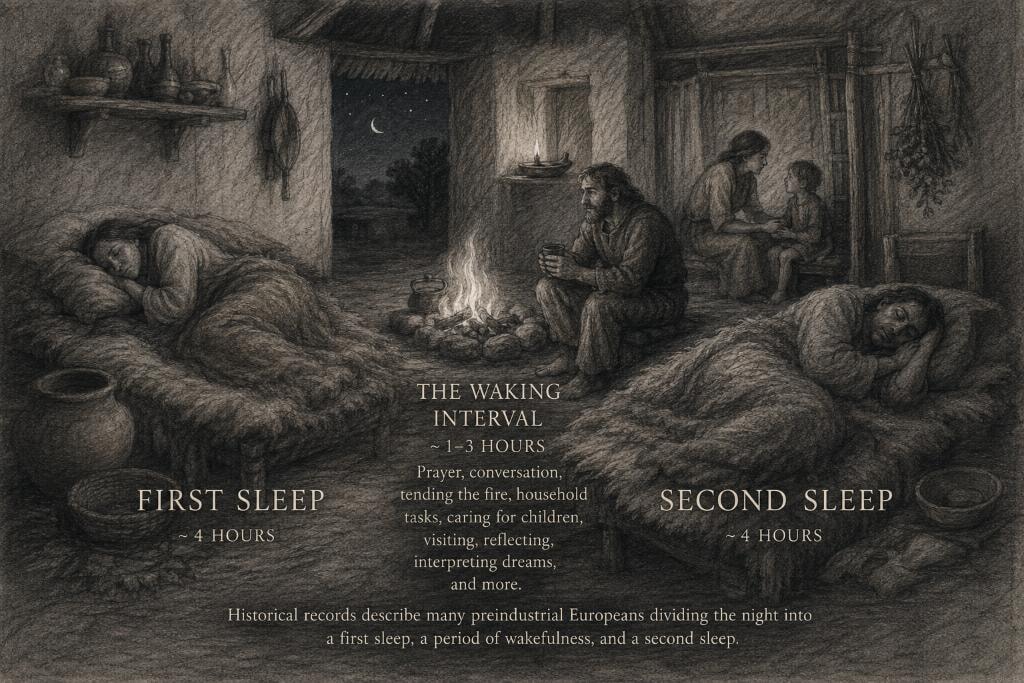
First sleep, the waking interval, and second sleep in a preindustrial household
The evidence in brief: Many preindustrial Europeans described a “first sleep” and “second sleep,” separated by a period of quiet wakefulness. Laboratory research shows that human sleep can divide into two episodes under long periods of darkness. However, studies of contemporary small-scale societies do not reveal one universal ancestral sleep schedule. The claim that Simmons Beautyrest invented eight-hour sleep in 1938 is unsupported.
Imagine waking at one in the morning.
You feel calm rather than alarmed. The house is quiet. You speak with your spouse, check the fire, pray, think about a dream, perhaps visit a neighbor. An hour later, you return to bed and sleep until dawn.
According to a widely shared social-media post, this was once the normal human night. People supposedly slept for four hours, remained awake for two, then slept for another four. The post adds a sharper accusation: the modern eight-hour night was invented in 1938 by the mattress company Simmons Beautyrest.
The story contains a genuine historical discovery wrapped in several layers of internet folklore.
Many preindustrial Europeans did refer to a “first sleep” and a “second sleep.” Laboratory experiments also show that human sleep can divide into two bouts under long periods of darkness. Yet evidence from living small-scale societies reveals substantial variation, including nights that resemble the consolidated sleep familiar today.
Human sleep has never followed one timeless schedule. It changes with light, temperature, age, work, danger, social life, and the expectations people carry into bed.
Why Would Humans Wake in the Middle of the Night?
Sleep creates an evolutionary problem.
An unconscious animal cannot forage, watch for predators, defend children, maintain a fire, or monitor rivals. Sleep must therefore provide benefits substantial enough to offset several hours of vulnerability.
Humans complicate the problem further. Compared with many other primates, our species sleeps for a relatively short period, with a high proportion of rapid eye movement (REM) sleep — the stage strongly associated with vivid dreaming. Humans also began sleeping on or near the ground, often in socially coordinated camps, rather than alone in elevated tree nests.
A continuous night of sleep could protect valuable physiological processes from interruption. A divided night could provide opportunities for vigilance, childcare, fire maintenance, social interaction, or adjustment to long winter darkness.
Both patterns are biologically possible. The ecological question concerns when each pattern becomes useful.
Two Competing Explanations for Segmented Sleep
Hypothesis 1: Segmented sleep reflects an ancestral human tendency. Under long natural nights, human sleep may spontaneously divide into two episodes. Artificial lighting, clock time, and industrial work schedules may suppress this older pattern. If this hypothesis is correct, people exposed to long periods of darkness should begin waking calmly between two sleep bouts, historical societies without strong artificial lighting should frequently describe first and second sleep, and middle-of-the-night wakefulness should sometimes occur without insomnia or distress.
Hypothesis 2: Segmented sleep was a cultural response to particular environments. First and second sleep may have been common in some societies because of long winter nights, household routines, poor heating, shared beds, religious practices, labor schedules, or expectations about normal sleep. If this hypothesis is correct, sleep patterns should vary across climates, seasons, economic systems, and cultures; some nonindustrial populations should sleep in one main nighttime interval; and historical references should cluster in certain regions and periods rather than appearing universally.
These hypotheses can overlap. Human physiology may permit segmented sleep while culture and ecology determine whether people adopt it.
The Historical Evidence for First and Second Sleep
Biphasic sleep is a pattern in which a person’s daily sleep occurs in two main episodes rather than one continuous period. Segmented nighttime sleep is one form of biphasic sleep: a first sleep is followed by a period of wakefulness and then a second sleep.
First sleep and second sleep were historical terms for two nighttime sleep periods separated by an interval of wakefulness. Records from preindustrial Europe describe people using the waking interval to pray, talk, tend fires, perform household tasks, have sex, or reflect on dreams.
Historian A. Roger Ekirch brought segmented sleep into public discussion after finding references to “first sleep” and “second sleep” in early modern European records. His research eventually identified references in court documents, diaries, medical texts, literature, prayer manuals, and household accounts. Similar expressions appeared in several languages, including premier sommeil in French and primo sonno in Italian. Ekirch reports finding more than two thousand references to divided nighttime sleep across historical sources.
The descriptions often treated the waking interval as ordinary. People prayed, interpreted dreams, tended animals, completed household work, conversed, had sex, checked fires, or simply remained quietly awake. The phrases “first sleep” and “second sleep” sometimes appeared without explanation, suggesting that contemporary readers understood them.
Evidence: Segmented sleep clearly existed as a recognizable practice in parts of preindustrial Europe.
Interpretation: The casual language surrounding it suggests that waking between sleep periods did not automatically signify illness or insomnia.
Uncertainty: Written records tell us how people described sleep more easily than how frequently every individual followed the pattern. Most surviving documents also represent particular literate populations, regions, and historical periods.
That distinction has become the center of a scholarly debate. Historian Niall Boyce reexamined Ekirch’s evidence and argued that the historical record may support more variation than the popular version of the story allows. References to first sleep and second sleep establish that segmented sleep occurred, Boyce argued, while leaving its prevalence and regularity less certain.
Ekirch responded that Boyce relied too narrowly on his earliest publication and overlooked the much larger body of evidence gathered later. He continues to defend segmented sleep as the predominant pattern in premodern Western Europe.
The disagreement concerns scale rather than existence. Few serious participants deny that segmented sleep occurred. The unresolved question asks how widespread, consistent, and geographically universal it was.
What Happens When Modern People Experience Long Nights?
In the early 1990s, psychiatrist Thomas A. Wehr conducted an experiment that remains central to the discussion. In Wehr’s 1992 extended-darkness experiment, participants accustomed to approximately sixteen hours of light and eight hours of darkness were shifted to a schedule with only ten hours of light and fourteen hours of darkness. After several weeks, their sleep expanded and commonly divided into two roughly symmetrical episodes separated by one to three hours of quiet wakefulness.
This experiment is often presented as proof that humans naturally sleep four hours, wake for two, and sleep for four more.
The actual finding requires more care.
The participants spent fourteen hours each day in darkness, far longer than most people in electrically illuminated environments. The study demonstrated that segmented sleep can emerge under extended darkness. It did not establish that every human body demands this schedule under ordinary conditions.
The waking interval also appeared physiologically different from anxious insomnia. Participants often experienced a quiet and contemplative state accompanied by hormonal changes associated with darkness and circadian regulation. A circadian rhythm is the roughly 24-hour internal clock that regulates sleep, wakefulness, and many other biological processes in response to light and darkness.
Evidence: Human sleep can become biphasic when nights are substantially lengthened.
Interpretation: Consolidated sleep represents one expression of a flexible sleep system rather than the only biologically possible arrangement.
Speculation: Preindustrial people living through long, dim evenings may have experienced similar periods of calm midnight wakefulness.
Wehr’s laboratory result supports Ekirch’s history. It does not prove that one sleep schedule governed the entire human past.
How Do Hunter-Gatherers and Small-Scale Societies Sleep?
Researchers have also measured sleep among populations living with limited electricity and relatively direct exposure to natural light and temperature.
The 2015 Current Biology study of three preindustrial societies, led by Gandhi Yetish and colleagues, examined the Hadza of Tanzania, the San communities of Namibia, and the Tsimane of Bolivia. These populations differed in ecology and subsistence, yet their average sleep durations fell around 5.7 to 7.1 hours per night. They generally fell asleep several hours after sunset and often woke before sunrise. Regular extended periods of midnight wakefulness were not the dominant pattern.
This finding creates an important problem for any universal story.
These communities live without many features blamed for modern sleep disruption, yet they do not consistently reproduce the classic European first-sleep, second-sleep pattern.
Their sleep does remain responsive to ecology. Duration changes seasonally. Temperature appears to influence sleep timing. Social activity continues after sunset. Nighttime awakenings occur, although they do not always divide the night into two formal halves.
Research among the Hadza, conducted by evolutionary anthropologist David R. Samson and colleagues, has also found that different chronotypes — the tendency to sleep earlier or later — produce overlapping periods of wakefulness across the night. In the Hadza sentinel hypothesis study, across sampled nights, someone in the group was usually awake. This pattern is consistent with the sentinel hypothesis, in which variation among sleepers reduces the amount of time an entire group remains simultaneously unconscious.
No individual needs to volunteer for guard duty. Differences in age, sleep timing, infant care, health, and circadian preference can create collective vigilance as an accidental property of group life.
This is a useful lesson from human behavioral ecology. Natural selection does not always need to produce a rigid behavior shared by everyone. It can favor a flexible system whose group-level consequences emerge from individual variation.
Human Sleep Follows Ecology, Not One Ancestral Script
The phrase “natural human sleep” sounds scientific, but it often conceals several different questions.
Natural under which temperature? At what latitude? During which season? In a camp with twenty people or an apartment occupied by one? With infants, predators, livestock, enemies, artificial light, shift work, religious obligations, or an alarm clock?
Human behavioral ecology examines behavior as a response to local costs and opportunities. From this perspective, sleep architecture should vary when the surrounding tradeoffs vary.
A pastoral household may wake to monitor animals. A farming family may organize rest around seasonal labor. Parents of young children experience fragmented sleep because dependent offspring require care. Older adults may fall asleep earlier and wake earlier. A socially active urban population may extend wakefulness deep into the night. Communities near the equator experience different seasonal light cycles from populations in northern Europe.
Culture further changes the calculation. Bells, prayer times, factory shifts, school schedules, street lighting, television, smartphones, climate control, and ideas about productivity all reshape when people consider sleep appropriate. The role of artificial light in changing human life is one of the most consequential technological transitions in the history of sleep.
Our circadian system provides constraints. Culture supplies timetables.
Did a Mattress Company Invent the Eight-Hour Rule?
No reliable evidence shows that Simmons Beautyrest invented the eight-hour sleep rule in 1938. The viral claim names Simmons Beautyrest and the year 1938, but no credible historical documentation currently supports it.
Simmons certainly helped commercialize sleep. The company introduced Beautyrest in 1925 and funded early sleep research through the Mellon Institute during the 1920s and early 1930s. Its advertising connected mattresses, health, achievement, and modern scientific expertise.
That commercial history makes the viral story sound plausible. Plausibility is weaker than documentation.
The association between eight hours and daily rest predates Beautyrest by more than a century. In 1817, Welsh social reformer Robert Owen promoted the slogan “eight hours labour, eight hours recreation, eight hours rest” as part of the movement to shorten punishing industrial workdays.
Owen’s “rest” did not necessarily mean eight hours of uninterrupted sleep. It referred to a protected portion of the day outside wage labor. Still, the slogan demonstrates that the number eight was culturally prominent long before the alleged 1938 advertising invention.
Industrialization probably helped consolidate nighttime sleep through several interacting changes: factory and school schedules rewarded predictable waking times; artificial light allowed people to remain active after sunset; urban lighting expanded evening social life; clock time replaced seasonal light as the organizer of daily activity; employers increasingly expected labor to occur in standardized blocks; and medical and commercial institutions promoted measurable sleep norms.
Mattress advertising participated in this transformation. It did not create it from nothing.
The viral post turns a long social transition into a story with one corporation, one date, and one deception. Social media tends to reward villains with good branding.
Do Adults Actually Need Eight Hours of Sleep?
Modern sleep medicine rarely treats eight hours as an exact biological commandment. The adult sleep-duration consensus guidance from a panel convened by the American Academy of Sleep Medicine and the Sleep Research Society concluded that adults should regularly obtain at least seven hours of sleep per night to support health. The amount required can vary among individuals, and some adults may benefit from longer sleep.
The relevant variables include age, health, pregnancy, physical activity, sleep quality, prior sleep deprivation, genetics, and individual physiology.
Seven to nine hours is therefore better understood as a population-level range than a stopwatch rule. A person who functions well with seven hours has not failed an eight-hour mandate. A person who spends eight hours in bed while repeatedly waking from sleep apnea has not necessarily obtained adequate rest.
Duration also tells only part of the story. Sleep regularity, circadian timing, continuity, breathing, environmental conditions, and daytime functioning all matter.
A divided schedule can provide sufficient sleep when the total duration and timing fit the individual. A fragmented schedule caused by pain, anxiety, caregiving, apnea, noise, or shift work may produce very different outcomes.
The shape of sleep carries less meaning without its cause.
Is Waking in the Middle of the Night Normal?
Brief awakenings are common. People often move through them without forming a lasting memory.
A longer waking period also does not automatically indicate pathology. The historical and laboratory evidence shows that humans can wake between sleep episodes without suffering a biological malfunction.
The useful question concerns consequences.
Someone who wakes calmly, feels sleepy again later, obtains enough total rest, and functions well during the day may be experiencing a benign variation.
Someone who remains awake in distress, loses substantial sleep, snores or gasps, experiences restless legs, or develops persistent daytime impairment may have a condition that deserves evaluation.
Historical awareness can reduce one harmful feedback loop. A person wakes at two in the morning, decides that normal humans must remain unconscious for eight uninterrupted hours, begins calculating the damage, and becomes too physiologically aroused to return to sleep.
Knowing that human sleep is flexible may lower the panic. It does not turn every sleep disorder into a forgotten medieval habit.
What Evidence Could Settle the Debate?
Several kinds of evidence could clarify how deeply segmented sleep belongs to the human past.
- Broader historical sampling: Records from Africa, Asia, the Americas, and Oceania could show whether first and second sleep terminology reflected a widespread human pattern or a set of regional traditions.
- Seasonal field studies: Repeated measurements within the same communities could reveal whether sleep divides during long nights and consolidates during shorter ones.
- Natural-light experiments: Larger studies could test how different photoperiods — the length of daily light exposure — affect sleep while separating the effects of darkness, temperature, activity, and social expectations.
- Cross-cultural comparisons: Researchers could examine whether people who culturally expect midnight waking experience less anxiety and return to sleep more easily.
- Household-level observation: Studies could test how childcare, age structure, fire maintenance, safety, and sleeping arrangements influence nighttime activity.
The most informative research would connect physiology with ecology. Measuring brain states alone cannot explain why people organize their nights as they do. Historical texts alone cannot show what their nervous systems were doing.
What Would Change My Mind?
- Strong archival evidence showing that references to first and second sleep were rare, metaphorical, or restricted to narrow populations would weaken the case for widespread preindustrial segmentation.
- Repeated field evidence of two formal nighttime sleep bouts across geographically diverse nonindustrial societies would strengthen the claim that segmented sleep reflects a broadly expressed ancestral tendency.
- Large controlled studies showing that extended darkness rarely produces biphasic sleep would reduce the importance of Wehr’s findings.
- Evidence tying the modern eight-hour standard to a documented Simmons campaign would revise the conclusion about the viral claim.
Key Takeaways
- First sleep and second sleep were genuine historical categories in parts of preindustrial Europe.
- Humans can develop biphasic sleep under long periods of darkness.
- Contemporary small-scale societies display varied sleep patterns rather than one universal ancestral schedule.
- The claim that Simmons Beautyrest invented eight-hour sleep in 1938 lacks credible supporting evidence.
- Eight hours functions as a useful approximation for some adults, not an exact requirement for every person.
- Waking during the night can be benign, although persistent distress or daytime impairment deserves attention.
- Human sleep is a flexible behavior shaped by biology, ecology, culture, and individual circumstances.
What We Still Do Not Know
We do not know whether the earliest Homo sapiens regularly slept in one interval, two intervals, several short bouts, or a shifting combination.
Archaeology preserves hearths and sleeping surfaces more readily than dreams and awakenings. Historical documents become abundant only during the latest fraction of human existence. Contemporary small-scale societies offer crucial comparisons, though they cannot serve as untouched replicas of the Paleolithic past.
The strongest conclusion is therefore modest.
Humans possess the capacity for consolidated sleep and segmented sleep. Neither arrangement defines the species by itself. Our nights have always been negotiated among darkness, danger, temperature, children, work, companionship, and the social meaning of being awake.
The modern eight-hour night is neither an ancient biological law nor a corporate fiction invented in a boardroom. It is one culturally prominent arrangement within a much older and more flexible human repertoire.
For a broader look at how ecological conditions shape human behavior, see Human Behavioral Ecology: Why Context Changes Behavior. For the evolutionary logic behind flexible behavioral systems, see Natural Selection Explained and From Sociobiology to Human Behavioral Ecology. For the role of collective vigilance in human cooperation, see The Evolution of Human Cooperation.
Frequently Asked Questions
Did people historically sleep twice each night?
Many historical documents from preindustrial Europe refer to a first sleep and a second sleep separated by a period of wakefulness. The evidence shows that segmented sleep was a recognized pattern, although scholars continue to debate how universal and consistent it was.
What did people do between first sleep and second sleep?
Historical accounts describe people praying, talking, tending fires, completing household tasks, interpreting dreams, caring for children, visiting neighbors, and having sex. The waking interval was often treated as an ordinary part of the night.
Is biphasic sleep the natural human sleep pattern?
Biphasic sleep is one biologically possible human pattern, but the evidence does not support one universal natural schedule. Human sleep changes with environmental light, temperature, season, age, social conditions, work demands, and cultural norms.
Did Simmons Beautyrest invent the eight-hour sleep rule?
There is no reliable evidence that Simmons Beautyrest invented the eight-hour rule in 1938. The company helped market mattresses and scientific ideas about sleep, but eight-hour rest campaigns existed during the nineteenth-century labor movement.
Do all adults need exactly eight hours of sleep?
No. Sleep requirements vary. Public-health guidance commonly recommends that adults obtain at least seven hours regularly, while many adults function best within a broader range of approximately seven to nine hours.
Is waking at 2:00 a.m. evidence of segmented sleep?
Possibly, but a single awakening cannot establish a segmented sleep pattern. Nighttime waking can result from normal sleep transitions, stress, temperature, noise, alcohol, medication, caregiving, pain, sleep apnea, or other factors.
Is biphasic sleep healthier than sleeping once per night?
Current evidence does not show that biphasic sleep is inherently healthier for everyone. Total sleep duration, regularity, circadian timing, sleep quality, health conditions, and daytime functioning are more informative than the number of sleep episodes alone.
References & Further Reading
Boyce, N. (2023). Have we lost sleep? A reconsideration of segmented sleep in early modern England. Medical History, 67(2), 91–108. https://doi.org/10.1017/mdh.2023.15
Ekirch, A. R. (2001). Sleep we have lost: Pre-industrial slumber in the British Isles. The American Historical Review, 106(2), 343–386. https://doi.org/10.2307/2651611
Ekirch, A. R. (2005). At day’s close: Night in times past. W. W. Norton.
Ekirch, A. R. (2016). Segmented sleep in preindustrial societies. Sleep, 39(3), 715–716. https://doi.org/10.5665/sleep.5558
Ekirch, A. R. (2024). Reflections on “Have we lost sleep?” Medical History, 68(1), 78–84.
Nunn, C. L., Samson, D. R., & Krystal, A. D. (2016). Shining evolutionary light on human sleep and sleep disorders. Evolution, Medicine, and Public Health, 2016(1), 227–243. https://doi.org/10.1093/emph/eow018
Samson, D. R., Crittenden, A. N., Mabulla, I. A., Mabulla, A. Z. P., & Nunn, C. L. (2017). Chronotype variation drives night-time sentinel-like behaviour in hunter-gatherers. Proceedings of the Royal Society B: Biological Sciences, 284(1858), 20170967. https://doi.org/10.1098/rspb.2017.0967
Watson, N. F., Badr, M. S., Belenky, G., et al. (2015). Recommended amount of sleep for a healthy adult: A joint consensus recommendation of the American Academy of Sleep Medicine and Sleep Research Society. Journal of Clinical Sleep Medicine, 11(6), 591–592. https://doi.org/10.5664/jcsm.4758
Wehr, T. A. (1992). In short photoperiods, human sleep is biphasic. Journal of Sleep Research, 1(2), 103–107. https://doi.org/10.1111/j.1365-2869.1992.tb00019.x
Yetish, G., Kaplan, H., Gurven, M., et al. (2015). Natural sleep and its seasonal variations in three pre-industrial societies. Current Biology, 25(21), 2862–2868. https://doi.org/10.1016/j.cub.2015.09.046
This article is intended for educational purposes and does not provide medical diagnosis or treatment. Persistent sleep disruption, breathing problems during sleep, severe daytime sleepiness, or other concerning symptoms should be discussed with a qualified healthcare professional.