The Evolution of Human Cooperation
Why humans help, share, punish, and form groups
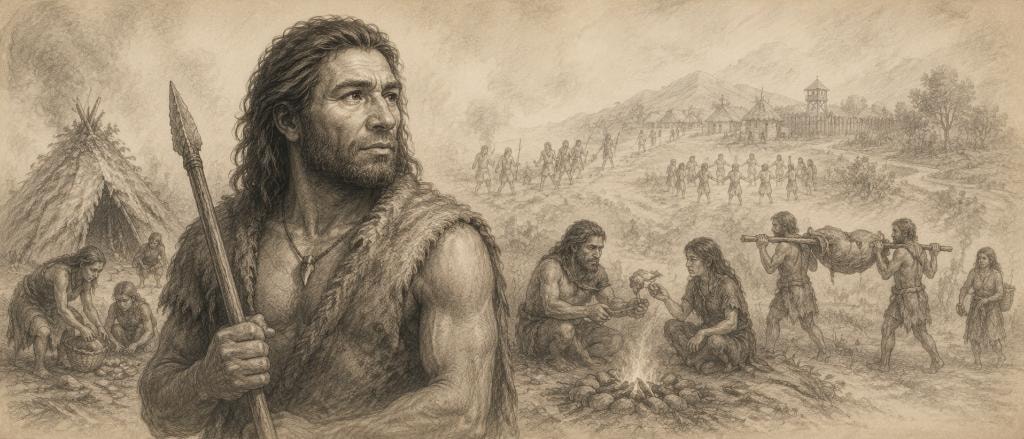
People cooperate constantly. We raise children together, share food, build companies, follow rules, defend friends, join institutions, donate money, and sometimes help strangers we may never see again.
But cooperation is not automatic. It has boundaries.
Humans are deeply social, but we are not equally cooperative with everyone. We cooperate more with family, people we trust, people who may return the favor, people inside our group, and people whose opinion can affect our reputation. Step outside those conditions and behavior can change quickly.
That is the evolutionary puzzle. If helping others can cost time, food, risk, status, or money, why did cooperation become such a central part of human life?
Direct answer: Human cooperation evolved because it helped people survive, raise children, manage risk, build alliances, and coordinate inside groups. But humans do not cooperate equally with everyone. Cooperation is selective. It expands when trust, kinship, reciprocity, reputation, shared stakes, and enforcement are present.
What human cooperation means in evolutionary terms
From an evolutionary perspective, cooperation is behavior that benefits another individual, partner, or group, often at some cost to the person doing it.
The cost does not have to be dramatic. It can be a shared meal, a favor, a risk taken in conflict, a lost opportunity, or the effort required to punish someone who breaks a rule.
The important point is simple: cooperation is not the same thing as kindness.
Kindness describes how a behavior feels. Cooperation describes what the behavior does inside a social system.
A person may cooperate because they love their child. They may cooperate because a neighbor helped them last month. They may cooperate because their reputation is being watched. They may cooperate because refusing would damage their place in the group.
Evolution does not require one motive. Human cooperation is built from several overlapping systems: kinship, reciprocity, reputation, punishment, group identity, shared threat, and culture.
That is why the better question is not whether cooperation is human nature.
The better question is: under what conditions do humans cooperate?
Four scientists who shaped the question
Edward O. Wilson treated social behavior as one of the central problems of evolution. His famous formulation captures the tension well: “Within groups, selfish individuals beat altruistic individuals, but groups of altruists beat groups of selfish individuals” (Wilson, 2012). Wilson’s point was not that humans are naturally saintly. It was that cooperation can be vulnerable inside a group but powerful when groups compete with one another.
Richard Dawkins pushed the gene-centered view into public conversation with a deliberately sharp line from The Selfish Gene: “We are survival machines — robot vehicles blindly programmed to preserve the selfish molecules known as genes” (Dawkins, 1976). That line is often misunderstood. Dawkins was not saying people are morally selfish in every action. He was explaining that natural selection works through inherited information that survives by being copied.
Robert Trivers gave one of the cleanest explanations for cooperation among non-kin. In “The Evolution of Reciprocal Altruism,” he argued that humans possess both altruistic and cheating tendencies, and that the expression of those tendencies depends on context (Trivers, 1971). This helps explain why people often cooperate more with those they expect to see again.
Martin Nowak modeled cooperation as a set of pathways rather than one single explanation. In “Five Rules for the Evolution of Cooperation,” he identified kin selection, direct reciprocity, indirect reciprocity, network reciprocity, and group selection as major mechanisms that can support cooperation (Nowak, 2006). That framework is useful because human cooperation rarely comes from one source alone.
Key terms
- Cooperation: behavior that benefits another person, partner, or group.
- Kin selection: helping relatives because they carry shared genetic interests.
- Reciprocity: helping someone because help may be returned later.
- Reputation: cooperating because others are watching, remembering, or judging.
- Free rider: someone who takes the benefits of cooperation without contributing.
- Coalition: a group of people who support one another in conflict, politics, work, or survival.
Humans cooperate with kin
The most familiar explanation is kinship.
People tend to help children, siblings, parents, and close relatives more than strangers. That pattern makes evolutionary sense. Helping a close relative can support shared genetic interests.
This does not mean people calculate genetics in their heads. They do not need to. Family attachment, obligation, guilt, loyalty, and inheritance rules can all carry the same logic at the behavioral level.
The prediction is straightforward: people should usually help closer kin more than distant kin or strangers, especially when the cost is high.
But kinship cannot explain everything. Humans cooperate far beyond family. We trade with strangers, serve in armies, build companies, join religious communities, and follow national laws with millions of unrelated people.
Kinship is one root of cooperation. It is not the whole tree.
Humans cooperate when favors can come back
Reciprocity explains cooperation between people who interact repeatedly.
You help me today. I help you later. That system only works when people remember past behavior, expect future contact, and can detect people who take without giving back.
This is why cooperation is stronger in teams, neighborhoods, families by marriage, long-term business relationships, and stable communities. The future keeps people honest.
It is also why cooperation weakens in anonymous, one-time exchanges. When nobody knows you, nobody remembers you, and nobody can punish you later, the temptation to take more and give less increases.
John Q. Patton’s work on meat sharing in Conambo, in the Ecuadorian Amazon, shows how practical this can be. Patton found that meat sharing was shaped by kinship and reciprocity, but also by political alliance. Meat was valuable. Giving it away was not random generosity. It helped maintain relationships that could matter later in conflict, status, and household security.
That is a useful reminder. Cooperation often looks moral on the surface, but underneath it may also be relational, strategic, and tied to future need.
Humans cooperate when reputation matters
Humans care deeply about what others think.
A generous person can gain trust, allies, status, mates, and future opportunities. A cheater can lose access to the group. Reputation turns private behavior into a public asset or liability.
This is indirect reciprocity. I may help you not because you personally helped me, but because others will see that I am reliable. Or I may refuse to work with someone because I heard they cheated others.
Reputation is one reason gossip is so powerful. It is not just noise. In small groups, gossip can carry information about trust, generosity, danger, loyalty, and rule-breaking.
Modern institutions scale this old system. Reviews, credentials, licenses, public records, professional references, legal penalties, social media, and brand trust all extend reputation beyond face-to-face life.
The prediction is clear: cooperation should increase when behavior is visible, remembered, and judged.
Humans cooperate inside groups that share risk
Groups that cooperate can do things individuals cannot do alone.
They can defend territory, raise children, store food, hunt large animals, build shelters, enforce rules, manage water, fight enemies, and survive disasters. A group that cannot coordinate is fragile.
But group cooperation has a problem: free riders.
If everyone else contributes and one person takes without contributing, that person may benefit in the short term. If too many people do that, the system breaks. This is why human groups develop punishment, shame, status loss, exclusion, law, and moral rules.
Wilson’s argument sits here. Selfish individuals may exploit cooperative people inside a group. But groups with more reliable cooperation may outperform groups that cannot hold together.
This is also why cooperation often becomes stronger under threat. War, disaster, scarcity, competition, and shared danger can tighten group bonds. The risk is that the same force can harden boundaries against outsiders.
Humans are selective cooperators
The evidence points toward a practical conclusion: humans are selective cooperators.
We cooperate more when the partner is kin. We cooperate more when the relationship repeats. We cooperate more when reputation is visible. We cooperate more when punishment exists. We cooperate more when group identity is strong. We cooperate more when the outcome is shared.
Patton’s meat-sharing work is useful because it avoids a romantic view of sharing. In Conambo, meat transfers were not explained by a single motive. They reflected kinship, reciprocity, status, and political alliance. Patton specifically argues that patterns of meat sharing may be best understood as outcomes of multiple adaptive strategies, including efforts to recruit and maintain coalitional support.
Robert Foley makes a related point about human evolution. We should be careful about treating human behavior as a fixed script from one ancestral environment. Human groups have always varied across ecology, mobility, social structure, resources, and cultural rules. Foley warns that hunter-gatherers themselves are highly variable, which means human behavior should be studied through variation, not flattened into one universal model.
This matters. Cooperation is not a single instinct that fires the same way everywhere. It is a flexible social strategy shaped by relationship, ecology, trust, institutions, and risk.
Best answer: Humans are cooperative, but selectively. Evolution favored cooperation when it helped relatives, supported repeated relationships, protected reputation, strengthened alliances, or improved group survival. Cooperation expands when trust and shared stakes are high. It contracts when relationships are anonymous, temporary, unfair, or unsafe.
Humans are cooperative, but not equally with everyone.
Inside a trusted circle, people share, forgive, protect, and contribute. Outside that circle, the same people may bargain hard, withhold information, compete, or ignore suffering.
That does not make humans fake. It means cooperation usually depends on conditions.
Those conditions include trust, repeated contact, shared stakes, reputation, group identity, and enforcement. When those conditions are strong, cooperation can be deep. When they are weak, people become more guarded.
Civilization can be understood partly as an attempt to expand cooperation beyond the small group.
Law, markets, contracts, religion, insurance, professional standards, citizenship, and human rights all try to solve the same problem: how to get unrelated people to cooperate at scale.
That is a major cultural achievement. It is also fragile.
Speculation: civilization expands the cooperation circle
The long arc of human social life may be partly understood as the expansion of cooperation beyond family and face-to-face groups.
Kin cooperation came first. Reciprocity widened the circle. Reputation widened it further. Institutions widened it again. Markets, courts, states, and digital platforms now allow strangers to coordinate across enormous distances.
But old instincts remain. People still ask: Can I trust this person? Is this fair? Is my group being exploited? Who is watching? What happens if I help? What happens if I refuse?
This helps explain why modern societies can be highly cooperative and deeply divided at the same time. We have built large systems for cooperation, but our trust mechanisms still react strongly to cheating, unfairness, threat, and group boundaries.
The challenge is not making humans cooperative from scratch.
The challenge is building systems where cooperation remains worth it.
What would change my mind?
- Strong evidence that humans cooperate equally with kin, friends, strangers, rivals, and outsiders under the same cost conditions.
- Evidence that reputation, repeated contact, punishment, and shared identity have little effect on cooperation.
- Cross-cultural evidence showing that cooperation does not respond meaningfully to ecology, scarcity, institutions, or group conflict.
- Evidence that large-scale cooperation can remain stable for long periods without trust, enforcement, reciprocity, shared norms, or credible consequences.
Key takeaways
- Human cooperation is real, but it is not unlimited.
- Cooperation is behavior that benefits others, often at some cost to the actor.
- Humans cooperate through kinship, reciprocity, reputation, group identity, punishment, and institutions.
- Humans are best understood as selective cooperators.
- Modern civilization depends on expanding cooperation beyond family, tribe, and face-to-face relationships.
- Trust is the operating condition. Without trust, cooperation contracts.
FAQ
Is cooperation human nature?
Yes, but not in a simple universal sense. Humans are highly cooperative, but cooperation is usually selective and shaped by trust, kinship, repeated contact, reputation, and shared group interest.
Why did cooperation evolve in humans?
Human cooperation likely evolved through several mechanisms, including kin selection, reciprocity, reputation, coalition building, group competition, and cultural institutions.
What is reciprocal altruism?
Reciprocal altruism is cooperation based on expected return. One person helps another, and the favor may be returned later.
Why do people cooperate more with family?
People often cooperate more with family because close relatives share genetic interests and usually live within long-term networks of obligation, care, and support.
Are humans selfish or cooperative?
Humans are both. Evolution shaped people to cooperate under some conditions and protect self-interest under others.
What makes cooperation break down?
Cooperation breaks down when trust collapses, cheating goes unpunished, relationships become anonymous, rules feel unfair, or one group believes another group is exploiting the system.
References & further reading
Dawkins, R. (1976). The Selfish Gene. Oxford University Press.
Foley, R. A. (1996). The adaptive legacy of human evolution: A search for the environment of evolutionary adaptedness. Evolutionary Anthropology, 4(6), 194–203.
Hamilton, W. D. (1964). The genetical evolution of social behaviour I and II. Journal of Theoretical Biology, 7, 1–52.
Nowak, M. A. (2006). Five rules for the evolution of cooperation. Science, 314(5805), 1560–1563.
Nowak, M. A., Tarnita, C. E., & Wilson, E. O. (2010). The evolution of eusociality. Nature, 466, 1057–1062.
Patton, J. Q. (2005). Meat sharing for coalitional support. Evolution and Human Behavior, 26(2), 137–157.
Trivers, R. L. (1971). The evolution of reciprocal altruism. The Quarterly Review of Biology, 46(1), 35–57.
Wilson, E. O. (1975). Sociobiology: The New Synthesis. Harvard University Press.
Wilson, E. O. (2012). “Survival of the selfless.” Harvard Gazette. Harvard University.
This article discusses human cooperation through evolutionary anthropology, human behavioral ecology, kin selection, reciprocal altruism, indirect reciprocity, reputation, coalition formation, group selection, and cultural evolution, drawing on Edward O. Wilson, Richard Dawkins, Robert Trivers, Martin Nowak, Robert Foley, and John Q. Patton.