Teach Children How to Think, Not What to Believe
Tradition, authority, religion, and the evolutionary origins of belief: Why children should learn to examine evidence before accepting claims about the world.
Children inherit the beliefs of the people around them
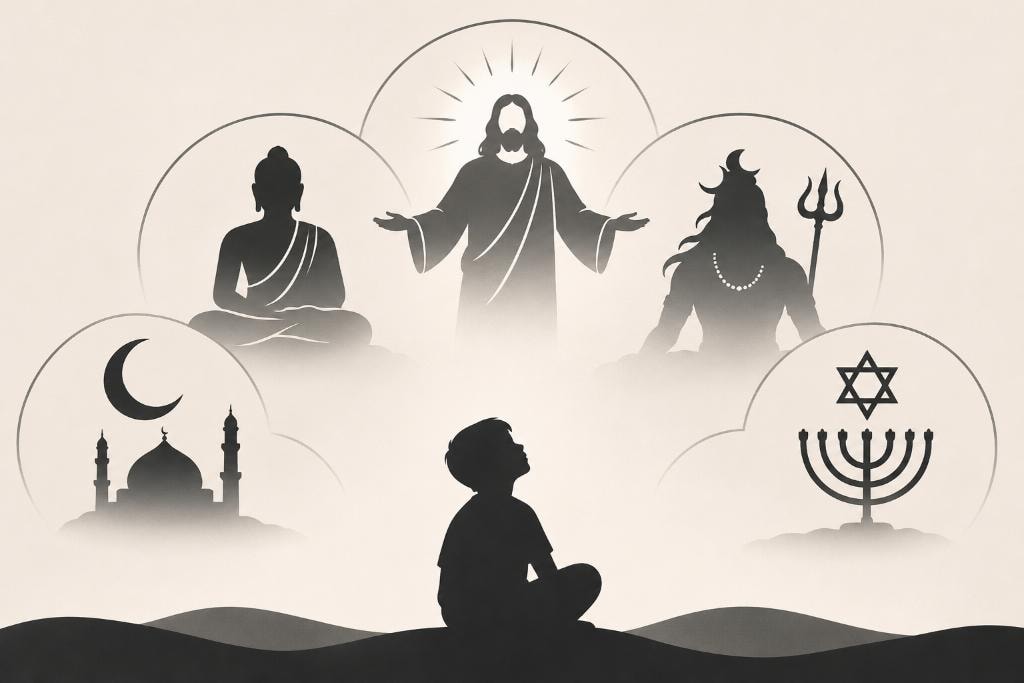
A child born into a Christian family is likely to learn about Jesus. A child born into a Muslim family will probably learn about Allah and the teachings of Muhammad. A child growing up in a Hindu household may encounter a very different understanding of divinity. In a secular household, the child may be taught that there is no convincing evidence for supernatural beings.
These children did not independently investigate the world's religions and arrive at their conclusions. They inherited the beliefs of the people around them.
There is nothing unusual about this. Human beings acquire much of their knowledge through parents, teachers, and communities. Without that capacity, every generation would have to rediscover how to survive.
But an uncomfortable question follows: If the circumstances of our birth strongly influence what we believe, how do we distinguish knowledge from inheritance?
This question reaches beyond religion. It concerns political convictions, cultural traditions, moral judgments, historical narratives, and increasingly, the information children encounter through digital media.
We should teach children to respect people, understand traditions, and listen to knowledgeable authorities. We should also teach them that factual claims deserve confidence in proportion to the evidence supporting them, regardless of who makes them.
Richard Dawkins and the Three Reasons We Believe
In Good and Bad Reasons for Believing, a letter written to his ten-year-old daughter Juliet, evolutionary biologist Richard Dawkins warned against three common foundations of belief: tradition, authority, and revelation (Dawkins, 2003).
His concern was straightforward. People frequently accept explanations because they have been repeated for generations, endorsed by respected figures, or experienced as deeply convincing personal truths.
Tradition can make a belief feel reliable simply because it is old. Authority can make an assertion appear credible because the speaker occupies a respected position. Revelation can persuade someone that an intensely personal experience provides knowledge unavailable through ordinary observation.
Yet these are different from evidence that other people can independently investigate.
Consider two children raised in different religious traditions. Each may be told that their family's understanding of God is correct. Both may be encouraged to trust their elders, respect sacred texts, and maintain the faith of previous generations.
The sincerity of their families tells us little about which conflicting supernatural claims, if any, are true.
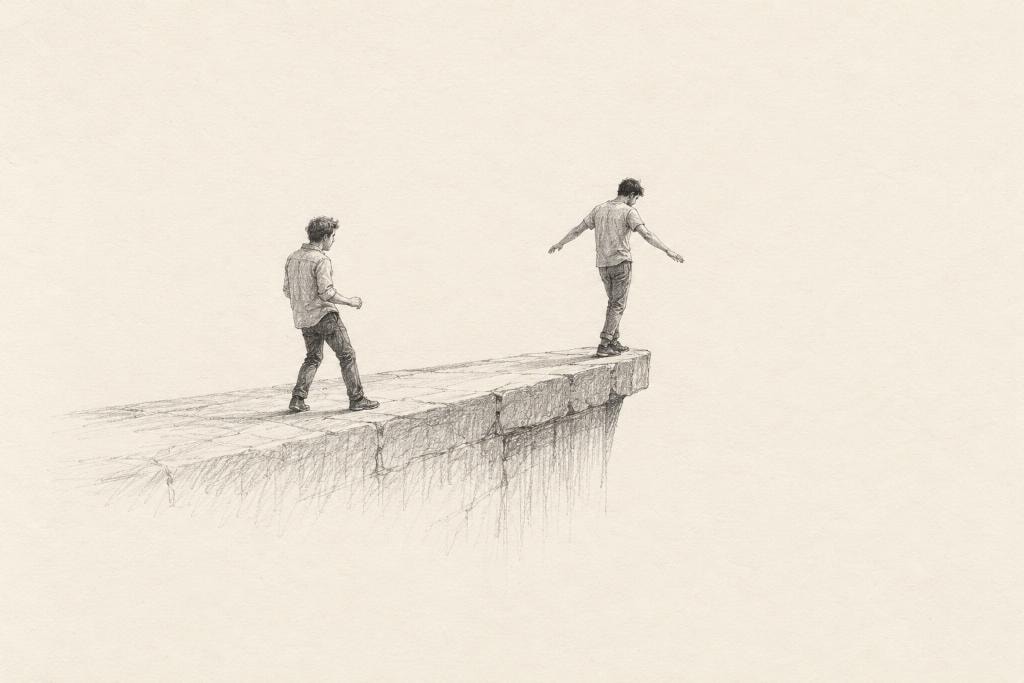
Dawkins' argument raises a difficult question for parents: Would we encourage our children to examine our beliefs with the same skepticism we expect them to apply to beliefs we disagree with?
There is an important qualification. Tradition, authority, and personal experience are not inherently worthless.
Traditional knowledge can preserve generations of observations about agriculture, ecology, medicine, and social relationships. Qualified authorities often possess knowledge that others have good reason to trust. Personal experiences provide evidence about what an individual perceived or felt, although they may not establish the cause of that experience.
The problem arises when these sources are treated as beyond examination.
A physician's advice deserves attention because medical expertise is developed through training, evidence, and professional accountability. A scientific claim gains credibility through methods that other researchers can inspect, challenge, and attempt to reproduce.
Authority becomes useful when it helps us identify reliable evidence. It becomes dangerous when it demands acceptance regardless of evidence.
Dawkins' letter therefore offers a principle that extends well beyond religion: Children should learn to ask how someone knows what they claim to know.
Why Evolution Made Children Trust Adults
Human children enter the world unusually dependent on others. They require years of care, protection, and learning before they can function independently.
From an evolutionary perspective, this extended period of development creates both opportunities and vulnerabilities.
A young child cannot safely discover every environmental danger through personal experimentation. Learning that certain plants are poisonous, that fire burns, or that particular social behaviors have consequences is often more efficient when the information comes from experienced adults.
Human survival has depended heavily on this ability to acquire knowledge socially.
Robert Boyd and Peter J. Richerson (1985) developed influential models of cultural transmission, showing how socially learned behavior can spread and persist across generations. Joseph Henrich (2016) examined how cumulative culture allows human populations to preserve and improve knowledge beyond what any single individual could discover.
The ability to trust others has therefore been enormously valuable.
However, the same mechanisms that transmit useful information can also preserve inaccurate explanations.
A child who learns an effective hunting technique from an experienced adult may also inherit that adult's unsupported beliefs about supernatural forces, neighboring communities, or the causes of illness.
Competing Hypotheses: Why Children Inherit Beliefs
Two hypotheses help explain why this happens.
Adaptive social learning: Children tend to learn from trusted, experienced, or apparently knowledgeable people because independent discovery is costly and sometimes dangerous. This predicts greater reliance on others when claims are difficult to test personally.
Cultural conformity: Children may adopt beliefs because agreement strengthens social belonging and disagreement risks disapproval. This predicts stronger public conformity when beliefs are closely associated with family identity, community membership, or social rewards.
These mechanisms can operate together. A child may initially believe something because a parent appears knowledgeable and continue believing it because questioning it carries social consequences.
Developmental research supports the broader observation that children are selective about whom they trust. Paul Harris and Kathleen Corriveau (2011) reviewed evidence that children use cues such as a speaker's previous accuracy and social standing when deciding whose information to accept.
That selectivity is useful, but it remains imperfect. A respected adult can be mistaken, and a widely accepted explanation can survive long after contradictory evidence becomes available.
The evolutionary advantage of social learning therefore creates an educational responsibility: We need to help children develop the ability to evaluate the information they inherit.
Did Humans Invent God? Osho and the Psychology of Belief
The Indian spiritual teacher Osho, also known as Rajneesh, offered a provocative explanation for the human idea of God.
In a passage from a press interview reproduced in The Last Testament, Volume 1, Osho rejected the existence of God and described the concept as a human invention. He associated religious belief with helplessness, fear of death, and the desire for protection.
The quotation captures his position: “God is the greatest lie invented by man.”
This is Osho's philosophical assertion, rather than an established scientific conclusion.
Nevertheless, his explanation raises a question that researchers in psychology and anthropology have examined from several directions.
Why are supernatural beliefs so widespread, and why do they frequently address death, suffering, uncertainty, and events beyond human control?
One possibility is that religious beliefs can help people manage existential anxiety. Awareness of mortality creates psychological challenges, and beliefs in continued existence or a meaningful cosmic order may provide reassurance.
Research associated with terror management theory has examined how reminders of mortality influence people's attachment to cultural worldviews and sources of meaning (Greenberg et al., 1986).
Another explanation concerns ordinary human cognition. Humans are skilled at recognizing agents, interpreting intentions, and detecting possible threats. These capacities are useful in social life and potentially dangerous environments. Some cognitive theories of religion propose that they also contribute to beliefs involving invisible agents or supernatural beings (Boyer, 2001; Atran, 2002).
A third explanation concerns the social functions of religion. Shared beliefs and rituals can help organize cooperation, reinforce group identities, and support institutions. Ara Norenzayan (2013), for example, examined how beliefs involving powerful, morally concerned gods may have contributed to cooperation in some large-scale societies.
These explanations differ, and their relative importance remains debated.
They also concern the origins, transmission, and consequences of belief. They cannot, by themselves, determine whether a supernatural being exists.
Osho's argument should therefore be examined using the same standard we would apply to a religious claim. If someone asserts that humanity invented God because humans fear death, we should ask what evidence supports that explanation, whether it applies across cultures, and what alternative explanations might account for the same observations.
The fact that an explanation is psychologically appealing does not establish that it is true. That principle applies equally to belief and disbelief.
Russell, Twain, Hitchens, Fry, and Asimov: Questioning What We Cannot Know
The question of what happens after death has occupied philosophers and religious thinkers for centuries. It is also one of the subjects on which adults frequently present their convictions to children with great certainty.
Bertrand Russell, in What I Believe (1925), expressed the expectation that his body would decay and that his personal consciousness would not survive death. His position was grounded in a naturalistic understanding of human existence.
Mark Twain approached mortality with characteristic humor. In his autobiographical reflections, he considered the vast period of nonexistence before birth and questioned why people should regard the period after death with such dread.
The ancient philosopher Epicurus offered a related argument: While we are alive, death has not arrived; when death arrives, we no longer experience anything. His reasoning challenges the fear of being dead, although it does not eliminate concerns about dying, losing loved ones, or being deprived of future experiences.
Christopher Hitchens questioned whether religious institutions possess special moral authority. In God Is Not Great (2007), he argued that moral reasoning and ethical behavior do not require belief in divine commands.
Stephen Fry raised another philosophical challenge during a 2015 interview with Gay Byrne. He questioned how an all-powerful and benevolent God could permit children to suffer from devastating diseases and other forms of apparently undeserved pain. This is a version of the longstanding philosophical problem of evil.
Richard Dawkins, in The Blind Watchmaker (1986), explained how natural selection can produce the appearance of design in living organisms without requiring an intelligent designer.
Isaac Asimov, the scientist and humanist, likewise questioned supernatural explanations and rejected the assumption that morality depends on divine rewards or punishments.
These thinkers provide different reasons for skepticism. They also illustrate why we should distinguish philosophical arguments from scientific findings.
Evolutionary biology provides extensive evidence explaining biological diversification and adaptation. That evidence challenges particular claims about the supernatural creation of species. It does not automatically resolve every philosophical definition of God.
Similarly, the existence of suffering raises serious questions for certain theological accounts of divine benevolence, but religious philosophers have developed responses involving free will, human limitations, and other considerations.
Children deserve to encounter these disagreements as arguments that can be examined.
They should learn that an influential thinker can make a persuasive case and still be challenged. Russell, Dawkins, Hitchens, Fry, Asimov, and Osho should be subject to the same intellectual scrutiny they encourage us to apply to religious authority.
Admiration for a thinker should never become another form of unquestioning belief.
How We Can Teach Children to Examine Evidence
Teaching children to evaluate claims requires more than telling them to be skeptical. They need opportunities to practice reasoning, recognize reliable sources, and distinguish what is known from what remains uncertain.
Psychologist Deanna Kuhn (1999) described critical thinking as a developing capacity involving awareness of one's own knowledge, reasoning strategies, and understanding of what counts as justification. Her work emphasizes that the ability to examine arguments develops through childhood and adolescence.
We can support that development through ordinary conversations.
When a child asks why the moon changes shape, we can demonstrate the phases of the moon using a lamp and a ball. When a child hears that a particular food prevents illness, we can investigate whether controlled studies support the claim. When a child encounters an extraordinary story online, we can help them find its original source.
When children ask about God, heaven, or what happens after death, we can explain what different traditions believe, what philosophers have argued, and which aspects can be investigated scientifically.
We should be comfortable distinguishing between statements such as “I believe this,” “There is strong evidence for this,” and “We do not know.”
Five Questions Every Child Should Learn to Ask
- What evidence supports this claim?
- Where did the information come from?
- Can other people independently examine it?
- Are there alternative explanations?
- What evidence would justify changing our minds?
These questions should apply to statements made by teachers, religious leaders, politicians, scientists, social media personalities, and parents.
But we must also teach children that evidence comes in different forms.
A historical claim may be supported by documents, artifacts, and independent accounts. A medical claim may require clinical studies. A scientific explanation may depend on observations, experiments, and mathematical models.
Moral questions involve evidence about consequences alongside judgments about values. Personal preferences, such as enjoying a particular kind of music, do not require scientific validation.
Some metaphysical propositions may lack agreed-upon methods of empirical testing. In such cases, intellectual honesty requires acknowledging the limits of what can be demonstrated rather than pretending that every question has a laboratory answer.
Evidence-based reasoning also involves evaluating expertise. Children cannot personally verify every claim about medicine, climate, astronomy, or ancient history. They must learn to identify reliable institutions, examine the quality of sources, and understand why agreement among independently working specialists can carry substantial weight.
The objective is calibrated confidence: strong confidence where evidence is strong, caution where it is limited, and willingness to revise conclusions when new information emerges.
The Responsibility Begins With Parents
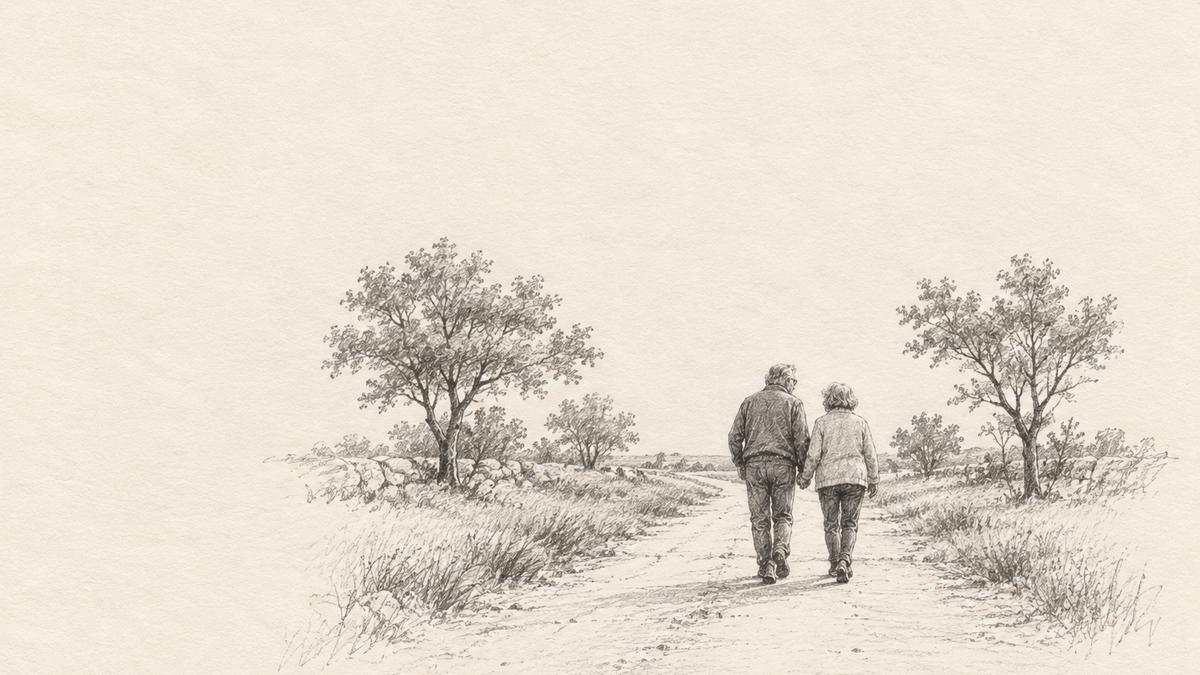
Parents are often the first authorities children encounter. Their behavior teaches children what kinds of questions are welcome and which subjects are considered untouchable.
A parent who encourages scientific curiosity but reacts angrily when a child questions a family belief sends a contradictory message.
Children may learn that asking questions is acceptable only when the answers do not threaten the convictions of adults.
This creates a difficult responsibility for parents. We naturally want to pass along the values, knowledge, and traditions that have shaped our lives. Some of those traditions are deeply connected to family identity and emotional security.
We can preserve that connection without requiring children to accept every inherited factual claim.
A religious parent can explain why faith matters to the family while allowing the child to explore alternative perspectives. A nonreligious parent can explain their skepticism without demanding that the child adopt atheism as an unquestionable conclusion.
Both can encourage children to read, investigate, compare explanations, and make judgments appropriate to their maturity.
There are limits. Young children need protection, guidance, and boundaries. Parents should not withhold necessary medical care or permit dangerous behavior simply because a child has not independently verified the evidence.
As children mature, however, the balance can gradually shift from instruction toward explanation and independent evaluation.
Parents should also demonstrate how to change their minds. Admitting an error, correcting a mistaken claim, or acknowledging uncertainty shows children that intellectual honesty matters more than preserving an appearance of certainty.
This may be especially important when family beliefs are involved.
If a child reaches a different conclusion after careful examination, the relationship should remain secure. The freedom to question loses much of its value when disagreement threatens love, acceptance, or belonging.
What Would Change My Mind?
Several questions deserve further research before we can determine which educational approaches work best across different families and cultures.
- Do children who receive explicit instruction in evaluating evidence become more resistant to misinformation later in life?
- How does a parent's willingness to acknowledge mistakes affect a child's intellectual independence?
- Can children learn to challenge unsupported claims while maintaining appropriate trust in scientific and professional expertise?
- How do family relationships and community expectations influence whether children express disagreement openly?
- Which teaching methods help children transfer reasoning skills from classroom exercises to religion, politics, health, and everyday decisions?
These questions matter because critical thinking is a skill that must be developed and tested, rather than a label we can simply attach to an educational philosophy.
Conclusion: The Freedom to Ask Why
Human beings have survived and prospered partly because each generation learns from those who came before it. Traditions preserve knowledge, institutions organize cooperation, and experienced adults help children navigate a complicated world.
Yet the same capacity to inherit knowledge also allows mistakes to endure.
Dawkins warned his daughter about tradition, authority, and revelation. Osho questioned whether religious belief emerges from fear and the desire for protection. Russell, Twain, Hitchens, Fry, and Asimov challenged different assumptions about mortality, morality, and supernatural explanations.
Their arguments differ, but they bring us back to a common intellectual responsibility: We should examine the reasons for our beliefs and remain willing to reconsider them.
Parents do not need to abandon their traditions or conceal their convictions. They should explain them, discuss their origins, and distinguish what can be demonstrated from what remains a matter of faith or philosophical interpretation.
We cannot protect our children from every false claim they will encounter. We can help them recognize when a claim is unsupported, when an authority is unreliable, and when their own convictions deserve reconsideration.
Perhaps the greatest intellectual freedom we can give children is the ability to disagree with us without fear, to acknowledge uncertainty without embarrassment, and to follow evidence even when it leads somewhere unexpected.
We should want our children to know what we believe. More importantly, we should want them to understand why we believe it, and to have the freedom to reach a different conclusion.
Key Takeaways
- Children acquire beliefs through social learning, which is essential to human survival and cultural evolution.
- Tradition, authority, and revelation can influence belief, but they do not independently establish the truth of factual claims.
- Religious beliefs may serve psychological and social functions, although those functions do not determine whether supernatural claims are true.
- Critical thinking requires examining evidence, understanding uncertainty, and recognizing reliable expertise.
- Parents should model intellectual honesty by welcoming questions, acknowledging mistakes, and allowing respectful disagreement.
- The ability to revise a belief when better evidence becomes available is a fundamental part of learning.
References & Further Reading
- Asimov, I. (1994). I. Asimov: A memoir. Doubleday.
- Atran, S. (2002). In gods we trust: The evolutionary landscape of religion. Oxford University Press.
- Boyd, R., & Richerson, P. J. (1985). Culture and the evolutionary process. University of Chicago Press.
- Boyer, P. (2001). Religion explained: The evolutionary origins of religious thought. Basic Books.
- Dawkins, R. (1986). The blind watchmaker. W. W. Norton.
- Dawkins, R. (2003). A devil's chaplain: Reflections on hope, lies, science, and love. Houghton Mifflin. See “Good and Bad Reasons for Believing.”
- Greenberg, J., Pyszczynski, T., & Solomon, S. (1986). The causes and consequences of a need for self-esteem: A terror management theory. In R. F. Baumeister (Ed.), Public self and private self (pp. 189–212). Springer.
- Harris, P. L., & Corriveau, K. H. (2011). Young children's selective trust in informants. Philosophical Transactions of the Royal Society B: Biological Sciences, 366(1567), 1179–1187. https://doi.org/10.1098/rstb.2010.0321
- Henrich, J. (2016). The secret of our success: How culture is driving human evolution, domesticating our species, and making us smarter. Princeton University Press.
- Hitchens, C. (2007). God is not great: How religion poisons everything. Twelve.
- Kuhn, D. (1999). A developmental model of critical thinking. Educational Researcher, 28(2), 16–26, 46. https://doi.org/10.3102/0013189X028002016
- Norenzayan, A. (2013). Big gods: How religion transformed cooperation and conflict. Princeton University Press.
- Osho. (1985). The last testament, volume 1. Press interview, Chapter 1.
- Russell, B. (1925). What I believe. Kegan Paul, Trench, Trubner & Co.
Written by Farzin Espahani
Editor in Chief, The Hominid Post
Farzin Espahani writes about human behavioral ecology, evolutionary anthropology, cooperation and the institutions humans build around biological and social risk.