The First Alliance: How Humans and Wolves Learned to Live Together
Before dogs guarded homes or slept beside children, humans and wolves pursued the same prey across Ice Age Eurasia. Their relationship may have begun with competition, but changing ecological incentives gradually created the oldest enduring alliance between humans and another animal.
The First Alliance Between Humans and Wolves
Scientific status: Dogs descended from ancient wolf populations and were domesticated before agriculture (established). Sustained human–wolf interaction began among Late Pleistocene hunter-gatherers (strongly supported). Scavenging, adoption, food sharing, vigilance, and hunting benefits all contributed (plausible). The exact date, place, wolf population, and sequence of events that produced the first dogs remain unresolved.
How did wolves become dogs? Dogs evolved from ancient wolf populations during the Late Pleistocene, before agriculture. Humans and wolves probably began as competitors and scavengers on the same hunting grounds. Natural selection favored wolves that tolerated people, while humans later fed, adopted, protected, trained, and bred useful animals. The exact place and sequence of dog domestication remain unresolved.
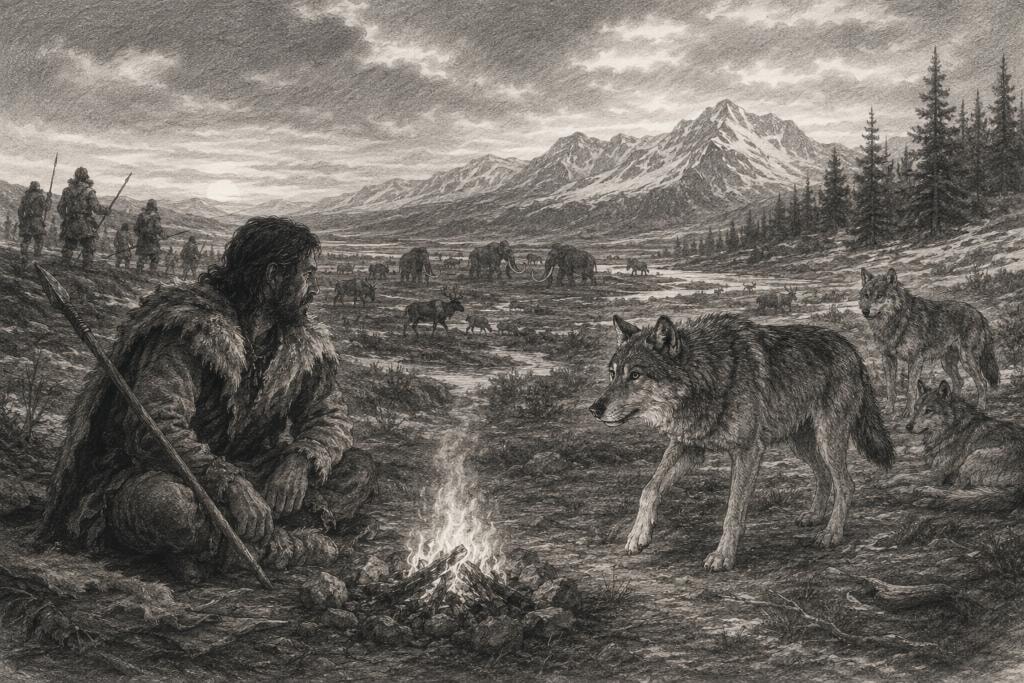
A herd of reindeer moves across an exposed Ice Age plain.
Wolves follow from downwind. They can smell the animals long before they see them. Several kilometers away, human hunters study tracks in the frozen ground and prepare stone-tipped weapons.
The wolves and humans are pursuing the same prey.
Both hunt cooperatively. Both defend territories. Both raise dependent young within social groups. Both can convert a large carcass into several days of food. Each is also capable of stealing a kill from the other.
For many generations, their relationship was probably dangerous and unstable. Wolves approaching human camps risked being killed. Humans confronting a wolf pack near a carcass faced teeth, numbers, and coordinated resistance.
Yet somewhere within that competition, a different relationship emerged.
Some wolves began remaining close to people. Some people began tolerating them. Food passed between the species. Distance narrowed. Familiarity replaced immediate aggression. Eventually, certain wolves could travel, rest, hunt, and reproduce beside humans.
The result was the dog: the first animal known to have entered a sustained domestic relationship with our species.
Humans later domesticated sheep, goats, pigs, cattle, horses, and chickens. Those relationships largely developed after people began farming. Dogs entered human society earlier, among mobile hunter-gatherers living in a world of dangerous carnivores, seasonal scarcity, and prey capable of outrunning or injuring a lone hunter.
The familiar story says humans domesticated wolves. That is partly true. The deeper history probably involved something more complicated: ecological opportunity, mutual tolerance, cultural learning, and natural selection operating on both sides of the campfire.
Two Predators in the Same Ecological Niche
An ecological niche is the combination of habitats, resources, risks, and behavioral strategies through which an organism makes a living.
Late Pleistocene humans and gray wolves (Canis lupus) occupied unusually similar niches across parts of Eurasia. Both were wide-ranging social hunters capable of pursuing large herbivores, including reindeer, horses, bison, musk oxen, and mammoths. They would have encountered the same migration routes, carcasses, watering places, and seasonal concentrations of prey.
This overlap initially created competition.
A reindeer consumed by wolves could no longer feed a human group. A mammoth killed or butchered by people could attract wolves, hyenas, foxes, and other scavengers. At concentrated kill sites, humans and wolves may have alternated between avoiding, threatening, following, and exploiting one another.
The behavioral puzzle is therefore clear: how could two predators competing for similar resources become partners?
Several hypotheses attempt to explain the transition.
The scavenging hypothesis: Less fearful wolves approached human camps to consume bones, organs, scraps, or abandoned meat. Wolves that tolerated people gained more food and left more offspring.
The adoption hypothesis: Humans captured or adopted wolf pups, raised them inside camps, and retained unusually manageable animals.
The hunting-alliance hypothesis: Wolves and humans gained information or hunting advantages by observing, following, or eventually coordinating with one another.
The dietary-surplus hypothesis: Human nutritional limits created surplus lean meat that could be fed to wolves without depriving people of the fat and carbohydrates they needed most.
These explanations can overlap. Dog domestication may have followed several pathways at different times or in different regions.
From Scavenger to Neighbor
The most familiar explanation begins at the edge of a human camp.
Wolves vary in temperament. Some are more cautious, while others are more willing to investigate unfamiliar animals, smells, and food sources. Wolves with lower fear of humans may have approached camps after people had finished eating or moved elsewhere.
Those animals gained access to a new food source.
Natural selection could then favor wolves capable of remaining near people without attacking them or provoking a lethal response. Over many generations, the animals living around humans would become behaviorally different from wolves that avoided people.
This is often called the commensal pathway. Commensalism describes a relationship in which one species benefits while the other experiences little immediate cost or benefit.
The hypothesis works well for animals that became associated with permanent settlements and stored food. Early dog domestication presents a harder problem. Pleistocene hunter-gatherers were mobile and sparsely distributed. Their camps may not have produced the predictable refuse found around later villages.
James Serpell has therefore argued that passive scavenging alone may be insufficient. Early people could also have adopted young animals, creating direct social relationships before a dependable camp-scavenging niche existed (Serpell, 2021).
The difference is important.
Under a purely commensal model, wolves first adapted themselves to human environments. Under an adoption model, humans actively brought wolf pups into their social groups. In reality, both processes may have occurred.
Bold wolves approached people. Curious humans adopted pups. Animals raised among people became easier to tolerate. Their offspring inherited both genetic tendencies and a social environment that made further interaction possible.
Domestication began to feed itself.
When Competition Became Affordable
One of the most interesting hypotheses begins with nutrition rather than friendship.
Humans and wolves can both survive on meat, but they cannot process extremely lean meat in the same way. Human physiology limits how much protein the liver and kidneys can metabolize safely. During severe northern winters, large prey animals often carry little fat. Hunters could therefore obtain more lean protein than they could efficiently consume while still lacking sufficient dietary fat or carbohydrates.
Wolves are more specialized for carnivory and can obtain a larger share of their energy from protein.
Maria Lahtinen and colleagues proposed that this nutritional difference could have reduced direct competition during harsh Ice Age winters. Humans might have provided wolves with surplus lean meat while retaining the scarcer fatty portions they needed. The researchers describe this as one possible condition that permitted prolonged coexistence between the two species (Lahtinen et al., 2021).
Evidence: Humans face physiological limits on protein consumption, particularly when other energy sources are scarce. Wolves tolerate a more protein-heavy diet.
Interpretation: Surplus lean meat could make feeding nearby wolves less expensive than it first appears. A resource humans could not fully use might support animals that provided vigilance or hunting benefits.
Speculation: Repeated winter feeding may have helped convert occasional scavengers into animals that remained near human groups throughout the year.
The hypothesis does not prove that people deliberately fed wolves until dogs appeared. It identifies an ecological opening.
Cooperation becomes easier when the cost of tolerating a potential partner falls.
Why Wolves?
Humans encountered many carnivores. Bears, foxes, hyenas, and large cats also scavenged from kills or competed for prey.
Only one lineage became dogs.
The answer may lie in the social organization wolves possessed before sustained contact with humans.
Wolves live in coordinated family groups. They cooperate in territorial defense, care of young, and, under some conditions, the pursuit of prey. Young wolves undergo long periods of social development and learning. Adults respond to posture, gaze, vocalizations, movement, and the behavior of familiar group members.
Humans possess the same broad package of traits, expressed through far more elaborate language and culture.
Both species form durable social bonds; live in family-based groups; defend territories and young; coordinate during collective pursuits; redistribute or share food; learn by observing others; interpret attention, posture, and movement; and adjust behavior according to familiarity and social context.
These similarities did not guarantee cooperation. Wolves remained dangerous, and most wolf populations never entered human society.
They did, however, provide a behavioral foundation on which selection could act.
Humans encountered an animal already adapted to coordination with social partners. A wolf capable of reading the movements of other wolves possessed some of the cognitive equipment needed to respond to human signals. Humans accustomed to collective hunting could recognize the value of another animal that tracked, pursued, detected threats, and communicated.
The two species did not share a language.
They shared a problem: how to coordinate with others while pursuing uncertain resources in a dangerous environment.
Did Wolves Domesticate Themselves?
The statement that wolves domesticated themselves is useful shorthand, but it can hide the feedback process involved.
No wolf decided to become a dog. No group of Paleolithic hunters needed to imagine a future spaniel, shepherd, or sled dog.
Domestication could begin through small differences in survival and reproduction.
Wolves that tolerated people gained food or protection. Humans who tolerated useful wolves gained vigilance, tracking assistance, warmth, defense, or eventually hunting support. Each advantage increased the probability of further interaction.
Natural selection probably dominated the earliest stages. Human choices later intensified the process.
People could adopt pups, feed responsive animals, kill dangerous ones, prevent aggressive individuals from reproducing, or exchange valuable animals with other groups. Such behavior would add deliberate human selection to the earlier ecological process.
The separation between “self-domestication” and “human domestication” may therefore be too clean.
Wolf behavior changed human behavior. Human behavior changed which wolves survived. The surviving wolves altered the advantages of living with animals. Human cultural practices then strengthened biological selection.
This interaction is an example of gene–culture coevolution. Cultural behavior changes the environment in which genetic selection occurs, while biological changes influence the future direction of culture. For a broader discussion of this process, see Dual Inheritance Theory and Gene–Culture Coevolution.
It also represents niche construction. Humans created camps, fires, carcass-processing sites, and defended social spaces. Wolves entering those spaces encountered a new ecological niche. Once dogs became useful for guarding, transport, or hunting, they helped humans reshape the environment again.
Neither species remained merely part of the other’s background.
Did Humans and Wolves Hunt Together?
Humans and wolves clearly pursued many of the same prey species. That evidence alone does not establish coordinated hunting.
A cautious reconstruction begins with information.
Wolves could locate herds, detect wounded animals, and sense approaching predators. Humans could observe wolf movements or follow their tracks. Wolves could follow human hunters and investigate carcasses left behind.
Each species might benefit from watching the other long before deliberate cooperation emerged.
More coordinated hunting may have developed after wolf-like dogs had already become tolerant of humans. Even limited assistance could matter. A dog that followed a scent trail, distracted an animal, alerted hunters to nearby prey, or prevented a wounded animal from escaping could improve the return from a hunt.
Direct evidence for such behavior during the earliest domestication phase remains limited. Archaeological bones can reveal diet, age, injury, and morphology. They rarely reveal exactly how an animal behaved during a hunt.
Evidence: Humans and wolves occupied overlapping landscapes and hunted many of the same animals.
Interpretation: Repeated encounters on shared hunting grounds created opportunities to observe and exploit one another’s behavior.
Speculation: Formal cooperative hunting may have emerged from earlier patterns of following, scavenging, warning, and opportunistic assistance.
The evidence supports ecological proximity. Claims about highly coordinated Ice Age hunting teams require greater caution.
What Ancient DNA Reveals
Genetic evidence confirms that dogs descend from ancient wolf populations and that domestication began before agriculture.
Modern wolves are not simply unchanged representatives of the population that became dogs. Dogs and living wolves descend from older wolf lineages, some of which disappeared.
A 2020 study of ancient dog genomes found that at least five major dog ancestry lineages had already diversified by approximately 11,000 years ago. Dogs were therefore geographically widespread and genetically varied near the beginning of the Holocene (Bergström et al., 2020).
A later analysis of ancient wolf genomes found that dogs are more closely related overall to ancient eastern Eurasian wolves than to western Eurasian wolves. Dogs from Africa and the Near East also carry substantial ancestry connected to another western Eurasian wolf population. This could reflect admixture between early dogs and local wolves or a more complex history involving more than one wolf source population (Bergström et al., 2022).
The genetic evidence therefore resists a tidy origin story.
Researchers have yet to identify one conclusive place, population, or moment when wolves became dogs. The process may have involved an extinct wolf population that has not yet been sampled. Later mixing between dogs and wolves further complicates the trail.
Ancient DNA can reconstruct ancestry.
It cannot show us the first wolf that accepted food beside a fire.
The Dog Buried With Humans
Around 14,000 years ago, people buried a young dog beside two humans at Bonn-Oberkassel in present-day Germany.
The burial demonstrates more than anatomical domestication. The animal was included in a human mortuary event.
A later analysis found that the dog had suffered repeated serious illness while still young. The researchers argued that it likely survived because humans provided food, protection, warmth, or other sustained care. During its illness, the animal would have offered little immediate value as a hunter or guard (Janssens et al., 2018).
Affection does not fossilize neatly. We cannot assume that Paleolithic people understood dogs exactly as modern pet owners do.
The burial nevertheless shows that the relationship had moved beyond opportunistic scavenging.
At least some dogs had entered human social life deeply enough to receive care while unproductive and inclusion after death.
The alliance had acquired an emotional dimension.
From General Partner to Specialist
Once dogs could live reliably beside humans, their possible roles multiplied.
Dogs could warn camps of approaching animals or unfamiliar people; track wounded prey; assist with hunting; defend food or sleeping areas; carry loads; pull transport equipment; provide fur, meat, or ritual value; and create social bonds between people or groups.
The evidence for each role varies by place and period. Early dogs should not automatically be imagined as perfectly trained modern working animals. A dog that merely detected danger or followed a scent trail could provide a meaningful advantage.
By approximately 9,000 years ago, dogs at the Zhokhov site in Arctic Siberia had body forms associated with specialized work. Archaeological research indicates that dogs were used for hunting and draft labor, while broader evidence supports a long history of dog-powered Arctic transport (Pitulko & Kasparov, 2017; Vitale et al., 2023).
This transition reveals a new phase of the relationship.
Early selection may have favored general tolerance, low aggression, and responsiveness. Later human cultures selected dogs for specific ecological tasks.
A useful hunting dog in a forest required different traits from a sled dog on Arctic ice. A livestock guardian needed different behavior from a small camp scavenger.
Humans did not produce one universal dog.
They produced populations fitted to local ways of life.
Dogs became part of humanity’s adaptive toolkit. For a broader look at how humans have used technology and relationships to reshape their environments, see From Fire to Artificial Intelligence: How Technology Reorganizes Human Work.
The Biology of Living Together
Domestication changed how dogs respond to people.
Dogs are unusually attentive to human gaze, tone, gestures, and emotional expression. Wolves raised intensively by humans can also respond to human signals, reminding us that domestication modified existing canid capacities rather than creating social intelligence from nothing.
Dogs, however, appear especially motivated to engage people.
In a widely discussed experiment, prolonged mutual gazing between dogs and their owners was associated with increased oxytocin in both species. Oxytocin is involved in mammalian bonding and social regulation. The same pattern was not observed in the tested wolf–human pairs (Nagasawa et al., 2015).
This finding should not be reduced to the claim that a dog’s gaze is identical to an infant’s attachment. Oxytocin has several functions, and a modern laboratory experiment cannot reconstruct the emotional lives of Ice Age humans or wolves.
The study does suggest that dogs became capable of engaging ancient mammalian bonding systems shared with humans.
Genetic research has also associated variation near genes involved in social behavior with the heightened sociability seen in many dogs. No single “friendliness gene” created the dog. Behavior develops through many genes interacting with experience, learning, and social environment.
Thousands of years of cohabitation made human signals increasingly relevant to dog survival.
Humans, in turn, became skilled at interpreting canine posture, movement, vocalization, and attention.
Communication changed on both sides.
The Alliance Was Never Equal
Calling the relationship an alliance should not romanticize it.
Humans increasingly controlled food, movement, reproduction, and survival for dog populations. Dogs were sometimes eaten, sacrificed, traded, abandoned, or forced to work. In recent centuries, selective breeding has produced some physical forms associated with chronic health problems.
Wolves remained competitors outside the domestic relationship. As pastoralism and permanent settlements expanded, humans killed wolves to protect livestock, territory, and game.
The history contains cooperation and coercion.
Human behavioral ecology predicts this variability. People value animals according to local incentives, risks, traditions, and available alternatives. A dog may be a hunting partner in one society, a guardian in another, a ritual animal in a third, and a household companion in a fourth.
The biological capacity for bonding does not dictate one moral arrangement.
Culture determines how that capacity is expressed.
From the Edge of the Fire to the Foot of the Bed
Most dogs today no longer help humans pursue reindeer.
Some still perform specialized work. Dogs herd livestock, guide people with impaired vision, detect explosives, locate missing people, guard homes, and assist hunters.
Many provide companionship without an obvious subsistence role.
From a narrow economic perspective, a household dog can appear costly. It consumes food, veterinary care, time, and space.
The social calculation is wider.
Dogs can provide vigilance, routine, emotional regulation, play, physical activity, and opportunities for human interaction. These benefits vary. Pet ownership is neither universally desirable nor biologically required.
The durability of the relationship nevertheless suggests that humans repeatedly find value in extending social life beyond the boundary of our own species.
The modern dog sleeping on a manufactured bed is far removed from a wolf approaching a Paleolithic carcass.
The underlying exchange remains recognizable.
Humans provide food, protection, and access to one of the planet’s most successful ecological niches. Dogs provide attention, communication, labor, vigilance, and companionship.
Both species became globally successful within the relationship, although humans clearly possess greater control over its terms.
The first alliance did more than turn wolves into dogs.
It expanded what a human society could include.
Key Terms
Domestication: A multigenerational process through which an animal population becomes genetically and behaviorally adapted to living within a human-controlled environment.
Commensalism: A relationship in which one species benefits while the other experiences little direct benefit or harm.
Mutualism: An interaction through which both species receive benefits.
Niche construction: The process by which organisms alter their environments and thereby change the selection pressures acting on themselves or other species.
Gene–culture coevolution: A feedback process in which cultural practices affect genetic selection and biological changes influence cultural development. See Dual Inheritance Theory and Gene–Culture Coevolution.
Human behavioral ecology: The study of how human behavior varies in response to ecological, social, and economic conditions. See Human Behavioral Ecology: Why Context Changes Behavior.
What Would Change My Mind?
- Ancient DNA showing that dogs originated only after permanent settlements and dependable refuse became common.
- Archaeological evidence demonstrating that early dog-like canids had no sustained relationship with mobile hunter-gatherers.
- Dietary reconstructions showing that humans and wolves always competed for the same nutritionally valuable portions of prey.
- Evidence that the earliest domestic dogs lacked the social tolerance required for regular cohabitation.
- A confirmed single domestication event that excludes repeated regional interaction between humans and wolves.
- Direct archaeological evidence contradicting the proposed role of hunting, vigilance, food sharing, or adoption.
Key Takeaways
- Humans and wolves began as ecological competitors occupying many of the same Ice Age hunting landscapes.
- Their similar social systems made sustained communication and cooperation more possible than with many other carnivores.
- Dog domestication probably combined scavenging, pup adoption, mutual tolerance, nutritional opportunity, and later intentional selection.
- Direct evidence that the earliest humans and wolves hunted cooperatively remains limited.
- Ancient genomes show that dogs were already genetically diverse by approximately 11,000 years ago.
- The Bonn-Oberkassel burial shows that dogs had entered human social and emotional life by around 14,000 years ago.
- Dogs later became specialized partners in hunting, guarding, transport, herding, and companionship.
- The relationship reflects changing incentives, natural selection, cultural transmission, and gene–culture coevolution.
Frequently Asked Questions
Did dogs evolve from modern wolves?
Dogs and modern wolves share ancestry, but dogs did not descend directly from any one living wolf population. They emerged from ancient wolf populations, some of which are now extinct.
Were dogs domesticated before agriculture?
Yes. Dogs lived with mobile hunter-gatherers thousands of years before the domestication of livestock and the widespread development of farming.
Did early humans keep wolves as pets?
Some people may have adopted wolf pups, but the modern category of pet may not accurately describe the earliest relationships. Early wolves or dogs could simultaneously serve social, defensive, hunting, dietary, or ritual roles.
Did humans and wolves share food?
Food sharing is plausible and supported by ecological models. Humans may sometimes have had surplus lean meat that wolves could digest more effectively, particularly during harsh northern winters.
Did dogs help humans survive?
Dogs eventually helped humans hunt, guard camps, transport goods, manage livestock, and detect threats. The benefits provided during the earliest stage of domestication remain less certain.
Why are dogs so responsive to humans?
Domestication favored dogs that attended to human gaze, movement, tone, and gestures. Development and individual experience also influence how well a dog understands people.
References and Further Reading
Bergström, A., Frantz, L., Schmidt, R., et al. (2020). Origins and genetic legacy of prehistoric dogs. Science, 370(6516), 557–564. https://doi.org/10.1126/science.aba9572
Bergström, A., Stanton, D. W. G., Taron, U. H., et al. (2022). Grey wolf genomic history reveals a dual ancestry of dogs. Nature, 607, 313–320. https://doi.org/10.1038/s41586-022-04824-9
Driscoll, C. A., Macdonald, D. W., & O’Brien, S. J. (2009). From wild animals to domestic pets: An evolutionary view of domestication. Proceedings of the National Academy of Sciences, 106(Supplement 1), 9971–9978. https://doi.org/10.1073/pnas.0901586106
Freedman, A. H., & Wayne, R. K. (2017). Deciphering the origin of dogs: From fossils to genomes. Annual Review of Animal Biosciences, 5, 281–307. https://doi.org/10.1146/annurev-animal-022114-110937
Janssens, L., Giemsch, L., Schmitz, R., Street, M., Van Dongen, S., & Crombé, P. (2018). A new look at an old dog: Bonn-Oberkassel reconsidered. Journal of Archaeological Science, 92, 126–138. https://doi.org/10.1016/j.jas.2018.01.004
Lahtinen, M., Clinnick, D., Mannermaa, K., Salonen, J. S., & Viranta, S. (2021). Excess protein enabled dog domestication during severe Ice Age winters. Scientific Reports, 11, Article 7. https://doi.org/10.1038/s41598-020-78214-4
Larson, G., Karlsson, E. K., Perri, A., et al. (2012). Rethinking dog domestication by integrating genetics, archaeology, and biogeography. Proceedings of the National Academy of Sciences, 109(23), 8878–8883. https://doi.org/10.1073/pnas.1203005109
Nagasawa, M., Mitsui, S., En, S., et al. (2015). Oxytocin-gaze positive loop and the coevolution of human-dog bonds. Science, 348(6232), 333–336. https://doi.org/10.1126/science.1261022
Perri, A. R. (2016). A wolf in dog’s clothing: Initial dog domestication and Pleistocene wolf variation. Journal of Archaeological Science, 68, 1–4. https://doi.org/10.1016/j.jas.2016.02.003
Pitulko, V. V., & Kasparov, A. K. (2017). Archaeological dogs from the Early Holocene Zhokhov site in the Eastern Siberian Arctic. Journal of Archaeological Science: Reports, 13, 491–515. https://doi.org/10.1016/j.jasrep.2017.04.003
Serpell, J. A. (2021). Commensalism or cross-species adoption? A critical review of theories of wolf domestication. Frontiers in Veterinary Science, 8, 662370. https://doi.org/10.3389/fvets.2021.662370
Vitale, E., Losey, R. J., Nomokonova, T., et al. (2023). An ethnographic framework for identifying dog sledding in the archaeological record. Journal of Archaeological Science, 154, 105772. https://doi.org/10.1016/j.jas.2023.105772
vonHoldt, B. M., Shuldiner, E., Koch, I. J., et al. (2017). Structural variants in genes associated with human Williams–Beuren syndrome underlie stereotypical hypersociability in domestic dogs. Science Advances, 3(7), e1700398. https://doi.org/10.1126/sciadv.1700398
Written by Farzin Espahani
Editor in Chief, The Hominid Post
Farzin Espahani writes about human behavioral ecology, evolutionary anthropology, cooperation and the institutions humans build around biological and social risk.