From Fire to Artificial Intelligence: Why Every Major Technology Reorganizes Human Work
Human history is partly the history of transferring effort from muscles to tools, from memory to writing, from distance to machines, and now from portions of cognition to artificial intelligence.
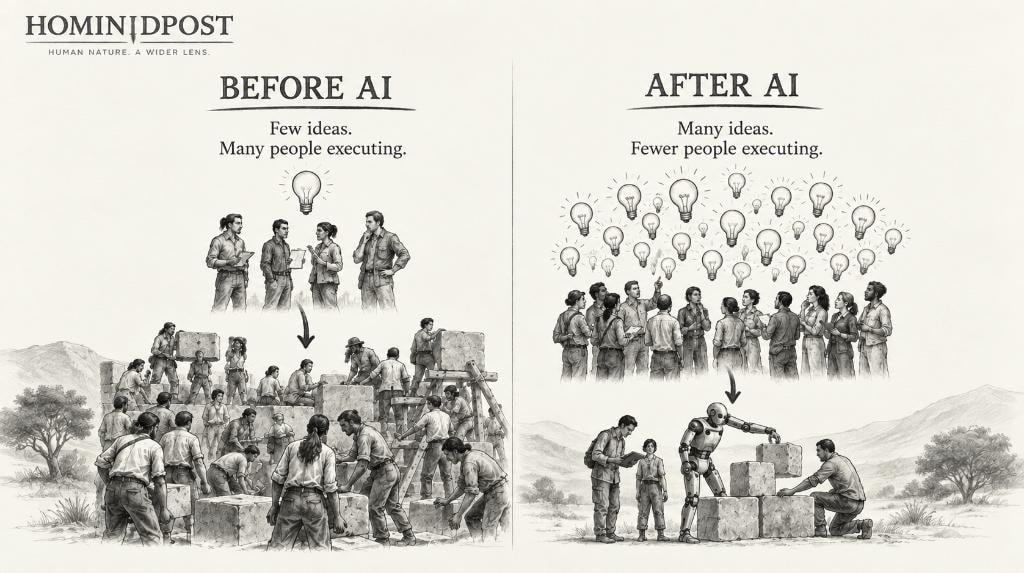
A person watching an artificial intelligence (AI) system produce software, images, research summaries, or customer responses in seconds may reasonably ask: What happens to the people who used to do that work?
Humans have asked versions of this question before.
What happened to people who transported goods when wheels and roads became common? To agricultural laborers when machines entered the farm? To stable workers when automobiles replaced horses? To telephone operators when switching became automated? To travel agents, newspaper printers, video-store employees, and clerical workers after the internet arrived?
Some occupations contracted sharply. Others disappeared. New industries emerged around the same technologies that caused the disruption.
That historical pattern gives us reason to resist predictions of permanent mass unemployment. It does not justify complacency. Technological change can expand total production while leaving particular workers, towns, professions, or generations worse off. The number of jobs in an economy may recover while the people who lost the old jobs never obtain the new ones.
Artificial intelligence therefore belongs in a long history of technological transitions, but it may compress that history into a shorter and more uneven adjustment period.
Direct answer
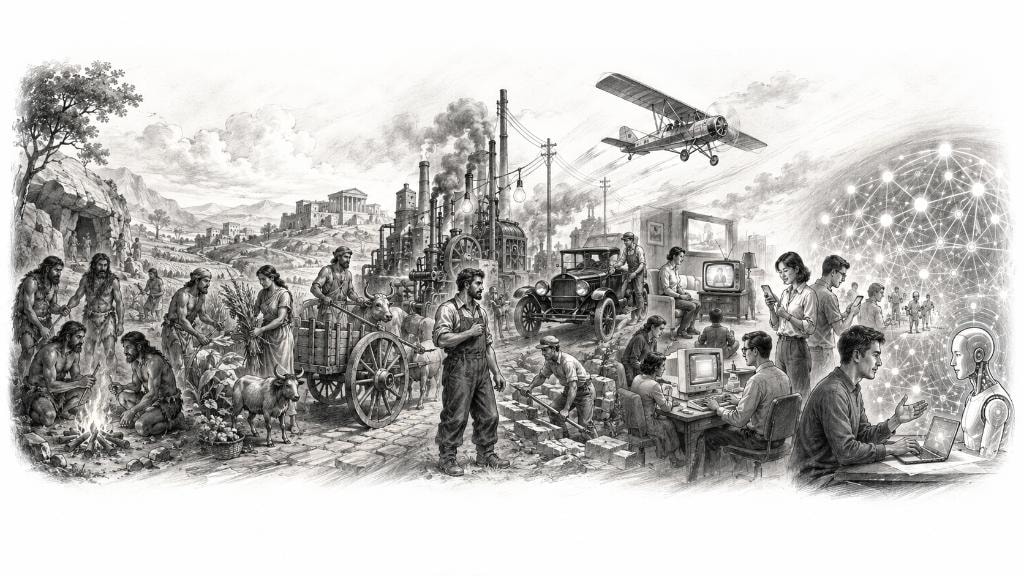
Artificial intelligence is part of a long pattern in which technology changes the value of human effort. Fire, domestication, the wheel, electricity, automobiles, airplanes, television, the internet and smartphones each reduced demand for certain tasks while creating new industries, skills and forms of coordination. History does not prove that AI will create enough good jobs for everyone it displaces. It shows that technology usually reorganizes work rather than simply eliminating the human need to contribute.
The behavioral puzzle
Why do humans repeatedly create technologies that reduce the need for human labor, even when those technologies threaten established livelihoods?
Two competing hypotheses help organize the question.
Hypothesis 1: Technology replaces human labor
Under this hypothesis, people adopt tools because tools perform valuable tasks with fewer workers. Employers and households gain productivity, but displaced workers lose bargaining power, income, and social status.
This hypothesis predicts that occupations containing routine, measurable, and repeatable tasks will shrink after an effective substitute appears. Employment losses should be concentrated among workers whose skills are closely tied to the displaced task.
Hypothesis 2: Technology reorganizes labor and expands demand
Under this hypothesis, productivity lowers costs, increases output, creates complementary services, and makes previously expensive products available to more people. Some tasks disappear, but new occupations emerge in design, production, maintenance, distribution, regulation, training, and complementary services.
This hypothesis predicts occupational turnover rather than the permanent disappearance of work. The composition of employment changes, even when total employment eventually grows.
Both hypotheses can be correct at the same time. One describes displacement. The other describes adaptation and expansion. The difficult questions concern timing, distribution, and who bears the cost while the economy reorganizes.
Fire: technology before employment
The controlled use of fire was among humanity's earliest transformative technologies. It provided warmth, protection, light, landscape management, and a means of cooking food.
Fire did not eliminate "jobs" in the modern sense because wage labor and formal occupations did not yet exist. It changed the allocation of effort.
Cooking reduced some of the physical and digestive costs of consuming food. Campfires extended social activity beyond daylight. Burning vegetation could alter landscapes and affect the availability of plants and game. Fire management also created new responsibilities: collecting fuel, maintaining embers, guarding camps, processing food, and coordinating activity around a shared resource.
The important pattern begins here. A technology rarely removes effort altogether. It changes where effort is spent.
Fire may have reduced time devoted to chewing, digestion, cold exposure, or predator avoidance while increasing the value of food preparation, fuel collection, planning, and social coordination. The gain came through a reorganization of the human energy budget rather than the invention of leisure without obligations.
Domestication: from searching for food to managing production
Plant and animal domestication came before the wheel and marked a deeper transformation of human work.
Foragers generally depended on mobile knowledge: where resources were located, when they became available, and how they could be acquired. Farming and herding shifted effort toward land clearance, planting, irrigation, storage, animal management, defense, and the maintenance of permanent settlements.
Domestication did not necessarily make life easier. Early agricultural populations often faced heavier workloads, narrower diets, infectious disease, crop failure, and stronger inequalities. Yet farming could support larger and denser populations. Surplus production also allowed more people to specialize in activities other than food procurement.
Potters, builders, administrators, soldiers, traders, priests, metalworkers, and other specialists became possible at greater scale because fewer people, proportionally, could produce the food required to sustain a settlement.
In this era, the phrase "new jobs" needs care. The shift concerned subsistence roles, obligations, and divisions of labor rather than modern occupations. Still, the underlying mechanism is familiar: greater productivity in one domain permitted labor specialization elsewhere.
The wheel: reducing transport costs, expanding networks
The wheel did not simply replace people who carried goods. Its major effect came from lowering the cost of moving weight across suitable terrain.
Wheeled carts increased the amount that people or draft animals could transport. This reduced demand for some forms of manual carrying, but it increased the value of road construction, carpentry, wheel making, vehicle repair, animal breeding, trade, storage, logistics, and territorial administration.
Lower transport costs also expanded the geographic range over which exchange could occur. Larger trade networks created opportunities that would not have existed in a world where every object had to be carried by hand.
This is a recurring feature of general-purpose technologies. Their employment effects extend far beyond the task they initially automate. The wheel changed settlement patterns, warfare, markets, and political control because it altered the economics of distance.
Electricity: an infrastructure for other inventions
Electricity differed from a single-purpose machine. It became an enabling system.
Factories no longer needed to organize every machine around a central steam-powered shaft. Workplaces could be redesigned around electric motors. Lighting extended production and commercial activity beyond daylight. Electrical networks supported telephones, refrigeration, household appliances, elevators, broadcasting, computing, and eventually digital communications.
The transition was gradual because organizations had to redesign factories and processes before electricity produced its full productivity gains. This remains relevant to AI. Installing a new technology does not automatically reorganize a workplace. Firms must change workflows, responsibilities, controls, training, and incentives before meaningful gains appear.
Automobiles: destruction around the horse, expansion around the road
The automobile provides one of the clearest examples of technological displacement and creation.
Motor vehicles reduced demand for horse-drawn transportation and affected stable workers, carriage makers, blacksmiths, feed suppliers, and other occupations connected to the horse economy. Historical United States labor data show a sharp shift from horse-drawn to motorized transport during the early twentieth century, alongside falling employment in livery-stable work and rapid growth in trucks and road transportation.
At the same time, automobiles created or expanded work in vehicle manufacturing, steel, glass, rubber, petroleum, road construction, dealerships, financing, insurance, repair, trucking, motels, restaurants, suburban construction, traffic management, and emergency services.
The automobile industry became one of the largest manufacturing sectors in the United States by the 1920s.
The result was larger than a substitution of engines for horses. The automobile reorganized cities, retail, housing, courtship, migration, leisure, policing, and access to employment.
Yet the gains were uneven. Communities built around older transportation systems lost income. Road construction divided neighborhoods. Traffic deaths and pollution imposed substantial costs. Technological expansion created work, but it did not distribute benefits or harms automatically.
Airplanes: shrinking distance, enlarging coordination
Aircraft displaced portions of long-distance rail and ocean travel, especially for passengers, mail, military operations, and high-value cargo.
They also created pilots, flight crews, mechanics, airport workers, air-traffic controllers, aircraft engineers, security personnel, reservation systems, aerospace manufacturers, tourism services, global logistics networks, and international business operations.
Air travel made some existing work less valuable while increasing the return to other forms of coordination. A meeting, shipment, repair part, specialist, or tourist could cross a continent or ocean in hours rather than days or weeks.
The employment effect therefore spread through other industries. Hotels, conferences, multinational companies, time-sensitive manufacturing, and international tourism all developed around the reduced cost of long-distance movement.
As with the wheel, the main economic change was a reduction in friction. When distance became less costly, people reorganized production and relationships around the new possibility.
Television: fewer local stages, larger shared audiences
Television altered entertainment, advertising, politics, news, sports, and household routines.
It competed with radio, cinema, newspapers, theaters, and live entertainment for attention and advertising revenue. Some local entertainment and media jobs declined as audiences concentrated around national broadcasters.
Television simultaneously created work in broadcasting, production, acting, writing, advertising, audience measurement, electronics manufacturing, cable distribution, sports rights, set design, journalism, and later satellite and subscription services.
Television demonstrates why job counts alone are insufficient. A technology may increase total media employment while narrowing the number of institutions that control distribution. It can create creative work while concentrating status, revenue, and influence among a smaller group of highly visible performers and companies.
The internet: removing intermediaries and creating platforms
The internet reduced the cost of publishing, communication, search, coordination, and distribution.
It weakened business models built around controlling access to information. Classified advertising, print directories, travel booking, music distribution, physical retail, newspaper circulation, and many clerical processes were disrupted.
The internet also produced web developers, search marketers, cybersecurity specialists, online merchants, digital creators, cloud architects, user-experience designers, data analysts, platform moderators, social-media managers, delivery networks, and entire categories of software and online services that had barely existed before.
Historical labor research does not support the claim that digital automation produced uniform job destruction across entire economies. Across 21 countries, employment grew over the period studied, although jobs at high risk of automation grew much more slowly than lower-risk jobs (Autor, 2015).
That qualification is essential. Aggregate employment can grow while routine occupations lose wages, security, and bargaining power. Digital change has often contributed to labor-market polarization, with growth in highly skilled work and lower-paid service work while some middle-income routine roles contract.
Smartphones: placing the market in the pocket
The smartphone combined telephone, camera, map, newspaper, music player, television, computer, payment device, marketplace, and social network.
It weakened demand for several standalone products and the jobs associated with producing or distributing them. Cameras, navigation devices, printed maps, physical music media, pay phones, and portions of retail banking were absorbed into a general-purpose device.
The smartphone also created application developers, mobile advertisers, content creators, ride-share drivers, delivery workers, mobile-payment services, device repair businesses, platform-based marketplaces, influencers, and an enormous data economy.
Some of these new opportunities came with weaker employment protections. A platform may create income-generating activity without creating stable employment, benefits, predictable hours, or meaningful bargaining power.
This is another reason the claim that "technology creates jobs" needs refinement. The quality of the replacement work matters. A new occupation may offer greater autonomy and income, or it may transfer risk from the company to the worker.
Artificial intelligence: automating parts of cognition
Artificial intelligence differs from many earlier machines because it can operate on language, images, patterns, predictions, and decisions.
Earlier automation concentrated heavily on physical labor and routine information processing. Generative AI can assist with writing, coding, design, analysis, translation, customer service, documentation, research, and administrative work. This places some professional and creative occupations inside the automation debate.
The International Labour Organization estimated in 2025 that roughly one in four jobs worldwide has some exposure to generative AI, with its analysis emphasizing transformation over complete replacement and clerical occupations facing the highest exposure (Gmyrek et al., 2025).
Exposure does not mean that one-quarter of jobs will disappear. Jobs are collections of tasks. Artificial intelligence may perform some tasks, accelerate others, and leave the remaining work dependent on human judgment, physical presence, accountability, trust, negotiation, or institutional authority.
Early workplace evidence supports this task-level view. In a randomized study involving thousands of knowledge workers, access to generative AI reduced time spent on email and modestly accelerated document work, while activities requiring organizational coordination, such as meetings, changed far less (Dillon et al., 2025).
That suggests a likely near-term pattern: AI will first alter tasks that individuals can change independently. Larger organizational effects will depend on whether companies redesign workflows, decision rights, quality controls, and staffing models.
| Technological transition | Approximate period | Work placed under pressure | Work or systems expanded |
|---|---|---|---|
| Controlled fire | Deep prehistory | Some effort devoted to raw-food processing, cold protection and predator avoidance | Fuel collection, cooking, camp maintenance and expanded social coordination |
| Plant and animal domestication | Beginning roughly 12,000 years ago | Mobile foraging as the dominant subsistence strategy | Farming, herding, storage, construction, administration and occupational specialization |
| Wheel and wheeled transport | Fourth millennium BCE | Some manual carrying and limited-distance transport | Cart production, roads, animal management, trade, storage and logistics |
| Electricity | 19th–20th centuries | Older lighting, power transmission and manual processes | Utilities, electrical engineering, appliances, communications and redesigned factories |
| Automobile | Late 19th–20th centuries | Horse transport, carriage work, stables and related supply chains | Vehicle production, roads, repair, petroleum, insurance, trucking and suburban services |
| Airplane | 20th century | Portions of long-distance rail, ocean passenger travel and mail delivery | Aviation, airports, aerospace, tourism, air cargo and global business coordination |
| Television | Mid-20th century onward | Portions of radio, theater, cinema and print advertising | Broadcasting, production, advertising, electronics, cable and national entertainment markets |
| Internet | Late 20th century onward | Print directories, classified advertising, physical distribution and some intermediaries | Software, e-commerce, cloud services, cybersecurity, digital media and platform businesses |
| Smartphone | 21st century | Standalone cameras, maps, music players, pay phones and some physical services | Applications, mobile commerce, content creation, delivery platforms and mobile payments |
| Artificial intelligence | Current transition | Routine elements of writing, coding, analysis, administration and customer service | AI implementation, governance, evaluation, workflow design, data operations and human oversight |
Why artificial intelligence may be different
Historical analogy is useful, but it cannot settle the future.
Fire, domestication, wheels, electricity, automobiles, airplanes, television, the internet, and smartphones each changed human work. Their transitions often unfolded over decades or centuries. Artificial intelligence software can diffuse globally at much greater speed.
Artificial intelligence resembles earlier industrial technologies because it can reduce the labor required for certain tasks and create demand for complementary skills. It differs in speed and scope: software can spread globally, operate across industries and affect cognitive as well as physical or clerical work.
AI may also affect several sectors simultaneously. A single system can assist an insurer, hospital, law firm, retailer, school, marketing department, software company, and government agency. Workers may therefore have less time to move from a declining occupation into an expanding one.
There is another difference. Many past technologies increased demand for educated cognitive labor while replacing physical or routine clerical work. AI can now perform portions of the work that education was supposed to protect.
The Organisation for Economic Co-operation and Development has found that occupations at high risk of automation account for a substantial share of employment, but has also reported no clear economy-wide collapse in labor demand attributable to AI so far (OECD, 2023). The absence of a collapse today does not prove that one cannot occur. It shows that adoption, organizational redesign, regulation, customer acceptance, and technical reliability constrain the pace of substitution.
Technological survival does not simply reward the strongest worker or largest organization, just as survival of the fittest does not mean survival of the strongest.
An evolutionary interpretation
Humans are cumulative cultural learners. We inherit techniques, modify them, and transmit improved versions to others. This allows knowledge to accumulate beyond the inventive capacity of any one person. Biological change through natural selection and cultural change through learning operate at very different speeds, even though both depend on variation and differential persistence.
Technologies spread when they improve outcomes under local constraints: less effort, more food, greater speed, lower cost, higher status, stronger military capacity, better coordination, or access to larger markets. This pattern becomes clearer when we examine how evolutionary thinking explains human behavior through incentives, constraints, learning, and conditional responses.
They also spread through competition. A company may adopt AI because the system is excellent. It may also adopt AI because competitors are using it, investors expect it, or executives fear appearing slow. Similar incentives affected earlier technologies. Adoption is shaped by prestige, imitation, coalition, regulation, and institutional pressure alongside technical usefulness.
Human production has always depended on social relationships as well as tools. Among the Conambo studied by John Q. Patton, even valuable material transfers such as meat sharing were embedded in kinship, reciprocity, status, and political alliances rather than governed by calories alone (Patton, 2005). Modern workplaces are more complex, but the principle survives: people exchange resources, information, protection, reputation, and trust inside social systems.
The consequences of a technology depend on ecology, institutions, and incentives, which is why context changes human behavior rather than merely revealing a fixed human response.
Artificial intelligence can generate an answer. It cannot independently carry legal responsibility, maintain a long-term reputation, absorb moral blame, negotiate legitimacy, or decide which institutional risks a community should accept. This is also why automation does not remove humans from the tribe: high-stakes systems still require responsibility, legitimacy, trust, and someone who can be held accountable. Humans will continue to assign those responsibilities through social and political arrangements.
Evidence, interpretation and speculation
Evidence
Past technologies repeatedly displaced specific tasks and occupations. Past technologies also created complementary industries and reduced costs in ways that expanded demand. The overall number of jobs has historically proved more resilient than predictions of permanent technological unemployment, although occupational disruption and wage losses have been substantial. Current research suggests that generative AI is more likely to transform many jobs than fully automate them in the near term.
Interpretation
AI will probably follow the historical pattern of simultaneous substitution and creation. Routine cognitive tasks will face the greatest immediate pressure. Work involving physical environments, trust, persuasion, accountability, care, leadership, and ambiguous judgment will be harder to remove completely. The central labor-market challenge will concern transition rather than the theoretical existence of future work. New jobs may appear in different industries, cities, or skill categories than the jobs that disappear.
Why does technology eliminate some jobs but create others? Technology substitutes for some tasks, lowers production costs, and expands what organizations can produce. Lower costs can increase demand, while new systems require design, maintenance, distribution, oversight, and complementary services. Job losses and job creation therefore occur together, but often in different places and at different times.
Speculation
AI may eventually create entirely new forms of work that are difficult to name today, just as early internet users could not easily have predicted app developers, social-media strategists, cloud-security engineers, or full-time digital creators. It is also possible that AI will create fewer complementary jobs per displaced worker than earlier technologies. Software can scale with relatively little labor. A small team may serve millions of users. History gives us competing precedents, not a guarantee.
What would change my mind?
- Clear evidence that AI-exposed economies experience sustained net employment declines rather than occupational reallocation.
- Evidence that new AI-related industries create far fewer jobs than the occupations they displace, even after adjustment periods.
- Data showing that human review adds no measurable value in high-stakes decisions involving accountability, trust, or ambiguous judgment.
- Long-term wage and mobility data showing that displaced workers consistently transition into equally secure and well-paid work without policy support.
- Evidence that AI productivity gains are broadly shared rather than concentrated among owners of capital, infrastructure, and proprietary data.
Key takeaways
- Fire and domestication reorganized human effort before modern employment existed.
- The wheel, electricity, automobiles, airplanes, television, the internet, and smartphones displaced established tasks while creating complementary industries.
- Historical job creation occurred at the economy-wide level, but individual workers and communities often suffered lasting losses.
- Artificial intelligence reaches further into cognitive and professional work than many earlier forms of automation.
- Current evidence supports widespread job transformation more strongly than immediate mass replacement.
- The outcome will depend on organizational design, labor institutions, education, competition, regulation, and who retains responsibility for consequential decisions.
What we still do not know
We do not yet know whether AI will resemble electricity, which enabled large complementary industries, or a highly scalable software system that allows a small number of firms and workers to produce most of the value.
We do not know how quickly new occupations will emerge, whether they will offer comparable wages, or whether mid-career workers will be able to move into them.
We also do not know whether societies will use AI productivity to reduce drudgery or primarily to reduce labor costs.
History supports a measured conclusion. Humans have repeatedly survived technological disruption by reorganizing work. Survival, however, is an aggregate description. It says little about which people paid the price, how long the transition lasted, or whether the gains were shared fairly.
Artificial intelligence will create new work. It will also remove tasks, weaken some occupations, and redistribute status and bargaining power. The important question is how deliberately we manage that transition.
References and further reading
Autor, D. H. (2015). Why are there still so many jobs? The history and future of workplace automation. Journal of Economic Perspectives, 29(3), 3–30. https://doi.org/10.1257/jep.29.3.3
Autor, D. H., Levy, F., & Murnane, R. J. (2003). The skill content of recent technological change: An empirical exploration. Quarterly Journal of Economics, 118(4), 1279–1333. https://doi.org/10.1162/003355303322552801
Bessen, J. E. (2015). Learning by doing: The real connection between innovation, wages, and wealth. Yale University Press.
Dillon, E. W., Jaffe, S., Immorlica, N., & Stanton, C. T. (2025). Shifting work patterns with generative AI. Working paper.
Foley, R. (1995). The adaptive legacy of human evolution: A search for the environment of evolutionary adaptedness. Evolutionary Anthropology, 4(6), 194–203.
Gmyrek, P., Berg, J., Kamiński, K., Konopczyński, F., Ładna, A., Nafradi, B., Rosłaniec, K., & Troszyński, M. (2025). Generative AI and jobs: A refined global index of occupational exposure. International Labour Organization. https://www.ilo.org/publications/generative-ai-and-jobs-refined-global-index-occupational-exposure
Organisation for Economic Co-operation and Development. (2023). OECD Employment Outlook 2023: Artificial intelligence and the labour market. OECD Publishing. https://doi.org/10.1787/08785bba-en
Patton, J. Q. (2005). Meat sharing for coalitional support. Evolution and Human Behavior, 26(2), 137–157. https://doi.org/10.1016/j.evolhumbehav.2004.08.008
Wyatt, I. D., & Hecker, D. E. (2006). Occupational changes during the 20th century. Monthly Labor Review, 129(3), 35–57. https://www.bls.gov/opub/mlr/2006/03/art3full.pdf
Written by Farzin Espahani
Editor in Chief, The Hominid Post
Farzin Espahani writes about human behavioral ecology, evolutionary anthropology, cooperation and the institutions humans build around biological and social risk.