Does Morality Have an Aesthetic Preference?
Perceived beauty predicts how much moral standing people grant an animal, even after danger and intelligence are accounted for. That finding raises a harder question about how humans build moral categories in the first place.
Does Morality Have an Aesthetic Preference?
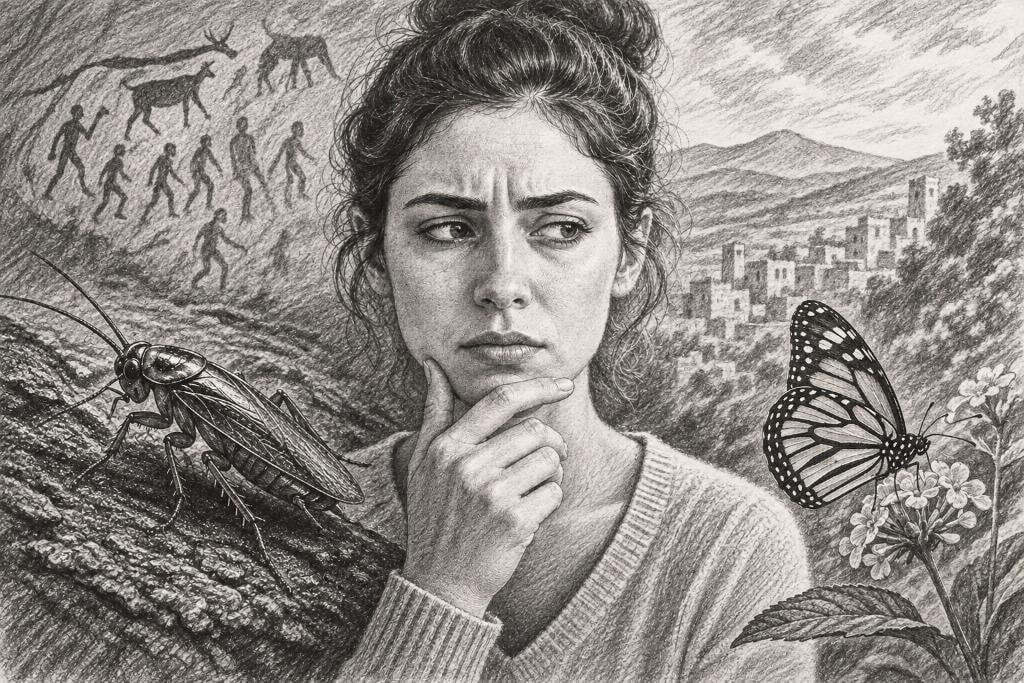
Two insects land on your kitchen counter. One is a cockroach. You crush it, and nobody objects; someone may thank you. The other is a butterfly. You crush it with the same motion, and the room turns on you. Both animals are insects, both were alive, and both were killed the same way. One had already entered the category of pest and the other the category of beautiful living thing before anyone made a moral argument.
Part of the difference is practical. Cockroaches contaminate food and butterflies do not. But experimental work suggests that beauty on its own shifts the moral standing people assign to animals, even when harmfulness and mental capacity are held constant. That gives us a behavioral puzzle: to what extent does human morality follow aesthetics?
The answer is unlikely to be a simple instinct that beautiful things are good. Moral judgment appears to be assembled from older systems for evaluating the world: attraction and aversion, danger and safety, usefulness and cost, familiarity and strangeness, alliance and hostility. Beauty is one input into that machinery. Tracing how it got there takes us through Nietzsche, the psychology of disgust, meat sharing in the Ecuadorian Amazon, and conservation budgets.
Nietzsche’s question: where did the value come from?
Friedrich Nietzsche is a useful starting point because he refused to treat moral categories as self-explanatory. Rather than asking what is good, he pushed toward a genealogical question: how did particular things come to be called good? His mature work rejected the idea that moral values arrive from a neutral, universal standpoint. Moral systems have histories. They emerge from human valuation, social relationships, interests, psychological dispositions, and struggles over what deserves admiration or contempt (Nietzsche, 1887/1998).
Aesthetics runs through the same work, from The Birth of Tragedy through The Gay Science and Twilight of the Idols. Nietzsche repeatedly tied valuation to perspective rather than assuming that humans encounter a world already sorted into beautiful and ugly, noble and contemptible, good and evil (Nietzsche, 1882/1974).
Some care is needed here. Nietzsche did not argue that people spare butterflies because they are beautiful, and using him that way would turn a philosophical method into a quotation machine. His contribution to this puzzle is the method itself. When a society treats one act of killing as trivial and another as troubling, he directs us to investigate the history and psychology behind those valuations instead of accepting the categories as given.
The word cockroach already carries a charge before any moral argument starts. Evolution supplies one layer of the reason.
Before morality, there was survival
Natural selection does not require an organism to understand microbiology before avoiding something dangerous. For most of human evolutionary history, pathogens were invisible, but their consequences were not. Rotting food, feces, bodily fluids, infected wounds, parasites, and decomposing organisms carried real costs. Individuals who recognized cues associated with contamination and avoided them gained a survival advantage.
One proposed mechanism is the behavioral immune system: a set of psychological processes that detect possible pathogen threats and motivate avoidance before infection occurs (Schaller & Park, 2011). Disgust sits at the center of this account. Valerie Curtis and colleagues argued that disgust is an adaptive system for disease avoidance, tuned to environmental information about infection risk (Curtis, Aunger, & Rabie, 2004; Curtis, de Barra, & Aunger, 2011).
Cockroaches are tightly associated with the environments this system flags: refuse, spoiled food, sewage, dark crevices, and contaminated surfaces. Their sudden movement adds another aversive cue. The butterfly arrives with the opposite package: flowers, daylight, color, symmetry, slow movement, and nothing that signals harm.
From the standpoint of immediate survival, these two animals never enter perception on equal terms. Before anyone consciously asks what ethical obligations they owe an organism, older perceptual and emotional systems have sorted the situation into approach or avoid, safe or dangerous, useful or contaminated.
Competing hypotheses
Hypothesis 1: Adaptive threat valuation. People respond differently to cockroaches and butterflies because the animals imply different costs and benefits. Disease risk, contamination, and threat produce aversion, and moral tolerance for killing follows from that aversion. Prediction: any apparent beauty effect should disappear once harmfulness and threat are statistically controlled.
Hypothesis 2: Aesthetic moral valuation. People grant greater moral standing to organisms they perceive as beautiful, independent of danger, usefulness, intelligence, or similarity to humans. Prediction: the beauty effect survives those controls, and experimentally manipulating perceived beauty shifts moral standing on its own.
Hypothesis 3: Cultural classification. Much of the difference is learned. Cultures teach that butterflies stand for beauty and transformation while cockroaches stand for dirt and infestation. Prediction: the size of the beauty effect varies substantially across cultures, and it appears in children only after exposure to the relevant categories.
These hypotheses are not mutually exclusive. The scientific problem is estimating how much each contributes. As the next sections show, the first two have been tested directly. The third has not.
Disgust can leak into morality
The survival account becomes more interesting because disgust does not stay confined to pathogen avoidance. In experiments reported by Schnall and colleagues, participants exposed to disgust-inducing conditions, such as a foul smell or a dirty workspace, judged unrelated moral violations more harshly (Schnall, Haidt, Clore, & Jordan, 2008).
This finding needs a caveat that early coverage rarely included. A 2015 meta-analysis found the effect of incidental disgust on moral judgment to be small and probably inflated by publication bias (Landy & Goodwin, 2015), and a large preregistered replication of the cleanliness studies did not reproduce the original results (Johnson et al., 2016). Evolutionary researchers also warn against treating moral disgust as pathogen disgust transferred wholesale into ethics.
The defensible conclusion is narrower than the headline version but still important. A psychological system built to answer the question of whether to touch something can nudge judgments that feel closer to whether something is wrong, at least at the margins. If aversion can acquire moral meaning, the cockroach problem starts to make sense. An organism associated with contamination generates avoidance first. Culture then supplies a label, such as filthy, vermin, or pest, that makes destruction seem permissible. The emotional reaction arrives quickly, and the justification arrives afterward.
Beauty enters the moral calculation
The butterfly side of the puzzle has better direct evidence. In a 2021 study in the Journal of Environmental Psychology, Christoph Klebl and colleagues tested whether perceived beauty influences the moral standing people assign to animals (Klebl, Greenaway, Rhee, & Bastian, 2021). Across a wide range of species, perceived beauty predicted moral standing even after accounting for perceived mental capacities and harmfulness. In a preregistered second study, experimentally manipulating perceived beauty shifted moral-standing judgments independently of similarity to humans, familiarity, and edibility.
That pattern is what Hypothesis 2 predicts and what Hypothesis 1 predicts should not happen. One limitation belongs in the same paragraph: the participants were Western online samples. Whether the effect is this strong outside such populations is an open question, and it is the test Hypothesis 3 requires.
The effect is visible outside the laboratory. A study of more than 10,000 participants in a zoo species-adoption program found that people overwhelmingly chose charismatic animals, and that endangered status had little influence on their choices (Colléony, Clayton, Couvet, Saint Jalme, & Prévot, 2017). An analysis of European Union conservation funding found that animals received far more money than plants, and that among plants, traits including flower color were associated with funding independent of extinction risk (Adamo et al., 2022).
Aesthetic preference, in other words, helps decide which living things attract attention, sympathy, and money. Morality appears to carry an aesthetic bias. Aesthetics, though, is only one of several systems feeding the judgment.
Value depends on relationships: meat sharing in Conambo
John Q. Patton’s research in Conambo, a community of Achuar and Quichua households in the Ecuadorian Amazon, offers a case from a different domain that clarifies the underlying mechanism (Patton, 2005).
Patton studied meat sharing. Giving away valuable food imposes a cost, so the question is what compensating benefit makes it worthwhile. Earlier researchers had proposed kin selection, reciprocal altruism, tolerated theft, and costly signaling. Patton’s data showed that no single mechanism explained the transfers. Kinship mattered, reciprocity mattered, and political alliance mattered as well: men gave more meat to households whose male heads were more likely to support them in conflicts. Meat, he argued, functioned partly as a tool for recruiting and holding allies.
The relevance to the butterfly is that the meat itself had no fixed social meaning. The same piece of meat could be food, a gift to kin, repayment, reputation, political investment, and a signal of alliance at once. Its value depended on relationships and context. Human moral judgments appear to work the same way. We rarely evaluate an organism, or another person, from biological facts alone. We evaluate a bundle of relational cues: kin or stranger, ally or competitor, useful or costly, beautiful or repulsive. Patton’s explicit warning against single-cause explanations of sharing applies with equal force to explanations of moral standing.
Morality built from older valuation systems
This suggests a broader interpretation. Human morality depends in part on psychological systems that evolved for problems that were never moral in the philosophical sense. Kin recognition organized investment. Reciprocity stabilized cooperation. Coalition tracking distinguished reliable partners from unreliable ones. Threat detection avoided predators and hostile individuals. Disgust reduced pathogen exposure. Mate-choice systems governed attraction. Status psychology managed hierarchy and reputation. Cultural learning let communities transmit rules about which behaviors, organisms, foods, and people deserved which response.
None of these systems is morality on its own. Together they supply much of the machinery from which moral intuitions are built.
This reading fits human behavioral ecology because it predicts conditional morality rather than a rigid ancestral program. Patton’s work shows exactly that conditionality: where alliances are unstable and politically consequential, meat acquires more value as a coalitional resource. Robert Foley makes the same methodological point about human evolution generally. There was no single environment of evolutionary adaptedness; ancestral environments varied enormously across time and place, and contemporary behavior cannot be read as the execution of one Pleistocene script (Foley, 1996). Moral psychology should be expected to be flexible. The cockroach does not trigger a cockroach-killing gene. People perceive a bundle of cues, run them through evolved and learned valuation systems, and produce a response.
Culture teaches what deserves affection
Biology alone cannot explain why butterflies symbolize transformation, why doves symbolize peace, why snakes represent evil in one tradition and sacred power in another, or why some societies eat animals that others treat as family. Cultural evolution reshapes the valuation landscape. Humans learn from parents, peers, institutions, religion, stories, and advertising, and once a classification becomes culturally stable, children inherit it without having to rediscover its ecological origin.
The distinctions can be biologically thin and culturally enormous. The brown rat in the alley is vermin. The fancy rat in the cage, which is the same species, has a name and a veterinarian.
Once culture attaches a symbol to an organism, the symbol feeds back into emotion. Avoidance becomes disgust, disgust becomes contempt, and contempt makes destruction easier to tolerate. The reverse happens with beauty: attraction becomes admiration, admiration encourages protection, and protection acquires moral language.
Evidence, interpretation, speculation
Evidence. Disgust has substantial support as part of a pathogen-avoidance system. Conservation preferences and funding show measurable biases toward charismatic and aesthetically appealing organisms. Experimental evidence, so far from Western samples, indicates that perceived beauty independently raises the moral standing assigned to animals. Patton’s research shows that a single cooperative behavior can simultaneously reflect kinship, reciprocity, alliance, and status.
Interpretation. Moral judgment probably draws on several older valuation systems rather than operating as an isolated faculty. Beauty, disgust, threat, kinship, reciprocity, and cultural classification can all influence what eventually feels right or wrong. The effect of incidental disgust on moral judgment is real but smaller than early studies suggested.
Speculation. The butterfly and the cockroach may be a small demonstration of a much larger tendency: humans may routinely mistake the emotional output of their valuation systems for an objective property of the thing being judged. That claim needs testing rather than acceptance.
Nietzsche’s question survives the biology
Evolutionary anthropology does not prove Nietzsche right. It gives his question mechanisms. When people call something good, evil, noble, disgusting, or worthy, the valuation sometimes has an excellent functional reason, such as killing an insect that is contaminating food. Sometimes it has a social reason, such as protecting a cooperative partner. Sometimes it has a cultural reason, since we inherit categories from the generations before us. And sometimes, the difference is partly that one creature is beautiful and another is ugly.
The risk begins when these mechanisms become invisible, because aesthetic bias does not stop at butterflies. Humans evaluate other humans by face, body, accent, clothing, disability, age, and group membership, and the effects are documented. A meta-analysis of attractiveness research found that physically attractive people are judged more favorably and treated better across a wide range of settings, including evaluations of competence and character (Langlois et al., 2000). The same mechanism that spares the butterfly shapes who gets hired, believed, and forgiven.
Explaining a bias evolutionarily does not justify it. Understanding why a judgment occurs and deciding whether it is defensible are separate problems. Natural selection can help explain our intuitions. It cannot tell us which intuitions to obey. If morality does carry an aesthetic preference, the useful question is whether we can tell when beauty has already decided who, or what, deserves our concern, and whether we are willing to overrule it.
What would change my mind?
- Evidence that perceived beauty has no independent effect on moral standing once threat, usefulness, sentience, familiarity, and cultural learning are adequately controlled.
- Cross-cultural evidence that aesthetic preference and moral valuation are largely unrelated outside contemporary Western populations.
- Developmental evidence that the beauty effect is present before children could have learned the relevant cultural categories, which would weaken Hypothesis 3, or absent until well after, which would weaken Hypothesis 2.
- Evidence that disgust and attraction operate independently of moral judgment rather than contributing to it.
- Models showing that butterfly-versus-cockroach judgments can be explained almost entirely by rational assessments of ecological costs and benefits.
Key takeaways
- People do not encounter organisms as morally neutral categories. Perception already carries information about threat, contamination, usefulness, familiarity, and attractiveness.
- Disgust has deep evolutionary connections to pathogen avoidance, but its influence on moral judgment is smaller and less reliable than early experiments suggested.
- Experimental evidence, currently from Western samples, shows that perceived beauty independently increases the moral standing assigned to animals.
- Patton’s meat-sharing research shows why single-cause explanations fail: one behavior can reflect reciprocity, kinship, status, and coalition management at the same time.
- Culture amplifies biological predispositions by turning organisms into pests, pets, sacred animals, or beautiful creatures.
- The same aesthetic bias measurably shapes judgments of people, which is where the practical stakes are highest.
- An evolutionary explanation of a moral intuition says nothing about whether the intuition is correct.
References & Further Reading
- Adamo, M., Sousa, R., Wipf, S., Correia, R. A., Lumia, A., Mucciarelli, M., & Mammola, S. (2022). Dimension and impact of biases in funding for species and habitat conservation. Biological Conservation, 272, 109636.
- Colléony, A., Clayton, S., Couvet, D., Saint Jalme, M., & Prévot, A.-C. (2017). Human preferences for species conservation: Animal charisma trumps endangered status. Biological Conservation, 206, 263–269.
- Curtis, V., Aunger, R., & Rabie, T. (2004). Evidence that disgust evolved to protect from risk of disease. Proceedings of the Royal Society B, 271(Suppl. 4), S131–S133.
- Curtis, V., de Barra, M., & Aunger, R. (2011). Disgust as an adaptive system for disease avoidance behaviour. Philosophical Transactions of the Royal Society B, 366(1563), 389–401.
- Foley, R. (1996). The adaptive legacy of human evolution: A search for the environment of evolutionary adaptedness. Evolutionary Anthropology, 4(6), 194–203.
- Johnson, D. J., Wortman, J., Cheung, F., Hein, M., Lucas, R. E., Donnellan, M. B., Ebersole, C. R., & Narr, R. K. (2016). The effects of disgust on moral judgments: Testing moderators. Social Psychological and Personality Science, 7(7), 640–647.
- Klebl, C., Greenaway, K. H., Rhee, J. J., & Bastian, B. (2021). Beauty of the beast: Beauty as an important dimension in the moral standing of animals. Journal of Environmental Psychology, 75, 101624.
- Landy, J. F., & Goodwin, G. P. (2015). Does incidental disgust amplify moral judgment? A meta-analytic review of experimental evidence. Perspectives on Psychological Science, 10(4), 518–536.
- Langlois, J. H., Kalakanis, L., Rubenstein, A. J., Larson, A., Hallam, M., & Smoot, M. (2000). Maxims or myths of beauty? A meta-analytic and theoretical review. Psychological Bulletin, 126(3), 390–423.
- Nietzsche, F. (1998). On the genealogy of morality (M. Clark & A. J. Swensen, Trans.). Hackett Publishing. (Original work published 1887)
- Nietzsche, F. (1974). The gay science (W. Kaufmann, Trans.). Vintage Books. (Original work published 1882)
- Patton, J. Q. (2005). Meat sharing for coalitional support. Evolution and Human Behavior, 26(2), 137–157.
- Schaller, M., & Park, J. H. (2011). The behavioral immune system (and why it matters). Current Directions in Psychological Science, 20(2), 99–103.
- Schnall, S., Haidt, J., Clore, G. L., & Jordan, A. H. (2008). Disgust as embodied moral judgment. Personality and Social Psychology Bulletin, 34(8), 1096–1109.
Written by Farzin Espahani
Editor in Chief, The Hominid Post
Farzin Espahani writes about human behavioral ecology, evolutionary anthropology, cooperation and the institutions humans build around biological and social risk.