Before Abraham: The Evolutionary Roots of Monotheism and Human Religion
How one god replaced many — and what evolutionary anthropology says about why it happened
Before Abraham: The Evolutionary Roots of Monotheism and Human Religion
Monotheism feels ancient. The idea of one god — singular, universal, morally demanding — sits at the foundation of Judaism, Christianity, and Islam, three traditions that together claim roughly half the world's population. It can feel like the natural endpoint of religious thought, the mature form that polytheism was always groping toward.
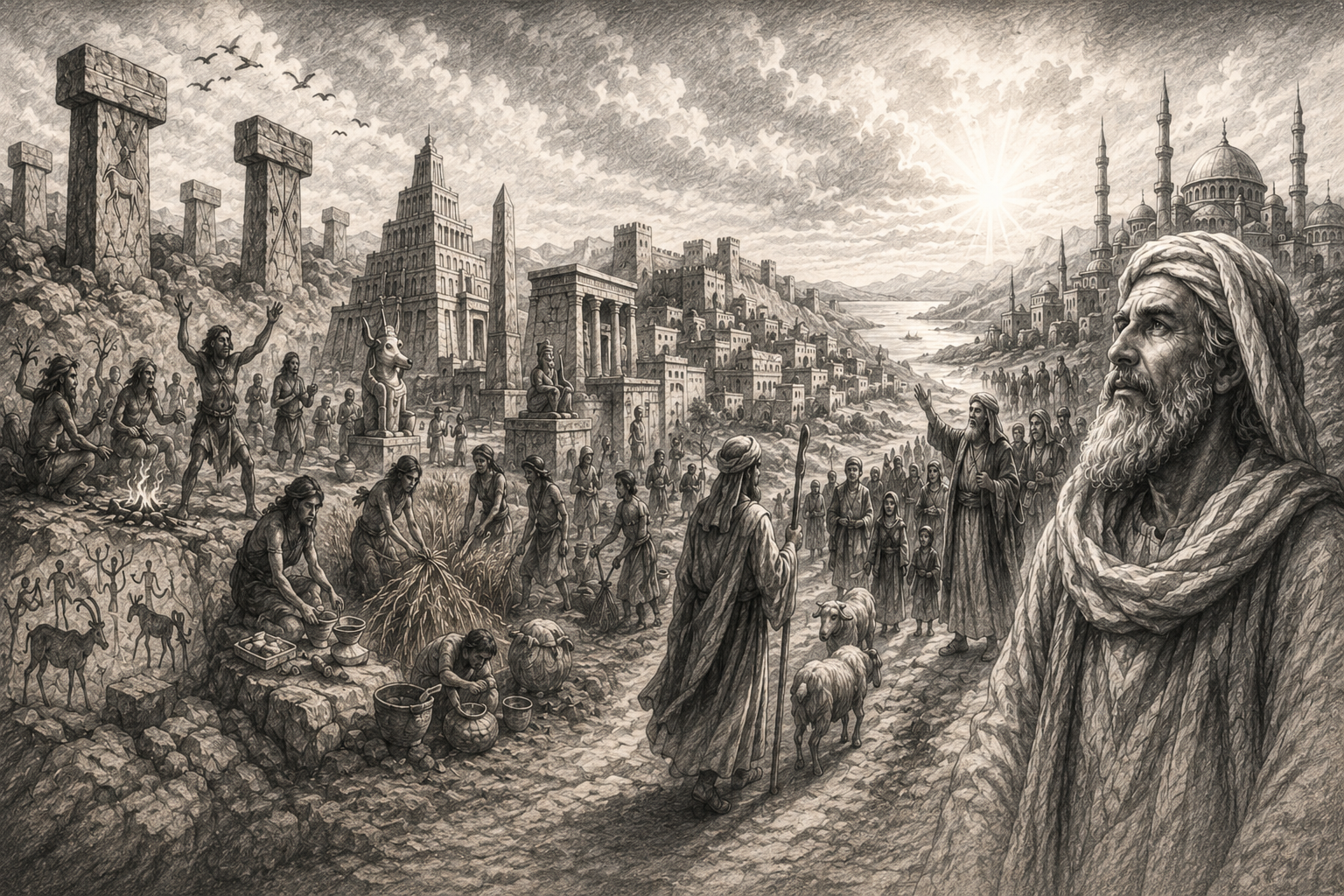
But that feeling is historically misleading. For most of human history, people did not worship one god. They worshipped many. They populated the world with spirits, ancestors, tricksters, sky gods, earth gods, and local deities tied to specific rivers, mountains, and harvests. The archaeological record, the ethnographic record, and the comparative study of religion all point in the same direction: monotheism is the exception, not the rule. It is a relatively recent development, and its emergence was not a theological discovery so much as a social and political transformation.
Understanding why monotheism emerged — and why it spread so successfully — requires stepping back from theology and asking an evolutionary question: what kind of religious beliefs help large groups of humans cooperate, compete, and survive?
What the Archaeological Record Actually Shows
The oldest evidence of religious behavior in the human lineage is not monotheistic. The burial practices of Neanderthals and early Homo sapiens, the cave paintings of Lascaux and Altamira, the carved figurines of the Upper Paleolithic — none of these suggest a single, universal, morally demanding deity. They suggest something more diffuse: a world saturated with agency, where animals, ancestors, and natural forces had intentions and could be appealed to, propitiated, or bargained with.
This is consistent with what anthropologists call animism — the attribution of mind, intention, and spiritual significance to non-human entities. Animism is not a primitive error. It is a predictable output of cognitive systems that evolved to detect agency in the environment. A brain that over-attributes agency — that hears a predator in every rustling bush — survives more often than one that under-attributes it. The cost of a false positive (unnecessary fear) is lower than the cost of a false negative (getting eaten). Natural selection, in this account, built us to be hyperactive agency detectors, and religion is partly what happens when that system runs on the full complexity of the human world. (Barrett, 2000; Guthrie, 1993).
Polytheism — the worship of multiple gods with distinct domains, personalities, and interests — appears to be the dominant religious form in complex pre-modern societies. The pantheons of ancient Mesopotamia, Egypt, Greece, Rome, India, and Mesoamerica all share a basic structure: a world governed by multiple divine powers, often in conflict with each other, whose favor must be cultivated through ritual, sacrifice, and correct behavior. These gods are powerful, but they are not omniscient, not perfectly moral, and not universally concerned with human ethics. They are, in many ways, scaled-up versions of the powerful humans and coalitions that dominated the social world.
Monotheism — the belief in a single, exclusive, morally demanding god who created the universe and governs all of human history — appears to emerge most clearly in the ancient Near East during the first millennium BCE. The Hebrew Bible records a long, contested, and non-linear transition from a world of competing gods to the insistence that only one god, YHWH, is real and worthy of worship. This transition was not smooth. The biblical text itself preserves evidence of earlier polytheism: references to divine councils, competing deities, and the persistent temptation of Israelite communities to worship other gods alongside or instead of YHWH. (Smith, 2001; Gnuse, 1997).
The Akhenaten Experiment
The most dramatic early experiment in monotheism predates the Hebrew Bible's consolidation and comes from an unexpected source: Egypt. Around 1350 BCE, the pharaoh Amenhotep IV renamed himself Akhenaten and declared that only one god — the Aten, the solar disk — was real. He closed the temples of other gods, redirected their resources to the Aten cult, moved the capital to a new city, and attempted to reorganize Egyptian religion around a single divine principle.
The experiment lasted roughly seventeen years. After Akhenaten's death, his successors — including the famous Tutankhamun — reversed the reforms, restored the old temples, and erased Akhenaten's name from the monuments. The Aten cult did not survive its founder.
Whether Akhenaten's monotheism influenced later Israelite religion is one of the more contested questions in ancient history. Sigmund Freud famously argued in Moses and Monotheism (1939) that Moses was an Egyptian priest of the Aten cult who transmitted monotheism to the Israelites. Most historians find this argument unconvincing, but the question of whether there was any cultural transmission between the Aten experiment and later Near Eastern monotheism remains open. What the Akhenaten episode does demonstrate is that monotheism can emerge as a top-down political project — a tool for centralizing religious authority and eliminating competing power centers — and that it can fail when it lacks sufficient social infrastructure to sustain it. (Assmann, 1997; Redford, 1984).
The Big Gods Hypothesis
Why did monotheism — or more broadly, belief in moralistic, omniscient gods — eventually succeed where earlier experiments failed? The most influential recent answer comes from the work of Ara Norenzayan and colleagues, summarized in the book Big Gods: How Religion Transformed Cooperation and Conflict (2013).
The core argument is straightforward. Small-scale human societies — forager bands, small villages — can maintain cooperation through direct reciprocity, reputation, and face-to-face monitoring. Everyone knows everyone. Cheaters are identified and punished. You do not need a god watching you if your neighbors are watching you.
But as societies scale up — as cities grow, trade networks expand, and people interact regularly with strangers they will never see again — the mechanisms that work in small groups break down. You cannot monitor everyone. Reputation systems become unreliable. The temptation to defect on anonymous strangers increases. Large-scale cooperation requires something more.
Norenzayan's hypothesis is that belief in Big Gods — gods who are omniscient, morally concerned, and willing to punish cheaters — helped solve this problem. If you believe that a powerful, watchful god will punish you for cheating, you are less likely to cheat, even when no human observer is present. Experimental evidence supports this: people behave more honestly, more generously, and more cooperatively when primed with concepts of watchful, moralizing gods. (Shariff & Norenzayan, 2007; Norenzayan et al., 2016).
The cross-cultural pattern is consistent with the hypothesis. Small-scale societies tend to have gods that are powerful but not particularly interested in human moral behavior — they care about ritual correctness, not ethical conduct. Large-scale societies tend to have gods that watch, judge, and punish moral violations. The transition from local, amoral gods to universal, moralizing gods tracks the transition from small-scale to large-scale social organization. (Whitehouse et al., 2019; Botero et al., 2014).
This does not mean that monotheism was consciously designed as a social technology. It means that religious traditions featuring moralizing gods had a competitive advantage in large-scale societies — they spread more successfully, retained members more effectively, and supported the kind of large-scale cooperation that allowed the societies hosting them to outcompete their neighbors.
Dual Inheritance and the Cultural Evolution of Religion
The Big Gods hypothesis sits within a broader framework: dual inheritance theory, or gene-culture coevolution. The core idea is that humans evolve through two inheritance systems simultaneously — genetic and cultural — and that these systems interact. Cultural evolution can be fast, cumulative, and partially independent of genetic change. A religious tradition can spread across a population in generations, not millennia, without any change in the underlying genome. (Boyd & Richerson, 1985; Henrich, 2016).
Applied to religion, dual inheritance theory suggests that religious beliefs and practices are subject to selection pressures just as biological traits are. Religions that promote in-group solidarity, high fertility, strong norm enforcement, and effective cooperation will tend to spread at the expense of those that do not — not because they are truer, but because the groups that hold them outcompete the groups that do not. This is cultural group selection, and it is one of the more controversial but empirically supported ideas in the evolutionary study of religion. (Wilson, 2002; Turchin, 2015).
Monotheism, on this account, succeeded not because it was theologically correct but because it was socially powerful. A god who is universal — who applies the same moral rules to everyone, who cannot be appeased by local ritual while ignoring distant strangers — is a god well-suited to large, diverse, anonymous societies. The universalism of the Abrahamic traditions was not just a theological claim. It was a social technology for extending the circle of moral concern and cooperation beyond the tribe.
The Byproduct Alternative
Not everyone accepts the adaptationist account of religion. An influential alternative, associated with Pascal Boyer, Dan Sperber, and the cognitive science of religion tradition, argues that religion is primarily a byproduct of cognitive systems that evolved for other purposes. (Boyer, 2001; Sperber, 1996).
On this view, the key cognitive systems are agency detection (the tendency to attribute intention to events), theory of mind (the ability to model other minds), and what Boyer calls the "Hyperactive Agency Detection Device" — the tendency to over-attribute agency to ambiguous stimuli. These systems evolved because they were useful for navigating a world full of predators, prey, and social partners. But they also generate, as a byproduct, a tendency to populate the world with invisible agents: ancestors, spirits, gods.
The byproduct view does not deny that religion has social functions. It simply argues that religion was not directly selected for those functions — it was selected for the underlying cognitive capacities, and religion is what happens when those capacities run on the full complexity of human social and natural environments. The social functions of religion — cooperation, norm enforcement, group cohesion — are real, but they are secondary elaborations of a system that was built for something else.
The debate between the adaptationist and byproduct views is not fully resolved. Most researchers now accept that both mechanisms are probably at work: religion exploits cognitive byproducts and is then culturally elaborated and selected for its social functions. The two accounts are not mutually exclusive. (Atran & Henrich, 2010).
Moralizing Gods and the Axial Age
One of the most striking patterns in the history of religion is what the philosopher Karl Jaspers called the Axial Age — a period roughly between 800 and 200 BCE when, independently and nearly simultaneously, major religious and philosophical traditions emerged across Eurasia. In China, Confucius and Laozi. In India, the Buddha and the authors of the Upanishads. In Persia, Zoroaster. In the Levant, the Hebrew prophets. In Greece, Socrates, Plato, and Aristotle.
These traditions differ enormously in their metaphysics. But they share a striking family resemblance: a turn toward universalism, ethical reflection, and the idea that the divine (or the cosmos, or the Tao) is concerned with human moral behavior. The Axial Age traditions are not all monotheistic, but they all move in the direction of moralizing religion — religion that cares about how you treat other people, not just whether you perform the correct rituals.
Why did this happen when it did? The most compelling answers point to the social conditions of the first millennium BCE: the rise of large empires and city-states, the expansion of long-distance trade, the emergence of literate intellectual classes, and the intensification of inter-group competition. These conditions created both the need for universalist moral frameworks and the social infrastructure — writing, schools, urban networks — to transmit and elaborate them. (Bellah, 2011; Jaspers, 1953; Turchin, 2015).
What This Means for Understanding Religion Today
The evolutionary and historical account of monotheism does not settle theological questions. Whether any god exists is not a question that evolutionary anthropology can answer. What it can do is explain why certain kinds of religious belief spread, persist, and shape human behavior in the ways they do.
Several implications follow from this account. First, the universalism of the Abrahamic traditions — the claim that one god governs all of humanity and applies the same moral rules to everyone — is not just a theological assertion. It is a social technology that helped extend cooperation beyond the tribe. The same universalism that makes these traditions theologically demanding also makes them socially powerful.
Second, the moralizing function of religion is real and consequential. Belief in watchful, punishing gods does appear to promote prosocial behavior, at least in some contexts. This does not mean that secular societies cannot be cooperative — they clearly can — but it does mean that religion has historically done real social work that secular institutions must find other ways to perform.
Third, the success of monotheism is not evidence of its truth. Cultural evolution selects for social utility, not metaphysical accuracy. A religious tradition can spread because it promotes cooperation, fertility, and group cohesion without those facts having any bearing on whether its theological claims are correct. Conflating evolutionary success with truth is a category error.
Fourth, the persistence of religious diversity — the fact that polytheism, animism, and other religious forms continue to exist alongside the Abrahamic traditions — is itself informative. Different religious forms are adapted to different social ecologies. Small-scale societies with strong kinship networks and face-to-face monitoring may not need Big Gods. Large, anonymous, mobile societies may need them more. The relationship between social structure and religious form is not deterministic, but it is real.
The Evolutionary Lens
Monotheism did not emerge because humans finally figured out the correct answer to the question of how many gods exist. It emerged because large, complex, literate societies created conditions in which moralizing, universalist religion had a competitive advantage. The traditions that survived and spread were those that could hold large groups together, enforce norms across anonymous interactions, and provide a framework for cooperation that extended beyond kinship and tribe.
This is not a debunking argument. Understanding the evolutionary and social conditions that favored monotheism does not settle the question of whether any god exists. But it does reframe the question. The spread of monotheism is a fact about human social history, not just a fact about divine revelation. And understanding it as such — as a product of the same evolutionary and cultural forces that shaped language, law, and markets — opens up a richer and more honest account of what religion is and what it does.
For a species that evolved in small bands, the ability to cooperate with millions of strangers under a shared moral framework is genuinely remarkable. Whether that framework requires a god, or whether secular institutions can do the same work, is one of the defining questions of the modern world. The evolutionary record suggests the question is harder than either side usually admits.
References
- Assmann, J. (1997). Moses the Egyptian: The memory of Egypt in Western monotheism. Harvard University Press.
- Atran, S., & Henrich, J. (2010). The evolution of religion: How cognitive by-products, adaptive learning heuristics, ritual displays, and group competition generate deep commitments to prosocial religions. Biological Theory, 5(1), 18–30. https://doi.org/10.1162/BIOT_a_00018
- Barrett, J. L. (2000). Exploring the natural foundations of religion. Trends in Cognitive Sciences, 4(1), 29–34. https://doi.org/10.1016/S1364-6613(99)01419-9
- Bellah, R. N. (2011). Religion in human evolution: From the Paleolithic to the Axial Age. Harvard University Press.
- Botero, C. A., Gardner, B., Kirby, K. R., Bulbulia, J., Gavin, M. C., & Gray, R. D. (2014). The ecology of religious beliefs. Proceedings of the National Academy of Sciences, 111(47), 16784–16789. https://doi.org/10.1073/pnas.1408701111
- Boyd, R., & Richerson, P. J. (1985). Culture and the evolutionary process. University of Chicago Press.
- Boyer, P. (2001). Religion explained: The evolutionary origins of religious thought. Basic Books.
- Gnuse, R. K. (1997). No other gods: Emergent monotheism in Israel. Sheffield Academic Press.
- Guthrie, S. E. (1993). Faces in the clouds: A new theory of religion. Oxford University Press.
- Henrich, J. (2016). The secret of our success: How culture is driving human evolution, domesticating our species, and making us smarter. Princeton University Press.
- Jaspers, K. (1953). The origin and goal of history. Yale University Press.
- Norenzayan, A. (2013). Big gods: How religion transformed cooperation and conflict. Princeton University Press.
- Norenzayan, A., Shariff, A. F., Gervais, W. M., Willard, A. K., McNamara, R. A., Slingerland, E., & Henrich, J. (2016). The cultural evolution of prosocial religions. Behavioral and Brain Sciences, 39, e1. https://doi.org/10.1017/S0140525X14001356
- Redford, D. B. (1984). Akhenaten: The heretic king. Princeton University Press.
- Shariff, A. F., & Norenzayan, A. (2007). God is watching you: Priming God concepts increases prosocial behavior in an anonymous economic game. Psychological Science, 18(9), 803–809. https://doi.org/10.1111/j.1467-9280.2007.01983.x
- Smith, M. S. (2001). The origins of biblical monotheism: Israel's polytheistic background and the Ugaritic texts. Oxford University Press.
- Sperber, D. (1996). Explaining culture: A naturalistic approach. Blackwell.
- Turchin, P. (2015). Ultrasociety: How 10,000 years of war made humans the greatest cooperators on Earth. Beresta Books.
- Whitehouse, H., François, P., Savage, P. E., Currie, T. E., Feeney, K. C., Cioni, E., … & Turchin, P. (2019). Complex societies precede moralizing gods throughout world history. Nature, 568(7751), 226–229. https://doi.org/10.1038/s41586-019-1043-4
- Wilson, D. S. (2002). Darwin's cathedral: Evolution, religion, and the nature of society. University of Chicago Press.
Editorial note: This article draws on evolutionary anthropology, cognitive science of religion, and comparative religious history. Evidence, interpretation, and speculation are labeled separately. Theological claims about the truth or falsity of religious traditions are outside the scope of this analysis.