What Bees, Ants, and Humans Reveal About Cooperation
The Red Queen, sociobiology, and the uneasy balance between individual interest and collective survival.
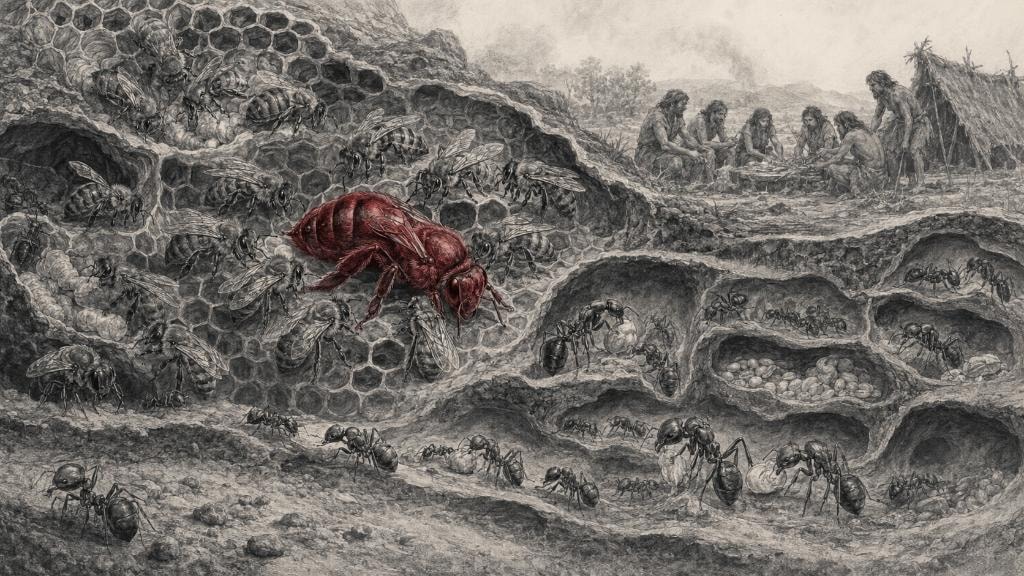
A worker honeybee may spend her life gathering food, regulating the temperature of the hive, feeding larvae, or defending the colony. She usually produces no offspring of her own. An ant may follow a similar path, working within a colony containing thousands—or, in some species, millions—of individuals organized around a reproductive queen.
From an individual perspective, this appears puzzling. Natural selection depends on reproduction. Why would evolution produce animals that surrender their own reproductive opportunities and devote their lives to others?
This was one of the central questions behind Edward O. Wilson's sociobiology: the systematic study of the biological foundations of social behavior. It also connects with the evolutionary world described by Matt Ridley in The Red Queen, where organisms must continually adapt because parasites, competitors, mates, and rivals are adapting around them.
Bees and ants show how far cooperation can evolve. Humans reveal something more complicated: cooperation among individuals who remain reproductively independent, cognitively flexible, culturally diverse, and frequently divided over who deserves help.
Key terms
Eusociality: A form of social organization involving cooperative care of young, overlapping generations, and a reproductive division of labor.
Sociobiology: The study of social behavior through evolutionary theory, ecology, genetics, and comparative biology.
Inclusive fitness: An organism's genetic contribution through its own reproduction and through effects on the reproduction of genetically related individuals.
Reciprocal altruism: Cooperation in which one individual provides a benefit with the possibility of receiving help later.
Cultural evolution: Changes in socially learned beliefs, practices, technologies, and institutions across time.
The Red Queen's world
Matt Ridley's The Red Queen: Sex and the Evolution of Human Nature is primarily a book about sexual reproduction, mate choice, parasites, and human nature. Bees and ants are therefore better treated as supporting examples than as the book's main subject.
The Red Queen metaphor comes from Lewis Carroll's Through the Looking-Glass, in which Alice must run merely to remain in the same place. Evolution can work in a similar way. A host evolves resistance; a parasite evolves a way around it. Prey become more vigilant; predators become more deceptive. An advantage rarely remains secure because other organisms respond to it.
This dynamic applies inside social systems as well. Cooperation creates benefits, but those benefits attract exploitation. A colony that gathers food efficiently may become a target for parasites, predators, or competing colonies. A human community that provides mutual assistance may attract people who take from the system without contributing to it.
Cooperation must therefore be maintained. Bees use chemical recognition, spatial organization, task specialization, and defensive behavior. Humans use reputation, punishment, law, religion, contracts, professional standards, and moral narratives. These systems differ greatly, but they confront a related problem: how can a group preserve collective benefits when individuals may gain by avoiding the costs?
In Red Queen terms, cooperation and exploitation evolve alongside each other. Better cooperation produces new opportunities for cheating. Better monitoring produces more sophisticated forms of evasion. No social order permanently solves this problem.
How bee and ant societies work
Bees and ants belong to the insect order Hymenoptera, although only some bee species are eusocial. All living ant species are social, while bees range from solitary species to highly organized colonies.
In a eusocial colony, reproduction is concentrated in one or several queens. Workers gather food, maintain the nest, defend the colony, care for larvae, and regulate temperature. Tasks can vary with age, body size, physiology, local conditions, and the immediate needs of the colony (Robinson, 1992).
The queen should not be imagined as a human monarch issuing instructions. She is principally a reproductive specialist. Colony organization emerges from chemical signals, repeated local interactions, inherited behavioral tendencies, and responses to environmental conditions.
A honeybee returning from a productive food source can communicate information about its direction and distance through the waggle dance. Ants often deposit pheromone trails that influence the movements of other workers. When more ants reinforce a successful path, the colony can concentrate its foraging effort without any individual ant possessing a complete plan.
This is decentralized coordination. Each insect follows relatively limited rules, yet the colony can produce complex collective outcomes.
Edward O. Wilson and Bert Hölldobler described advanced ant colonies as "superorganisms" because reproductive and worker castes function somewhat like reproductive and somatic tissues within a body (Hölldobler & Wilson, 2009). The analogy is useful, but incomplete. Colonies still contain conflict over reproduction, resource allocation, and sex ratios. Their unity is substantial, never absolute.
Why would workers give up reproduction?
There are two major evolutionary explanations, with continuing disagreement over how they should be formulated.
Hypothesis 1: Kin selection and inclusive fitness
W. D. Hamilton proposed that helping behavior can spread when the reproductive benefit delivered to a relative, adjusted for genetic relatedness, exceeds the helper's cost (Hamilton, 1964).
A worker may therefore transmit copies of shared genes by helping a mother produce additional sisters. The worker does not reproduce directly, but her behavior can still influence the representation of shared genetic variants in future generations.
This explanation initially appeared especially compelling for ants, bees, and wasps because of their haplodiploid sex-determination system. Under certain conditions, sisters can be more closely related to one another than mothers are to their daughters.
However, haplodiploidy alone cannot explain eusociality. Many haplodiploid species are solitary, while termites, snapping shrimp, and naked mole-rats developed forms of eusociality without this genetic system. Relatedness may facilitate cooperation, but it does not automatically create colonies.
Prediction: Worker sacrifice should become more likely when helpers direct benefits toward relatives and when those benefits substantially increase relatives' reproductive success.
Hypothesis 2: Colony-level selection and the defended nest
Wilson's later work with Martin A. Nowak and Corina E. Tarnita emphasized ecological pathways and selection among colonies. Their proposed sequence begins when offspring remain near a parent's nest. The nest supplies a defensible resource. Cooperative care then increases colony survival and reproduction. If colonies containing effective helpers outperform less organized colonies, selection can strengthen reproductive specialization and division of labor (Nowak et al., 2010).
Under this account, close relatedness is often a consequence of family formation and limited dispersal, while competition among colonies helps drive the transition toward eusociality.
This argument remains contested. Many evolutionary biologists maintain that inclusive-fitness and multilevel-selection approaches can often describe the same evolutionary process using different accounting methods.
Prediction: Eusociality should be more likely to emerge where offspring can remain together, occupy a valuable nest, defend it, and improve the reproductive success of the colony through cooperative care.
What evidence would separate the explanations?
Researchers would need to compare closely related species that differ in social organization and measure: genetic relatedness among colony members; the ecological value and defensibility of nests; the costs of dispersing or reproducing independently; the effects of worker behavior on colony reproduction; competition within colonies and between colonies; and whether changes in ecology precede or follow changes in relatedness and social structure.
The evidence suggests that no single variable explains every transition to eusociality. Kinship, ecology, development, demography, and colony competition interact.
Humans cooperate differently
Humans share several surface similarities with social insects. We divide labor, exchange information, defend territories, care cooperatively for young, store resources, construct settlements, and sometimes sacrifice ourselves for a larger group.
The underlying system is very different.
Most human adults retain reproductive potential. Human occupations are generally learned rather than determined by permanent biological castes. People can leave groups, change roles, challenge leaders, form new coalitions, and cooperate with strangers. A worker ant cannot resign from the colony and establish a competing consultancy. Humans do this with some regularity.
Human cooperation also depends heavily on prolonged childhood. Children require years of feeding, protection, instruction, and social learning. Mothers commonly receive help from fathers, grandparents, siblings, and other caregivers. Sarah Blaffer Hrdy described humans as cooperative breeders because childcare often extends beyond the mother–child pair (Hrdy, 2009).
This extended dependence creates incentives for kin cooperation. Yet kinship cannot explain the scale of human society. People trade with strangers, serve in national institutions, donate to distant populations, join religious communities, and cooperate through corporations and markets.
Additional mechanisms for large-scale cooperation
Reciprocity
Robert Trivers argued that cooperation can evolve among nonrelatives when individuals interact repeatedly and can return benefits over time (Trivers, 1971). Food sharing, alliance support, childcare, and protection can become reciprocal relationships. Reciprocity requires some ability to recognize partners, remember past behavior, and respond to cheating. Humans are unusually capable in all three areas.
Reputation
People often behave more generously when others can observe them. A reputation for reliability can produce future partners, allies, customers, mates, or assistance. A reputation for exploitation can lead to exclusion.
Richard D. Alexander placed indirect reciprocity—the social consequences of what others know about us—near the center of human moral behavior (Alexander, 1987). Human cooperation therefore operates within a network of witnesses, stories, and judgments.
Norms and institutions
Human groups transmit rules about fairness, obligation, punishment, property, marriage, inheritance, and authority. These rules vary across societies and can change much faster than genes.
Cultural evolution allows a useful institution to spread through imitation, teaching, competition, migration, or deliberate reform. It also permits harmful systems to persist when they benefit powerful coalitions, are protected by ideology, or are difficult to challenge.
Laws and compliance systems are extensions of this capacity. They make expectations visible, assign responsibility, document behavior, and establish consequences. Their effectiveness still depends on enforcement, legitimacy, and public trust.
Three similarities — and three important limits
The comparison between insects and humans is most useful at the level of problems: coordination, communication, specialization, free-riding, defense, and resource distribution. It becomes misleading when human organizations are described as hives or when leaders are treated as queens. Human beings possess competing interests, overlapping identities, moral agency, and the ability to revise institutions. A human population cannot be understood as a colony with a single reproductive interest.
Cooperation contains conflict
Wilson's sociobiological view does not require us to believe that societies are naturally harmonious. Social systems exist partly because individual interests overlap and partly because they do not.
Inside an ant colony, queens and workers can have different evolutionary interests. Workers may police one another's reproduction. Colonies compete with other colonies. Parasites can manipulate social signals.
Human conflict is even more layered. Families cooperate while negotiating inheritance. Employees work toward a company's objectives while pursuing income, security, recognition, and advancement. Citizens finance public goods while disagreeing about who should pay and who should benefit.
This supports two competing interpretations of human cooperation.
Biological interpretation: Humans possess evolved capacities for kin care, reciprocity, coalition formation, punishment, status tracking, and social learning because these capacities produced survival or reproductive advantages under recurring conditions.
Cultural interpretation: The scale and form of cooperation depend primarily on learned norms and institutions that organize behavior beyond genetic kinship.
The available evidence supports interaction between them. Humans inherit capacities for social behavior, while culture influences which relationships become morally important, which forms of exchange are legitimate, and how cooperation is enforced.
Evolution supplied a flexible social organism. History, ecology, and institutions shape what that flexibility produces.
What would change my mind?
- Evidence that eusocial colonies function without meaningful effects from relatedness, nest ecology, reproductive division of labor, or competition among colonies.
- Cross-cultural evidence showing that human cooperation varies little with institutions, reputation, resource conditions, or expected reciprocity.
- Evidence that human occupational and social roles operate like developmentally fixed insect castes.
- Strong longitudinal findings showing that moral rules spread independently of incentives, power, learning, and group competition.
Key takeaways
- The Red Queen provides a useful framework for understanding why cooperation requires continual maintenance: exploiters, competitors, and parasites adapt too.
- Bees and ants achieve extensive cooperation through kinship, defended nests, reproductive specialization, communication, and division of labor.
- Edward O. Wilson viewed social insects as powerful evidence that natural selection can produce organization above the level of the individual.
- The relative importance of kin selection and colony-level selection remains scientifically disputed.
- Human cooperation extends beyond kin through reciprocity, reputation, cooperative childcare, language, norms, and institutions.
- Humans are not ants with larger brains. Our roles are more flexible, our group memberships overlap, and our institutions can be deliberately challenged and redesigned.
- Cooperation does not eliminate individual interest. It creates systems that align, monitor, negotiate, and sometimes suppress competing interests.
What we still do not know
Scientists can identify mechanisms that support cooperation, but predicting which mechanism will dominate in a particular society remains difficult.
When does punishment protect a public good, and when does it protect entrenched power? When does loyalty strengthen a community, and when does it conceal exploitation? Why do some institutions earn voluntary cooperation while others depend almost entirely on coercion?
Bees and ants demonstrate that natural selection can build extraordinarily coordinated societies. Humans demonstrate that cooperation can become more flexible, more expansive, and more contested.
That tension may be our version of the Red Queen: we continually develop new ways to cooperate, while creating new opportunities to compete over the systems cooperation makes possible.
References & further reading
For a contemporary case study in how cooperative human systems extend parental investment across decades — including into medicine — see The Body Can Remember a Future It Has Not Reached, which examines long-term fertility preservation through an evolutionary lens.
Alexander, R. D. (1987). The biology of moral systems. Aldine de Gruyter.
Hamilton, W. D. (1964). The genetical evolution of social behaviour. I and II. Journal of Theoretical Biology, 7(1), 1–52. https://doi.org/10.1016/0022-5193(64)90038-4
Hölldobler, B., & Wilson, E. O. (2009). The superorganism: The beauty, elegance, and strangeness of insect societies. W. W. Norton.
Hrdy, S. B. (2009). Mothers and others: The evolutionary origins of mutual understanding. Harvard University Press.
Nowak, M. A., Tarnita, C. E., & Wilson, E. O. (2010). The evolution of eusociality. Nature, 466, 1057–1062. https://doi.org/10.1038/nature09205
Ridley, M. (1993). The Red Queen: Sex and the evolution of human nature. Viking.
Robinson, G. E. (1992). Regulation of division of labor in insect societies. Annual Review of Entomology, 37, 637–665. https://doi.org/10.1146/annurev.en.37.010192.003225
Trivers, R. L. (1971). The evolution of reciprocal altruism. The Quarterly Review of Biology, 46(1), 35–57. https://doi.org/10.1086/406755
Wilson, E. O. (1975). Sociobiology: The new synthesis. Belknap Press of Harvard University Press.
Written by Farzin Espahani
Editor in Chief, The Hominid Post
Farzin Espahani writes about human behavioral ecology, evolutionary anthropology, cooperation and the institutions humans build around biological and social risk.