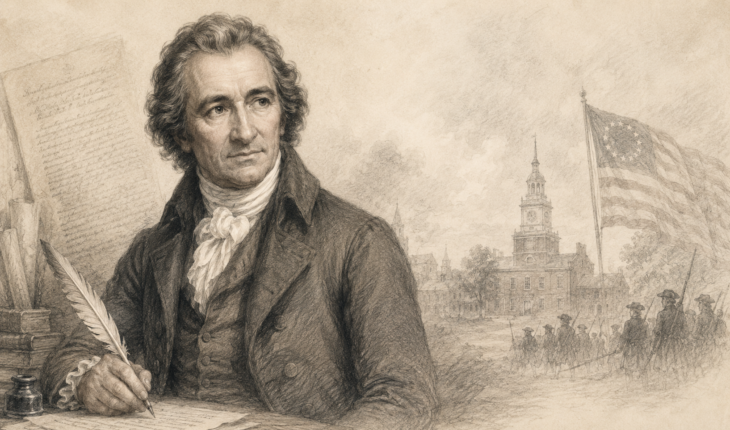
How Thomas Paine turned independence from elite argument into public judgment
By: Farzin Espahani
In January 1776, the American colonies were already at war, but many colonists had not yet accepted independence as the political endgame. They were angry at Parliament, suspicious of royal authority, and exhausted by imperial pressure. Still, separation from Britain remained a dangerous step. It meant treason, war, economic uncertainty, and the collapse of a familiar political order.
Thomas Paine’s Common Sense entered that moment as a short pamphlet with an unusually large consequence. It did more than argue for independence. It changed who had permission to reason about sovereignty. Paine took a constitutional debate that could have remained inside assemblies, taverns, and elite correspondence, and turned it into a public test of judgment. In plain language, he asked ordinary colonists to decide whether monarchy still deserved obedience.
That was its democratic force.
The behavioral puzzle: why did a pamphlet move a revolution?
Colonial Americans had lived with British authority for generations. Many still thought of themselves as English subjects defending inherited rights. A pamphlet by a recent English immigrant should not have been able to shift the public mood so quickly.
Two explanations help make sense of its effect.
Hypothesis 1: Paine succeeded because he gave colonists a better argument.
On this view, Common Sense clarified the logic of independence. It attacked monarchy, rejected hereditary rule, and argued that America’s interests had separated from Britain’s. The pamphlet worked because its reasoning was direct and portable. A reader could repeat it.
Hypothesis 2: Paine succeeded because he changed the social incentives around independence.
On this view, the pamphlet mattered because it made separation easier to say in public. It turned independence from a dangerous elite position into a respectable mass position. People who were already moving emotionally toward rupture now had language, moral cover, and a shared script.
Both explanations are probably true. Paine’s achievement was intellectual and social. He gave people an argument, then gave that argument a public life.
What Paine argued
Common Sense is built around a few claims, each designed to cut through inherited loyalty.
First, Paine separated society from government. Society, he argued, comes from human needs and cooperation. Government arises because human beings are imperfect and require rules. This distinction mattered. It allowed Paine to treat government as a tool rather than a sacred inheritance. A government could be judged by whether it protected people, not by how old it was or who ruled it.
Second, Paine attacked monarchy as an irrational institution. Hereditary rule violated the idea that political authority should be tied to competence, consent, and accountability. A king could inherit power without wisdom, virtue, or public trust. For Paine, this was not a minor defect. It exposed monarchy as a system that confused birth with legitimacy.
Third, Paine argued that reconciliation with Britain had become unrealistic. The colonies had grown economically and politically distinct. Britain’s imperial interests would keep pulling America into wars, trade restrictions, and dependence. Paine’s claim was practical: the colonies could not build a secure future while remaining subordinate to a distant crown.
Finally, Paine turned independence into a continental project. He did not write as if Massachusetts, Virginia, Pennsylvania, or South Carolina should merely defend local grievances. He wrote as if America could become a political body of its own. That was a major imaginative move. Democracy requires more than complaint. It requires a public capable of imagining itself as a legitimate source of authority.
Why the language mattered
The style of Common Sense was part of the argument. Paine did not write like a lawyer protecting every clause from objection. He wrote for movement. His sentences were direct, moral, and designed for circulation. The pamphlet could be read aloud, summarized, argued over, and carried into new rooms.
That mattered in a world where political opinion moved through print, sermons, letters, taverns, committees, and public readings. Paine understood that persuasion is an operating system. Ideas need language, distribution, repetition, and social reinforcement. Common Sense had all four.
Its plain style also carried a democratic claim. Paine’s writing implied that ordinary people could understand political legitimacy without permission from aristocrats, lawyers, bishops, or kings. That was a quiet revolution inside the louder one. The people were not merely being asked to support independence. They were being treated as competent judges of it.
How Common Sense influenced American democracy
The most immediate effect of Common Sense was to make independence politically actionable. Before Paine, many colonial leaders criticized British policy while still hoping for reconciliation. After Paine, that middle position became harder to sustain. The pamphlet helped move the public conversation toward the conclusion that independence was the necessary next step.
Its deeper influence was on democratic legitimacy.
Paine argued that government rests on the people rather than on royal inheritance. That principle later became central to American democratic identity. The Declaration of Independence gave it formal language. The Constitution later built institutions around it, though with major limits and compromises. Paine’s contribution was earlier and rougher. He helped popularize the idea that authority must answer to the governed.
He also helped shift American political culture away from inherited status. In a monarchy, rank comes from birth. In Paine’s republican vision, public authority had to be justified by public purpose. That distinction became one of the moral foundations of American democracy, even when American institutions failed to live up to it.
Paine also widened the audience for political argument. Democracy depends on a public that can absorb claims, test them, repeat them, reject them, and act through them. Common Sense trained that muscle. It showed that print could organize mass judgment before modern parties, mass media, or elections as we know them.
Evidence, interpretation, and speculation
Evidence: Common Sense was published in January 1776 and quickly became one of the most widely circulated political texts of the revolutionary period. It argued for immediate independence, republican government, and rejection of monarchy.
Interpretation: Its influence came from timing, clarity, and public reach. Paine gave colonists a language that made independence easier to defend socially and morally.
Speculation: The Declaration of Independence may still have happened without Paine, given the war already underway. But it likely would have faced a slower and more fractured public conversion. Paine reduced the political cost of saying the quiet part aloud.
The limits of Paine’s democratic vision
Any serious analysis has to hold two facts together. Paine helped democratize political imagination, and the democracy that emerged remained sharply limited.
The American Revolution spoke in universal terms, but political rights were not universal. Enslaved Africans, Native peoples, women, and many propertyless men were excluded from full participation. Paine’s language of liberty helped create standards that later reformers could use against those exclusions, but the founding order did not resolve them.
That tension is part of the American democratic inheritance. The country was founded through claims broader than its institutions were willing to honor. Paine’s writing widened the moral vocabulary of democracy. American law and practice moved more slowly, often only after conflict, pressure, and organized struggle.
This does not reduce Paine’s importance. It clarifies it. Common Sense helped create a political standard that exceeded the society that first adopted it.
Competing hypotheses
| Hypothesis | Prediction | What we would look for |
|---|---|---|
| The argument hypothesis | People changed their views because Paine’s case against monarchy and empire was persuasive. | Letters, newspapers, and political debates showing adoption of Paine’s reasoning. |
| The coordination hypothesis | People were already angry, but Paine made independence publicly sayable and socially safer. | Rapid spread of pro-independence language after publication, especially outside elite circles. |
| The timing hypothesis | The pamphlet mattered because it arrived when reconciliation had already become unlikely. | Evidence that military events and British policy had already moved opinion before January 1776. |
| The print-network hypothesis | Its influence depended on colonial print culture and public reading practices. | Reprints, editions, tavern readings, newspaper references, and local discussion networks. |
What would change my mind?
- Strong evidence that colonial public opinion had already decisively shifted toward independence before January 1776.
- Evidence that Common Sense circulated widely but was rarely discussed or cited in political settings.
- Local records showing that military events alone, rather than printed argument, explain the timing of independence sentiment.
- A clearer map of regional variation showing the pamphlet had little influence outside a narrow set of already-radical communities.
Key takeaways
- Common Sense helped turn independence from a risky elite argument into a public political demand.
- Paine’s attack on monarchy made inherited rule look irrational rather than natural.
- The pamphlet strengthened the democratic idea that ordinary people could judge political legitimacy.
- Its influence came from language, timing, distribution, and the social need for a shared argument.
- Paine’s democratic language exceeded the actual democracy created in 1776, especially given slavery, dispossession, and restricted political rights.
- The pamphlet’s lasting power is its operating lesson: political change needs ideas people can understand, repeat, and use.
References & further reading
Bailyn, B. (1967). The ideological origins of the American Revolution. Harvard University Press.
Britannica. (2025). Common Sense. Encyclopaedia Britannica.
Foner, E. (1976). Tom Paine and revolutionary America. Oxford University Press.
Kaye, H. J. (2005). Thomas Paine and the promise of America. Hill and Wang.
Maier, P. (1997). American Scripture: Making the Declaration of Independence. Knopf.
National Constitution Center. (2023). Thomas Paine: The original publishing viral superstar.
Paine, T. (1776). Common Sense; addressed to the inhabitants of America. Robert Bell.
Wood, G. S. (1992). The radicalism of the American Revolution. Alfred A. Knopf.