An evolutionary reading of the Iran–Israel rivalry, and of why both sides so often see themselves as the victim
By: Farzin Espahani
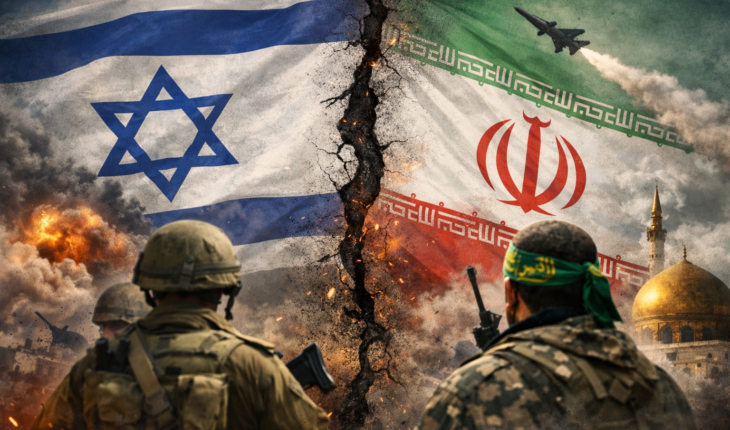
Why can two states that once had relatively close ties come to regard each other as near-civilizational enemies? The puzzle is not that the Iranian hardline state and Israeli hardline coalitions fight. States fight often enough. The harder puzzle is why the hostility feels morally total. Each side narrates itself as acting under siege, each treats the other as unusually dangerous, and outside audiences split into rival moral camps that see opposite victims. Relations between Iran and Israel were relatively close until the 1979 Iranian Revolution. Since then, the rivalry has moved through proxy warfare, covert action, and, in recent years, direct missile and drone exchanges. That trajectory alone tells us something important: this is not an ancient and inevitable hatred. It is a historically built conflict that has become psychologically sticky. (Simon, 2010; Afary, 2026; Reuters, 2024).
An evolutionary lens helps because humans are not just aggressive primates. We are coalition-forming primates. We sort people into “us” and “them,” extend sympathy unevenly, moralize group boundaries, and become especially rigid when threat, memory, and sacred values are fused together. That does not mean war is biologically predetermined. It means our species is unusually good at binding identity to conflict. Once political entrepreneurs attach fear, honor, humiliation, and historical suffering to a rivalry, hatred can become self-reinforcing even when it is materially costly. That is closer to what we are looking at here. The governments are not the same as the peoples, and the peoples are not reducible to religions. But state elites can still recruit older human instincts for coalition loyalty, revenge, and vigilance. (Mathew & Boyd, 2011; Zefferman & Mathew, 2015).
The first correction: this is not timeless
One of the laziest ways to explain the Iran–Israel rivalry is to describe it as ancient. The modern state-level enmity is not ancient. Iran and Israel developed close ties under the shah, grounded less in sentiment than in converging strategic interests. That changed after 1979, when the new Islamic Republic defined itself against the shah’s Western alignment, against American influence, and against Israel as both a regional rival and a symbol of what revolutionaries viewed as imperial order. Britannica notes that anti-colonial and anti-imperialist commitments were central to the new regime’s posture, while U.S. Institute of Peace materials note that relations with Israel were relatively close until the revolution. That matters because it shifts the explanation away from primordial essence and toward political reconstruction. (Afary, 2026; Simon, 2010).
The rivalry then hardened institutionally. The Islamic Revolutionary Guard Corps (IRGC) was built after 1979 not only as a military force but as a guardian of the revolution itself. The Council on Foreign Relations notes that the IRGC reports directly to the supreme leader, plays a central role in Iranian power projection, and works with regional affiliates including Hamas and Hezbollah. Through that architecture, hostility toward Israel became more than rhetoric. It became embedded in military doctrine, patronage networks, and regional deterrence strategy. What began as revolutionary identity became organizational routine. (CFR, 2026).
Recent events deepened that pattern. Reuters describes April 2024 as the point at which decades of shadow war spilled into direct state-on-state fire, with Iran launching an unprecedented direct attack on Israeli territory after the Damascus strike, followed by further missile exchanges in October 2024 and major Israeli strikes in Iran in June 2025. Once a rivalry moves from proxy ambiguity to direct reciprocal fire, threat perception changes. Suspicion hardens into memory. Worst-case thinking stops sounding paranoid and starts sounding prudent. (Reuters, 2024).
Competing hypotheses
Security dilemma hypothesis. Each side sees the other’s deterrence as offensive preparation. Prediction: even if rhetoric softens, military competition persists.
Regime-maintenance hypothesis. Hardliners on both sides gain domestic cohesion from permanent emergency. Prediction: de-escalation will be politically hardest when leaders are internally weak.
Sacred-values hypothesis. Once land, martyrdom, genocide memory, and holy sites are moralized, compromise feels like betrayal rather than bargaining. Prediction: material concessions alone will not stabilize the conflict.
Coalitional-psychology hypothesis. Victim narratives are not just sincere memory. They are also tools for disciplining allies, recruiting fence-sitters, and punishing dissent.
The most plausible answer is not one of these alone. It is the combination.
Why the hatred feels deeper than strategy alone
Pure strategy does not usually produce metaphysical language. Yet this conflict routinely does. That is a clue. Hatred deepens when three things stack on top of one another.
First, threat becomes existential. Israeli discourse has long treated a hostile Iran, especially a potentially nuclear Iran, as more than a normal adversary. That framing is amplified by the place of Holocaust memory in Jewish and Israeli identity. Pew found that 65 percent of Israeli Jews said remembering the Holocaust is essential to their Jewish identity. This does not mechanically dictate policy. But it does shape the emotional weight of eliminationist rhetoric, missile threats, mass-casualty attacks, and hostage-taking. When a group’s memory contains a recent example of industrialized annihilation, ordinary deterrence language is more likely to be heard through an existential filter. (Pew Research Center, 2016; Britannica, n.d.).
Second, grievance becomes sacred. On the Iranian hardline side, hostility to Israel is tied not just to geopolitics but to a moralized revolutionary identity: anti-imperialism, Palestinian solidarity, and opposition to a regional order associated with the United States and its allies. Britannica notes that foreign interference, including the 1953 coup, is central to the revolution’s political memory. The same source also notes that the shah’s close ties with Israel fed dissident rhetoric before 1979. When a regime’s origin story is built around humiliation by outside powers, Israel can be cast not merely as a neighboring state but as a symbol of the larger system the revolution claims to resist. (Afary, 2026; Britannica Editors, 2026).
Third, suffering becomes a coalition resource. Humans do not simply count deaths and then rank tragedy neutrally. We interpret suffering through group boundaries. A dead civilian inside one’s own coalition is a family member, neighbor, or sacred witness. A dead civilian on the other side is more likely to be absorbed into abstractions about security, proportionality, deterrence, or unfortunate necessity. This is why two audiences can watch the same region burn and leave with opposite moral conclusions. The raw material is real suffering. The interpretation is coalition-filtered.
Why many Israelis see Israel as the victim
This part is not hard to understand, even if one disagrees with what follows from it politically. Hamas’s October 7 assault involved deliberate killings and abductions of civilians. Amnesty International documented verified footage of armed men shooting civilians and taking hostages, and stated plainly that massacring civilians and hostage-taking are war crimes. For Israelis, that attack confirmed a core fear: that if the protective shell cracks, civilians are not incidental targets but central ones. That fear is then folded into a longer story of Jewish vulnerability, from pogroms to the Holocaust to modern missile threats. (Amnesty International, 2023).
The Iranian link matters here too. The IRGC’s ties to Hamas and Hezbollah, noted by CFR, make the threat appear systemic rather than local. In Israeli perception, this is not merely a Gaza problem or a Lebanon problem. It is an arc of encirclement backed by a state that openly defines Israel as an enemy and has invested for decades in armed nonstate allies. Add direct Iranian missile and drone attacks in 2024, and the siege narrative becomes easier for hardliners to sustain domestically. Under those conditions, many Israelis do not experience their state as the strong party. They experience it as the party that must be strong or die. (CFR, 2026; Reuters, 2024).
That does not make every Israeli policy justified. It does explain the psychology. In evolutionary terms, a coalition under perceived existential threat discounts outside criticism and rewards leaders who promise vigilance, retaliation, and boundary defense. Ambiguity becomes suspect. Restraint becomes harder to sell.
Why many Palestinians, many Iranians, and much of the wider region see Palestinians as the victim
This side is also not hard to understand. The West Bank has been under Israeli occupation since 1967, as Britannica notes. The same source describes military administration, restrictions on political activity, and the later expansion of settlements, land expropriation, and the security rationale Israel used to retain control. Gaza was later blockaded by Israel and Egypt after Hamas’s 2007 takeover, and the Israel–Hamas war brought mounting death tolls and large-scale destruction. By late 2025, Britannica described the death toll in Gaza as exceeding 70,000 and noted widespread destruction across the strip. OCHA’s 2026 reporting also documents ongoing displacement linked to settler violence and access restrictions in the West Bank. If one’s moral lens begins with occupation, blockade, settlement expansion, and mass civilian suffering, then Palestinians appear not as a side issue inside the Iran–Israel rivalry but as its central human fact. (Britannica, West Bank; Britannica, Israel-Hamas War; OCHA oPt, 2026).
For Iranian hardliners, that suffering is politically useful as well as morally resonant. It helps convert a foreign policy rivalry into a civilizational cause. But here another correction matters: the Iranian people are not reducible to the Iranian hardline state. Many Iranians oppose their own regime, and CFR notes that the IRGC has also become central to internal repression and to suppressing mass protests. So when outsiders interpret “Iran’s side” as a simple moral bloc, they miss an important distinction. The regime can instrumentalize Palestinian suffering while also coercing Iranians at home. (CFR, 2026).
Anthropologically, this is common enough. Coalitions often turn third-party suffering into loyalty tests. Support for Palestine can become, inside a revolutionary framework, a signal of authenticity. Support for maximal Israeli security can become, inside a siege framework, a signal of seriousness. In both cases, moderates are vulnerable to accusations of naivete or betrayal.
Why victimhood diverges so sharply
The reason one audience sees Israelis as the primary victim while another sees Palestinians, or even Iran, as the primary victim is not that one side has facts and the other has propaganda. It is that each coalition begins the moral story at a different point in time.
If the story begins with the Holocaust, regional antisemitism, October 7, hostage-taking, Hezbollah rockets, and Iranian threats, Israel looks like the endangered party. If the story begins with dispossession, occupation, blockade, settlement expansion, and large-scale Palestinian civilian suffering, Palestinians look like the obvious victims. If the story begins with the 1953 coup, Western interference, the shah, and the revolutionary rejection of imposed order, Iranian hostility can be narrated as resistance rather than aggression. Different starting points generate different moral maps. (Pew Research Center, 2016; Britannica, 2026; Amnesty International, 2023; OCHA oPt, 2026).
This is why arguments that merely compare body counts rarely settle anything. Coalitions do not only measure loss. They rank meaning. A smaller loss can feel more existential if it confirms a feared script of annihilation. A larger loss can feel more invisible if the other side treats it as collateral to a legitimate defense. In evolutionary terms, victimhood is not only grief. It is also a claim on loyalty, status, and moral priority within and across coalitions.
What an evolutionary lens adds, and what it does not
Evidence. Humans are unusually capable of large-scale cooperation and conflict among unrelated individuals, and scholars such as Sarah Mathew and Matthew Zefferman argue that group-structured cultural selection and norm enforcement help explain how humans sustain large-scale warfare and coalition discipline. That is one reason intergroup conflicts can scale far beyond kinship. (Mathew & Boyd, 2011; Zefferman & Mathew, 2015).
Interpretation. The Iran–Israel rivalry is best understood as a modern strategic conflict that recruits ancient human capacities: coalition loyalty, moral boundary policing, threat amplification, and selective empathy. The hatred feels deep because it is repeatedly refreshed by real violence and by institutions that gain from keeping memory hot.
Speculation. Hardliners on both sides may, to some degree, need each other. Not because the conflict is fake. It plainly is not. But because the existence of a vivid enemy simplifies domestic politics. It makes dissent look dangerous. It turns compromise into weakness. It helps leaders convert messy governance failures into a cleaner story about external threat.
That last point is an inference, not a settled fact. But it fits a recurrent pattern in human politics.
What would reduce the hatred
An evolutionary reading does not license fatalism. Coalition psychology is powerful, but it is not destiny. The same human species that sacralizes revenge can also widen the moral circle under changed incentives.
The rivalry would likely soften only if several things happened at once: the material basis of Palestinian grievance narrowed; the use of proxy warfare declined; Iranian elites gained less from revolutionary mobilization; Israeli elites gained less from permanent emergency; and outside patrons stopped subsidizing maximalist positions. None of that is simple. But the point is analytical. Durable hatred usually requires institutions that keep feeding it.
What we still do not know
We still do not know which mechanism carries the most weight at different moments. Is the main engine elite self-preservation, genuine security fear, sacred value commitment, or all three in changing proportions? We also do not know how quickly public narratives would shift if violence fell sharply. Many conflicts look ancient when they are active and surprisingly contingent when they cool.
That is why the cleanest conclusion is also the least satisfying. The hostility is deep, but it is not primordial. It is historically produced, institutionally rewarded, and psychologically reinforced.
What would change my mind?
- Strong evidence that elite rhetoric softens without any corresponding drop in material threat would weaken the regime-maintenance argument.
- Strong evidence that occupation, blockade, and settlement pressure could be substantially reduced without changing regional attitudes would weaken the grievance-centered argument.
- Strong evidence that publics maintain equally intense hostility after sustained de-escalation would strengthen the view that sacred values now dominate strategy.
- Strong evidence that victim narratives converge when threat falls would suggest the polarization is less ancient than it feels.
Key takeaways
- The Iran–Israel rivalry is historically recent in state terms, not timeless.
- Hatred deepens when security fear, sacred values, and political incentives stack together.
- Israelis and Palestinians are seen as victims by different audiences because each coalition starts the moral story at a different point.
- Hardline politics thrives on selective empathy and permanent emergency.
- An evolutionary lens explains why the conflict feels total; it does not excuse what any side does in its name.
References & further reading
Afary, J. (2026). Iranian Revolution. Encyclopaedia Britannica.
Amnesty International. (2023). Israel: Palestinian armed groups must be held accountable for deliberate civilian killings, abductions and indiscriminate attacks.
Britannica Editors. (2026). Why did Iran stop being a U.S. ally? Encyclopaedia Britannica.
Council on Foreign Relations. (2026). The Islamic Revolutionary Guard Corps (IRGC).
Mathew, S., & Boyd, R. (2011). Punishment sustains large-scale cooperation in prestate warfare. Proceedings of the National Academy of Sciences.
Office for the Coordination of Humanitarian Affairs, occupied Palestinian territory (OCHA oPt). (2026). Humanitarian Situation Report, 2 April 2026.
Pew Research Center. (2016). Religious and Cultural Identity in Israel.
Reuters. (2024). Iran and Israel: open warfare after decades of shadow war.
Simon, S. (2010). Iran and Israel. United States Institute of Peace, The Iran Primer.
Zefferman, M. R., & Mathew, S. (2015). An evolutionary theory of large-scale human warfare. Evolutionary Anthropology.
To understand the deeper historical and anthropological setting behind this conflict, read our article on [The Levant Is a Corridor of Human History].
This argument becomes even clearer when read alongside [The Paradox of Human Warfare Explained], which examines why human warfare is such an unusual form of collective violence.