By: Farzin Espahani
A trait shaped by natural selection because it helped solve a recurring problem
The word adaptation gets used casually. People say humans are “adapted to screens,” “adapted to city life,” or “adapted to stress” when they usually mean something softer: accustomed, adjusted, trained, or coping. In evolutionary biology, the term has a narrower and more demanding meaning.
An adaptation is a trait that became common in a population because, over generations, it tended to improve survival or reproduction under some recurring set of conditions. Put more simply, it is a feature that natural selection helped build because it did useful work often enough to matter.
That trait can be:
- anatomical, such as the structure of the eye or the shape of the human foot
- physiological, such as sweating, immune responses, or altitude tolerance in some populations
- developmental, such as the long human childhood
- behavioral, such as food-sharing patterns, parental investment, or mate-choice tendencies
The key point is that an adaptation is not just any trait that exists. It is a trait that shows evidence of having been shaped by selection.
Why the concept matters
Adaptation is one of the central ideas in evolutionary thinking because it helps explain why living things often look as if they were designed for particular tasks without requiring a designer in the biological model. Wings are good for flying. Kidneys regulate fluid balance. Camouflage reduces detection. Human hands are unusually good at gripping and manipulating objects.
That does not mean evolution produces perfection. It does not. Evolution works like a tinkerer with inherited materials, not like an engineer with unlimited freedom. It modifies existing structures under constraints. So adaptations are often effective, but they are rarely elegant in a clean-sheet sense.
A useful way to think about it is this: adaptation explains why organisms often show a fit between trait and task. The fit may be rough, partial, or burdened by costs, but it is not random.
Some relatively clear examples
Some examples are widely accepted because the evidence is strong and the functional relationship is fairly easy to see.
The eye for vision
Eyes differ across species, but the broad point is obvious. Structures that detect light and help organisms navigate, avoid danger, find food, or track conspecifics have clear survival value. The vertebrate eye is not perfect, but it is still a powerful example of a system showing strong fit between structure and function.
Enamel thickness in relation to diet
Teeth record evolutionary pressures very well. In some primates and hominins, thicker enamel makes more sense in relation to harder, more abrasive, or mechanically demanding foods. This is not proof that every thick-enamel lineage ate exactly the same things, but it is a good example of anatomy reflecting recurring dietary pressures.
Camouflage in prey species
If a moth blends into bark or a fish blends into reef structure, it becomes harder for predators to detect. This is one of the clearest cases where the adaptive logic is visible.
Sweat-based thermoregulation in humans
Humans are unusually good at cooling ourselves through sweating. That matters for endurance, heat tolerance, and activity in hot conditions. It is one of the more persuasive physiological adaptations in our lineage.
Aspects of bipedal anatomy
The pelvis, femur, knee, spine, and foot in humans all show evidence of selection for habitual upright walking. No single bone proves the case alone. The strength comes from the package. When multiple traits point to the same recurring functional demand, the adaptation argument gets much stronger.
What makes something an adaptation?
To call a trait an adaptation, you need more than a good story. A serious case usually asks several questions.
What problem did the trait help solve?
“Problem” here does not mean a consciously experienced problem. It means a recurring challenge related to survival or reproduction. That challenge might involve avoiding predators, processing food, regulating body temperature, attracting mates, rearing offspring, or coordinating with allies.
Is the trait heritable in the relevant way?
Natural selection only builds on variation that is passed on across generations. If something appears entirely through one-off learning or accident, it is not an adaptation in the strict evolutionary sense, even if it is useful.
Does the trait show evidence of functional design?
The trait does not need to be perfect. It just needs to show signs of organization that make sense for the proposed role. The hand, for example, is not just a random cluster of tissues. Its bones, tendons, and muscles work together in a coordinated way.
Is there comparative, ecological, developmental, archaeological, or fossil support?
Strong adaptation claims usually rest on more than one line of evidence. Comparative data ask whether related species facing similar conditions show similar traits. Developmental data ask how the trait emerges. Archaeology and fossils can help place the trait in time and context.
Are there better alternative explanations?
This is where many weak arguments fail. The question is never just “could this have been useful?” Plenty of things could have been useful. The question is whether selection is the best explanation, relative to byproducts, drift, constraints, and cultural transmission.
Adaptation is not the same as acclimation
One of the most important distinctions is between adaptation and acclimation.
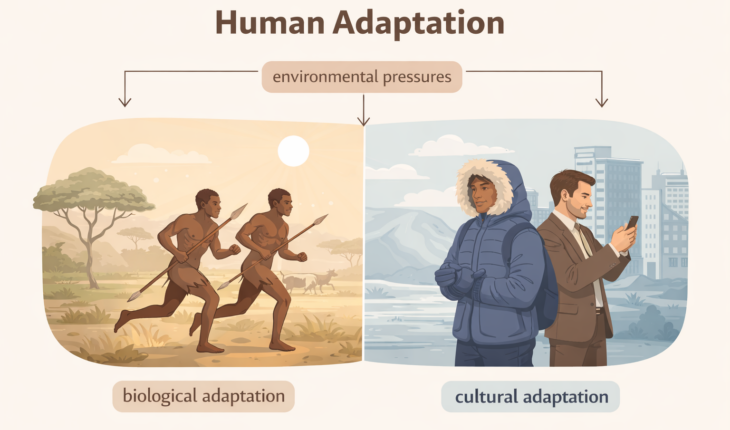
If a person moves to a hotter climate and gradually becomes better at tolerating heat, that is an adjustment within a lifetime. It may involve physiological changes in sweat rate, behavior, and hydration patterns. That is real, but it is not itself an evolutionary adaptation.
The capacity to adjust may be part of our evolved design. The adjustment itself is not the adaptation.
This matters because humans are highly plastic. We change through development, learning, and cultural input all the time. Some of that flexibility is one of our deepest strengths. But not every change we undergo is an adaptation in the evolutionary sense.
Adaptations carry tradeoffs
A useful adaptation is rarely free. Selection works with competing demands. Improving one thing can damage another. Many traits make sense only when read as compromises.
Childbirth
Human childbirth is the classic example. Large infant brains increase the difficulty of birth. Bipedalism places constraints on pelvic form. The result is not a perfect solution. It is a compromise between locomotion and obstetrics.
The human spine
The human back supports upright posture and frees the hands, but it also leaves us vulnerable to pain, disc problems, and mechanical strain. That does not mean bipedalism failed. It means the system carries costs.
The immune system
A strong immune response can protect against infection, but it can also damage the body through inflammation, allergy, or autoimmunity. Defense and collateral damage are tied together.
Attachment
Human attachment systems support pair-bonding, childrearing, and long-term coordination. The same systems also make jealousy, grief, heartbreak, and obsession possible. The benefits and liabilities are bound up in the same machinery.
This is a good rule of thumb: if someone proposes an adaptation with no costs, no tradeoffs, and no limits, skepticism is warranted.
Behavioral adaptations need extra caution
Behavior is where the concept becomes both most interesting and most dangerous. It is interesting because behavior affects mating, parenting, status, cooperation, and survival. It is dangerous because people can generate endless plausible stories with too little evidence.
Common mistakes include confusing:
- what is useful now with what was selected in the past
- what is widespread with what is adaptive
- what is culturally common with what is biologically evolved
- an average sex difference with deep biological destiny
This is why better work in human behavioral ecology tends to frame behavior conditionally. Instead of saying “humans evolved to do X,” it often asks:
- under what ecological conditions is X more likely?
- what are the costs and benefits?
- how do age, status, risk, kinship, and institutions change the payoffs?
That kind of framing is usually more realistic than assuming every recurring behavior is hardwired.
Robert Foley’s critique of simplistic “environment of evolutionary adaptedness” thinking is helpful here. He argues that hunter-gatherers themselves are highly variable, and that broad claims about a single ancestral setting can flatten real ecological and social diversity.
Some traits are byproducts, not adaptations
One of the most useful corrections in evolutionary thought came from critics of loose adaptationism, the habit of treating every visible trait as if natural selection must have built it for its current role. Their point was not that adaptation is unimportant. Adaptation remains one of the central ideas in evolutionary biology. Their point was narrower and more disciplined: before calling something an adaptation, we need to ask whether that is actually the best explanation.
That matters because many traits do useful things now without having been directly selected for that exact job. Others are leftovers, side effects, constraints, or outcomes of chance. In practice, a living organism is not a bag of neatly optimized solutions. It is a historical structure built out of older parts, developmental pathways, ecological tradeoffs, and inherited limitations.
A byproduct of selection on another trait
A trait can exist because selection favored something else, and the trait in question came along for the ride. Bodies are integrated systems. Bones, muscles, hormones, and behaviors do not evolve in isolation.
A familiar biological example is the belly button. It is universal and visible, but no one argues that selection designed navels for their own independent function. They are scars left by fetal development.
A more debated human example is the chin. Human chins are distinctive, but there is long-running debate about whether the chin is a direct adaptation or a structural consequence of other changes in facial architecture. A feature can be striking without being the thing selection directly targeted.
A behavioral example helps too. Human attraction to highly processed sugary foods is not plausibly an adaptation to soda and packaged desserts. A better explanation is that older taste preferences for calorie-dense foods are being exploited in radically new food environments. The modern behavior is better understood as a byproduct of older nutritional biases than as a direct adaptation to supermarkets.
A compromise produced by competing demands
Some traits are best understood as compromises. Evolution rarely gets to maximize one outcome by itself.
Human childbirth is again the clearest case. Selection had to balance upright walking with the passage of a large-brained infant through the birth canal. The result is functional but difficult.
The same logic applies to the human knee, spine, and pelvis. These structures work, but they also break, ache, and strain. If someone treated them as perfectly optimized designs, the story would be too clean.
Behavior can show the same pattern. Attachment systems can support parenting and pair stability while also generating jealousy and grief. A trait may be useful overall while still carrying sharp emotional or structural costs.
A product of developmental constraints
Evolution works through development, and development limits what can be built. Organisms do not start from zero in each generation. They grow through inherited pathways.
The famous example outside humans is the recurrent laryngeal nerve, which takes an awkward detour in mammals because evolution modified an inherited vertebrate body plan rather than redesigning it from scratch.
In humans, many anatomical features reflect the fact that a primate lineage moved into habitual bipedalism using materials shaped by earlier locomotor histories. The result is workable, but not infinitely flexible. Evolution can only modify what development can produce.
Developmental constraints also matter behaviorally. Human childhood is unusually long. Once a lineage depends on prolonged learning and extended immaturity, many other features of parenting, provisioning, schooling, and kin support become tied into that developmental framework.
A result of drift
Some traits spread through genetic drift, meaning chance rather than adaptive advantage. This matters especially in small populations.
If a trait becomes common after a bottleneck, founder event, or long isolation, that does not automatically mean the trait solved an important problem. Some differences arise because of demographic history, not because selection strongly favored them.
This is especially important when people over-interpret population differences. Not every difference needs a deep adaptive story.
A culturally transmitted habit
Humans add another layer of complexity because many recurring behaviors spread through culture rather than direct biological selection. A behavior may be stable, widespread, and socially consequential while being maintained through teaching, imitation, punishment, prestige, and institutions.
Marriage rules are an obvious example. Arranged marriage, monogamy, cousin marriage, dowry systems, inheritance patterns, and courtship rituals can all be durable, but that does not mean each one is a biological adaptation. Many are culturally transmitted social arrangements.
The same applies to dress codes, table manners, beauty standards, legal norms, schooling routines, and professional etiquette. These may be important and persistent without being direct products of natural selection.
Even where biology clearly matters, culture can strongly shape expression. Romantic love is a useful case. Helen Fisher argues that romantic love is linked to a deeper mammalian attraction system tied to mate choice, reward, and motivation. But the social scripts around love, marriage, fidelity, and emotional display vary widely across societies. The underlying capacity may have deep roots, while its cultural packaging is highly variable.
This does not weaken evolutionary thinking. It improves it. The point is not to reject adaptation. The point is to stop treating adaptation as the answer before the evidence is in.
Human examples: stronger candidates and weaker ones
In humans, some adaptive claims are relatively strong because they rest on several lines of support.
Stronger candidates
Bipedalism is one of the strongest. The fossil record, pelvis shape, femur angle, spinal changes, and foot structure all point in the same direction.
Long juvenile periods are another. Human children remain dependent for unusually long periods, and that fits with brain growth, learning, and skill acquisition.
Intense social learning is also a strong candidate. Humans rely heavily on teaching, imitation, and cumulative culture. That fits not just with modern behavior but with broader life history and archaeological evidence.
Cooperative childrearing, or alloparenting, is another persuasive case. Human offspring are demanding, expensive, and slow to mature. Support from fathers, grandmothers, siblings, and wider networks fits the broader human package.
Thermoregulation through sweating is also relatively strong as a physiological adaptation.
More contested or weaker claims
Weaker claims usually jump too fast from a modern surface trait to an ancestral function.
Saying “humans evolved for luxury brands,” “men evolved for sports cars,” or “women evolved for office gossip” is too specific and too shallow. A better question is whether humans evolved broader sensitivities to prestige, signaling, alliance value, and reputation, with modern consumer objects or office behaviors serving as cultural expressions of those older tendencies.
That is where anthropology helps. Cross-cultural comparison, ecology, archaeology, demography, and primatology all put pressure on neat stories.
John Q. Patton’s work on meat sharing is helpful for this reason. Rather than forcing one explanation, he tests several: kin selection, reciprocity, tolerated theft, showing off, costly signaling, and coalitional support. In Conambo, meat transfers appear influenced by kinship and reciprocity, but also by alliance politics and coalition management. That is a stronger model of adaptation thinking: multiple hypotheses, local ecology, and attention to real social structure.
A better rule of thumb
When you encounter a trait and wonder whether it is an adaptation, do not ask only, “What is this good for?” Ask a harder set of questions:
- Was this feature directly selected for that role?
- Could it be a side effect of another selected trait?
- Does it reflect a compromise?
- Was development constraining the available forms?
- Could chance have played a role?
- Is culture carrying most of the pattern?
That kind of skepticism does not weaken evolutionary explanation. It makes it more honest.
What would change my mind?
- Strong comparative or developmental evidence showing a trait is better explained as a byproduct than a direct adaptation
- Fossil, ecological, or experimental evidence that undercuts the proposed function
- Cross-cultural evidence showing the “universal adaptation” is actually narrow and institution-dependent
- Better demographic or genetic evidence indicating drift or founder effects rather than selection
- A stronger alternative explanation that predicts the observed pattern more cleanly
Key takeaways
- An adaptation is a trait shaped by natural selection because it improved survival or reproduction under recurring conditions.
- Adaptations can be anatomical, physiological, developmental, or behavioral.
- A useful story is not enough. Strong adaptation claims need multiple lines of evidence.
- Adaptation is different from short-term acclimation, learning, or coping.
- Adaptations usually involve tradeoffs, costs, and constraints.
- Some traits are byproducts, compromises, products of developmental constraint, results of drift, or culturally transmitted habits rather than direct adaptations.
- Human behavioral traits require extra caution because culture and development strongly shape expression.
References & further reading
Fisher, H. E., Aron, A., & Brown, L. L. (2006). Romantic love: A mammalian brain system for mate choice. Philosophical Transactions of the Royal Society B, 361(1476), 2173–2186.
Foley, R. (1995). Humans Before Humanity: An Evolutionary Perspective. Oxford: Blackwell.
Foley, R. (1996). The adaptive legacy of human evolution: A search for the environment of evolutionary adaptedness. Evolutionary Anthropology, 4(6), 194–203.
Patton, J. Q. (2005). Meat sharing for coalitional support. Evolution and Human Behavior, 26(2), 137–157.
Williams, G. C. (1966). Adaptation and Natural Selection. Princeton: Princeton University Press.
Winterhalder, B., & Smith, E. A. (2000). Analyzing adaptive strategies. In E. A. Smith & B. Winterhalder (Eds.), Evolutionary Ecology and Human Behavior (pp. 51–77). New York: Aldine de Gruyter.