By: Farzin Espahani
The Levant tends to get flattened in public argument. People speak of it as if it were a single civilization, a single people, or a single inheritance waiting to be assigned. Archaeology gives a more demanding picture. The Levant is an eastern Mediterranean corridor whose significance comes from movement, layering, and repeated transformation. Human groups passed through it, settled in it, fought over it, mixed within it, and rebuilt their lives there across very different ecological and political worlds (Encyclopaedia Britannica, 2026; Barash et al., 2022).
That is why the Levant matters so much. It sits in the hinge zone between Africa and Eurasia. If you want to understand dispersals out of Africa, contact between different human populations, the long transition from foraging to village life, the emergence of early urbanism, or the later spread of Arabic and Islam, this region keeps returning to the center of the story (Barash et al., 2022; Tillier & Arensburg, 2017). The Levant is not important because it preserves a clean origin. It is important because it preserves a corridor where major human transitions became visible.
Where the Levant is, and how old it is
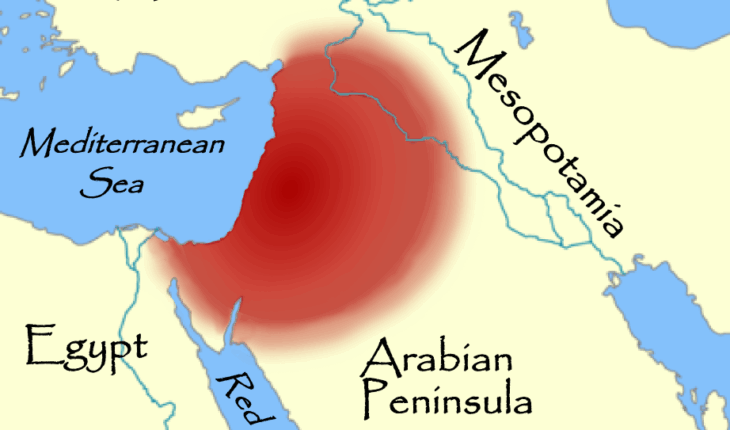
In current usage, the Levant usually refers to the eastern Mediterranean, centered on modern Syria, Lebanon, Israel/Palestine, and Jordan, with some broader definitions stretching toward adjacent zones such as southern Türkiye, Sinai, or Cyprus (Encyclopaedia Britannica, 2026). The word itself is relatively late, emerging through European usage of the eastern Mediterranean. The inhabited landscape, however, is vastly older. Archaeological work in the region reaches deep into the Pleistocene, and places such as Tell es-Sultan, ancient Jericho, preserve evidence of human occupation back to around 10,500 BCE (Encyclopaedia Britannica, 2026; UNESCO, 2023).
That split between the age of the term and the age of the landscape matters. The Levant is not old because the label is old. It is old because generations of humans kept returning to a corridor that linked ecologies, continents, and exchange systems.
A land bridge that changed the human story
One reason archaeologists treat the Levant as foundational is geography. Barash and colleagues describe it as the major land bridge connecting Africa and Eurasia, which makes it central to debates about hominin movement beyond Africa (Barash et al., 2022). That phrasing may sound technical, but the underlying point is simple. If a population moved north from Africa without crossing open water, the Levant was one of the main routes available. Geography did not dictate a single path, but it sharply raised the odds that this region would accumulate evidence of movement, pause, adaptation, and replacement.
That is why the Levant matters beyond local history. It lets archaeologists study big questions through a regional record. Who moved when. Which groups overlapped. Which technologies traveled. Which environments acted as bottlenecks and which acted as refuges. A corridor concentrates traffic, and over long stretches of time it also concentrates evidence.
Where human groups met, overlapped, and likely mixed
The Levant also matters because it complicates simple population stories. The older public model imagined a neat succession: one human type leaves, another arrives, and the handoff is clean. Archaeological and paleoanthropological work has made that harder to sustain. Syntheses such as Quaternary of the Levant emphasize a more complex regional history involving repeated occupations by Neanderthals and modern humans, with real scope for interaction and probably genetic exchange (Tillier & Arensburg, 2017).
Anthropologically, that matters because contact zones tell us more than sealed lineages do. They show how populations respond under pressure, how technologies and behaviors travel, and how identities that look distinct in textbooks may have been messier on the ground. The Levant is one of the places where the human past stops looking like a parade of isolated types and starts looking like what it probably was more often: a sequence of encounters.
The long road from foragers to villages
If the Levant were only important for dispersal, it would already deserve attention. Its significance runs deeper because it also preserves one of the clearest records of the transition from foraging to settled life. The Natufian has long been treated as one of the key archaeological cultures in this story, and Bar-Yosef argued that it marked a threshold to the origins of agriculture (Bar-Yosef, 1998). Later work at Shubayqa 1 in Jordan strengthened that picture by showing how early and regionally varied late Epipalaeolithic settlement could be, with dates around 14,600 to 12,000 calibrated years before present (Richter et al., 2017).
The importance of this evidence is easy to miss if one expects a dramatic invention scene. Agriculture did not simply appear one morning and reorganize life by decree. More settled lifeways, intensified use of wild foods, new forms of storage, and more durable habitation all helped create the conditions in which farming became viable. The Levant preserves that slower transition unusually well. It shows that the shift from foraging to cultivation was not a switch but a sequence.
Jericho and the archaeology of staying put
Few sites capture this process more clearly than Jericho, or Tell es-Sultan. UNESCO describes the site as preserving a long sequence of human occupation beginning around 10,500 BCE, including early permanent settlement and monumental features such as walls, a ditch, and a tower in the Pre-Pottery Neolithic (UNESCO, 2023). Jericho matters because it records more than age. It records coordination. Building substantial communal structures implies planning, labor organization, recurring occupation, and some degree of social continuity.
That makes Jericho important for anthropology as much as for archaeology. Sedentism changes incentives. Once people stay put longer, questions of storage, defense, inheritance, household labor, and local hierarchy begin to take on new forms. A site like Jericho lets us watch those changes take shape in the ground rather than infer them only from theory.
Villages became cities, and coastlines became conduits
The Levant’s importance does not end with the Neolithic. Sites such as Byblos show how the region later became one of the eastern Mediterranean’s major urban and maritime theaters. UNESCO describes Byblos as continuously inhabited since Neolithic times and as bearing exceptional witness to Phoenician civilization (UNESCO, n.d.). In practical terms, that means the Levant mattered not only because people settled there early, but because the region later linked inland and maritime worlds through trade, craft production, writing, and political exchange.
This longer arc matters. Too much writing on the ancient Near East treats the story as a set of disconnected revolutions. First villages, then cities, then empires, then religions. The Levant pushes against that habit. It shows accumulation, inheritance, and reuse. Later developments sat atop older social landscapes.
Why the Levant matters anthropologically
Anthropologically, the Levant is valuable because it preserves layered transitions rather than a single ancestral truth. It shows that sedentism emerged unevenly, that farming grew out of earlier shifts in settlement and subsistence, that urbanism built on older village worlds, and that later imperial and religious transformations unfolded through populations that were rarely starting from scratch (Bar-Yosef, 1998; Tillier & Arensburg, 2017).
This is where the region becomes especially useful for a human behavioral ecology lens. Ecology set constraints. The corridor linked coast, upland, valley, and desert margin. Those environments created different payoffs for mobility, storage, alliance, and exchange. Cultural transmission then worked on top of those constraints, carrying techniques and institutions forward while also reworking them. The result was not a single Levantine essence. It was a historically layered social field.
The Arab conquest of the Levant, clearly stated
That layered reading also helps with later historical questions, including the politically charged issue of Arab arrival after the rise of Islam. The basic historical point is straightforward. Yes, Arab-Muslim armies invaded and conquered the Byzantine Levant in the seventh century CE. Scholarship on the early Islamic eastern Mediterranean places the rapid conquest of Palestine, Syria, and Egypt between roughly 633 and 643 CE (Avni, 2022). This was a conquest, and there is no analytical value in softening the term.
The more difficult question is what conquest changed, and how quickly. Political sovereignty changed fast. Demography, language, religion, and social identity did not all change at the same speed. Work on the early Islamic Near East emphasizes that Arabization and Islamization were gradual processes, unfolding through administration, settlement, intermarriage, conversion, patronage, and language shift across generations (Vernet, 2021). That is the key distinction. Military conquest was real. Instant civilizational replacement is a much weaker claim.
This matters because modern arguments often skip from “there was a conquest” to “the population was wholly replaced.” Archaeology and history rarely support such clean leaps. More often they show continuity under new rulers, old populations adapting to new political orders, and identities shifting unevenly across class, region, and time. The Levant after the Arab conquests fits that broader pattern.
A corridor, not a possession
The Levant is best understood as a corridor whose significance comes from repeated passage and repeated settlement. That gives it unusual archaeological value. It concentrates evidence for dispersal, contact, sedentism, agriculture, urbanism, and later historical transformation in one connected region. It also gives it unusual political difficulty, because any corridor with a long record of layering resists exclusive ownership claims based on a single moment in time.
That resistance is part of what makes the Levant worth studying seriously. It forces a harder view of human history, one less interested in origin myths and more interested in how populations move, persist, absorb, and change. For archaeology, that is the region’s strength. For anthropology, it is the larger lesson.
References
Avni, G. (2022). Between Ramla and Fusṭāṭ: Archaeological evidence for Egyptian contacts with early Islamic Palestine (eighth–eleventh centuries). In J. Bruning, J. H. M. de Jong, & P. M. Sijpesteijn (Eds.), Egypt and the Eastern Mediterranean World: From Constantinople to Baghdad, 500–1000 CE. Cambridge University Press.
Bar-Yosef, O. (1998). The Natufian culture in the Levant, threshold to the origins of agriculture. Evolutionary Anthropology, 6(5), 159–177.
Barash, A., Belmaker, M., Bastir, M., Soudack, M., O’Brien, H. D., Woodward, H., Prendergast, A., Barzilai, O., et al. (2022). The earliest Pleistocene record of a large-bodied hominin from the Levant supports two out-of-Africa dispersal events. Scientific Reports, 12, 1721.
Encyclopaedia Britannica. (2026, February 27). Levant. Encyclopaedia Britannica.
Richter, T., Arranz-Otaegui, A., Yeomans, L., & Boaretto, E. (2017). High resolution AMS dates from Shubayqa 1, northeast Jordan reveal complex origins of Late Epipalaeolithic Natufian in southwest Asia. Scientific Reports, 7, 17025.
Tillier, A.-M., & Arensburg, B. (2017). Neanderthals and modern humans in the Levant: An overview. In Y. Enzel & O. Bar-Yosef (Eds.), Quaternary of the Levant: Environments, climate change, and humans. Cambridge University Press.
UNESCO. (2023). Ancient Jericho/Tell es-Sultan. World Heritage Centre.
UNESCO. (n.d.). Byblos. World Heritage Centre.
Vernet, A. (2021). Arabicization, Islamization, and the colonies of new believers. In Late Antique Responses to the Arab Conquests. Brill.