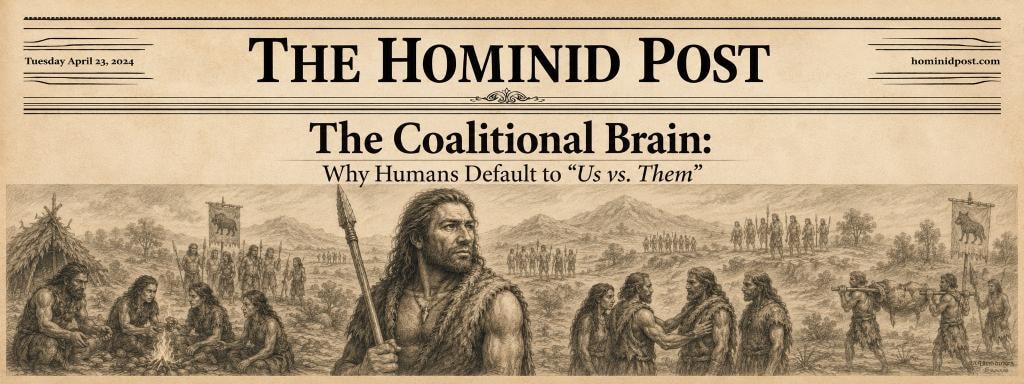
The Coalitional Brain: Why Humans Default to "Us vs. Them"
How the evolved logic of alliance and exclusion still shapes modern politics, identity, and conflict
Coalitions are survival tech. They are also the hidden engine beneath our best cooperation and our worst division.
A man comes out of the forest with blood on his forearms and a heavy animal slung across his shoulders. The village hears him before they see him. Children trail behind him. Dogs orbit his legs. Adults drift in, not because they are hungry (they are), but because something bigger than hunger is about to happen.
When a large kill shows up, it is never “just food.” It is an event. It changes the temperature of the whole social world.
He lowers the carcass, and the cutting begins. People watch closely, not in a petty way, but in a human way: who gets a choice portion, who gets invited to help, who gets handed something without asking. A stranger might assume the distribution is governed by fairness, or need, or family ties. But the logic underneath can be colder and more precise.
In one Amazonian community studied over many months, patterns of meat sharing lined up with something political: support in conflicts. Men who gave more meat to particular people were more likely to receive backing from them in disputes later. Meat moved through the village like a vote you could eat. Sharing, in this sense, functioned as a strategy for building and maintaining coalitions. (Patton, 2005).
If you want a clean origin story for “us vs. them,” you could start right there, at the moment the knife touches bone. Not because humans are uniquely selfish. Because humans are uniquely social in a way that makes alliances feel like infrastructure.
Coalitions are survival technology.
The brain’s oldest question: who will stand with me?
We like to imagine the human mind as a truth engine. Give it facts, and it will compute reality.
Most days, it is an alliance engine.
Your brain is constantly running a quiet scan: Who is with whom? Who trusts whom? Who is trading favors? Who looks friendly but will switch sides when the pressure rises?
This is not a modern corruption caused by politics, social media, or the workplace. It is older than offices. Older than nation-states. Older than writing. A large slice of human success comes from our ability to coordinate with some people against threats, competitors, and uncertainty. Coalitions let a relatively weak animal do strong-animal things.
Researchers have tested how quickly people infer alliances even from small cues. In one set of experiments, simply watching patterns of cooperation changed how participants categorized others. When coalition cues mattered more than appearance, some common social categories lost salience. The mind, in these studies, behaved like it was built to track alliances first, and to use visible markers only when they predict alliances. (Pietraszewski et al., 2014; Kurzban et al., 2001).
This helps explain a strange truth about humans: we can treat “my kind” as sacred, even when “my kind” is defined by something trivial. Split people into random groups and they still lean toward favoritism. The “us” can be manufactured in minutes. (Tajfel et al., 1971).
From an evolutionary angle, this makes uncomfortable sense. Across most of human history, being socially mis-sorted was costly. Wrong ally. Wrong side. Wrong moment. You might not get help when you needed it. You might get punished when you broke a rule you didn’t know existed. You might find yourself alone during a crisis, which is one of the most dangerous conditions a human can be in.
So the coalitional brain doesn’t wait for certainty. It prefers fast and “good enough.” It would rather misfire than miss.
Why cooperation is hard even though we depend on it
Now comes the tension. Humans owe everything to cooperation: food sharing, childcare, defense, learning, trade, culture. And yet we struggle to cooperate cleanly, especially at scale.
Why?
Because cooperation is a system that has to solve a recurring problem: someone can take the benefits without paying the costs.
If you have ever carried a group project, you have met this problem. Our ancestors met it too, but with higher stakes. If a few people hunt while others lurk near the fire and still eat, the hunters eventually stop hunting. The group weakens. And then the forest decides what happens next.
That is why cooperation, in evolutionary terms, usually relies on mechanisms that make “being decent” strategically stable: kin ties, repeated interaction, reputation, clustering with other cooperators, and competition between groups. (Nowak, 2006).
And once groups get large, another ingredient becomes important: enforcement. Many human communities maintain cooperation partly through punishment of noncooperators, even when punishing is costly. This can feel irrational in a narrow sense, but it can stabilize group norms in a broader one. (Boyd et al., 2003).
So cooperation is difficult because it is expensive, vulnerable to exploitation, and constantly under attack by short-term incentives.
But our coalitional brain does not only ask, “Will we cooperate?”
It asks, “With whom?”
That is where “us vs. them” becomes the default lens.
Three human strategies around the same fire
Imagine, again, the village after a kill. The animal is down. The pot is coming. People gather. The same opportunity appears to everyone: food, status, safety, relationships, future support.
But not everyone plays the same social game.
Over time, human groups tend to produce recurring “types,” not as fixed personalities, but as strategies that fit different conditions.
Let’s meet three of them.
1) The self-centered type: the Taker
The Taker is not necessarily loud. Often, the Taker is charming. The Taker smiles, agrees, nods, and says the right words. The Taker also keeps a private ledger that always tilts in one direction.
In a small band, the Taker’s strategy is simple: extract value while avoiding consequences.
Sometimes it works, especially when:
- interactions are one-shot,
- people are distracted,
- accountability is weak,
- or the Taker can move to a new group before reputation catches up.
From an adaptive perspective, a limited amount of taking can pay off in unstable environments. If you don’t know whether you will be alive next month, hoarding today can look “rational” in the blunt language of survival.
But in stable groups, the Taker’s problem is reputation.
Human cooperation leans heavily on memory. People track who shows up, who shares, who helps, who defects. Systems like indirect reciprocity (help those who help others) make generosity strategically valuable over time. (Nowak, 2006).
That is why many societies, historically and currently, develop ways to punish freeloading. Not because humans are moral angels, but because groups that cannot suppress exploitation tend to collapse. (Boyd et al., 2003).
In the meat-sharing scene, the Taker hovers near the distribution, ready to accept, slow to give. People notice. Maybe not today. But the village is a long memory.
2) The altruistic type: the Builder
The Builder gives early. The Builder shares more than necessary. The Builder seems to care about the group as a living thing.
In modern life, we often romanticize this as pure goodness. Evolution doesn’t need purity. It needs outcomes.
A cooperative, generous strategy can be adaptive because it builds:
- allies,
- protection,
- reputation,
- and a reliable network that pays back over time.
In small-scale societies, sharing high-value resources can also be a way to purchase social insurance: I feed you when I can, you feed me when I cannot. In that sense, “altruism” can be a stability strategy in a world of variable luck. (Nowak, 2006).
And sometimes, giving is explicitly political. The Amazonian case shows how sharing can translate into conflict support. Food becomes a way of locking in future backing. (Patton, 2005).
The Builder, at the fire, is not naive. The Builder understands the most human truth of all: your survival depends on other people feeling bound to you.
3) The “I know better than everyone” type: the Decider
The Decider is different from the Taker and the Builder. The Decider is not primarily chasing resources. The Decider is chasing control.
The Decider believes the group needs direction, and that someone competent takes the wheel. The Decider also tends to believe that someone competent is… them.
This strategy can be adaptive in certain environments. When threats are real and coordination is hard, groups sometimes benefit from decisive leadership. Too much debate can kill you. A leader who can organize action quickly can make a group more competitive against rivals.
But the Decider carries a hidden risk: coalitions do not like being managed without consent.
Humans are exquisitely sensitive to status, fairness, and being sidelined. In many groups, the fastest way to trigger “us vs. them” is not difference in identity. It is difference in power.
The Decider often creates two camps without intending to:
- those inside the circle of influence,
- and those outside it.
And once that split forms, people stop arguing about the plan and start arguing about the alliance map.
This is where coalitional psychology becomes obvious. People may tolerate a Decider when the Decider delivers protection, resources, or victory. But when outcomes wobble, loyalty becomes conditional, and rivals begin to recruit support. Coalitions form around an alternative narrative:
we could do better without him.
That is how leadership turns into faction.
“Us vs. them” is not a bug. It’s a prediction machine.
Here is the key idea: the coalitional brain is trying to predict behavior.
If you know who is aligned with whom, you can predict who will share, who will defend, who will punish, who will betray.
Visible traits can become markers for “us” and “them,” but the deeper variable is perceived allegiance. That is why categories can shift quickly when the alliance structure shifts. (Kurzban et al., 2001; Pietraszewski et al., 2014).
It also explains why trivial divisions can become real. The brain is not searching for the most philosophically meaningful identity. It is searching for the most useful map.
And usefulness, in a social world, often means: who is safe, and who is a risk.
A modern mirror: the workplace, the internet, the neighborhood
Even if you never hunt, you still live inside the same architecture.
At work, coalitions rarely announce themselves as coalitions. They show up as:
- who gets looped in,
- who gets the benefit of the doubt,
- who gets forgiven,
- who gets the “heads up” before the decision becomes official.
On the internet, coalitions harden into tribes faster because cues are compressed, context is missing, and status games are constant.
In neighborhoods, coalitions can form around school boundaries, local politics, religious communities, or the simple fact that people have shared history.
The setting changes. The nervous system does not.
Why cooperation fails, and how it becomes possible again
Cooperation tends to fail when:
- the Takers can extract without consequences,
- the Builders get burned and stop building, and
- the Deciders turn coordination into control, triggering faction.
The good news is that coalition boundaries are not destiny. They are responsive to incentives, shared threats, and shared projects.
Experiments suggest that when people are given clear cross-cutting cooperative structures, some entrenched categories can weaken, at least temporarily, because the brain reprioritizes the alliance map. (Kurzban et al., 2001; Pietraszewski et al., 2014).
And in real life, humans repeatedly expand “us” when:
- cooperation produces visible mutual benefit,
- norm enforcement feels legitimate,
- and status is handled with care rather than humiliation.
Those conditions are not utopian. They are engineering.
Coalitions are survival tech. They can be used to exclude, punish, and dehumanize. They can also be used to create safety, coordination, and belonging at scales no other species can manage.
The same brain that defaults to “us vs. them” is also the brain that can learn, under the right conditions, to build a wider “us.”
The meat comes off the bone either way.
The question is who sits close enough to the fire to share it.
References
- Boyd, R., Gintis, H., Bowles, S., & Richerson, P. J. (2003). The evolution of altruistic punishment. Proceedings of the National Academy of Sciences, 100(6), 3531–3535. https://doi.org/10.1073/pnas.0630443100
- Kurzban, R., Tooby, J., & Cosmides, L. (2001). Can race be erased? Coalitional computation and social categorization. Proceedings of the National Academy of Sciences, 98(26), 15387–15392. https://doi.org/10.1073/pnas.251541498
- Nowak, M. A. (2006). Five rules for the evolution of cooperation. Science, 314(5805), 1560–1563. https://doi.org/10.1126/science.1133755
- Patton, J. Q. (2005). Meat sharing for coalitional support. Evolution and Human Behavior, 26(2), 137–157. https://doi.org/10.1016/j.evolhumbehav.2004.08.008
- Pietraszewski, D., Cosmides, L., & Tooby, J. (2014). The content of our cooperation, not the color of our skin: An alliance detection system regulates categorization by coalition and race, but not sex. PLOS ONE, 9(2), e88534. https://doi.org/10.1371/journal.pone.0088534
- Tajfel, H., Billig, M. G., Bundy, R. P., & Flament, C. (1971). Social categorization and intergroup behaviour. European Journal of Social Psychology, 1(2), 149–178. https://doi.org/10.1002/ejsp.2420010202