Three labels, three levels of the family tree
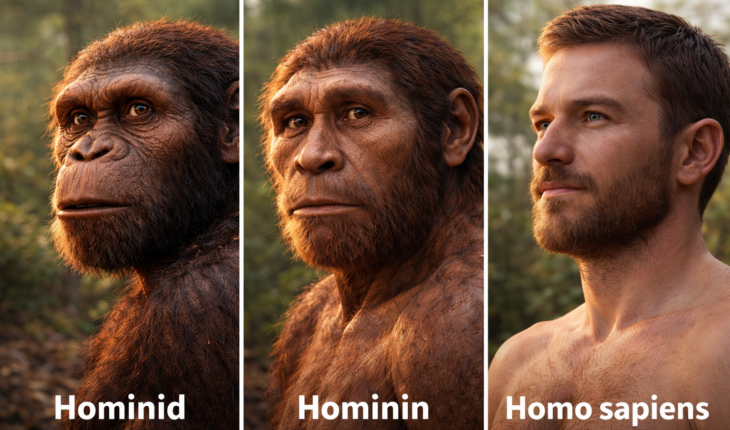
These three terms get mixed together constantly: hominid, hominin, and Homo sapiens. They sound similar, and they all sit somewhere in the story of human evolution. Yet they refer to different levels of biological classification.
If you want to read anthropology without getting lost, this distinction helps immediately.
Start with the broadest term: hominid
- humans
- chimpanzees
- bonobos
- gorillas
- orangutans
- extinct relatives within that family
A hominid is any member of the family Hominidae, the great apes. That includes:
So every human is a hominid, but not every hominid is human.
Narrower term: hominin
A hominin refers to members of the tribe Hominini. In current usage, that usually means humans and our extinct relatives after the split from the chimpanzee lineage.
This includes forms such as:
- Australopithecus
- Paranthropus
- early Homo
- Neanderthals
- Denisovans
- modern humans
Chimpanzees are hominids, but they are usually not called hominins in ordinary paleoanthropological usage. The word hominin is designed to mark the more human-side branch.
Narrowest term here: Homo sapiens
Homo sapiens is our species. This refers to anatomically modern humans and, depending on context, behaviorally modern humans as well.
So the nesting looks like this:
- Homo sapiens is a species
- that species belongs to the genus Homo
- which belongs to the tribe Hominini
- which belongs to the family Hominidae
Or in plain English:
Every Homo sapiens is a hominin, and every hominin is a hominid.
Why experts use different words
These labels solve different problems.
If you want to talk about the great ape family broadly, hominid works.
If you want to talk about the specifically human branch after our split from chimpanzees, hominin works better.
If you want to talk about modern humans specifically, use Homo sapiens.
A lot of confusion comes from older books and documentaries that used hominid where most researchers today would say hominin. You still see that legacy language in public writing.
A practical example
Take Australopithecus afarensis, the species associated with the famous fossil “Lucy.”
What is it?
- It is a hominid, because it belongs to the great ape family.
- It is a hominin, because it belongs on the human side of the split from chimpanzees.
- It is not Homo sapiens.
Now take a chimpanzee.
- It is a hominid.
- It is generally not called a hominin in standard human-evolution writing.
- It is definitely not Homo sapiens.
Now take you.
- You are a hominid.
- You are a hominin.
- You are Homo sapiens.
Why the distinction matters
This is more than taxonomic housekeeping. Each label carries a different claim about relationship.
When someone says “hominid,” they are placing humans inside the great apes. That matters because it keeps human evolution comparative.
When someone says “hominin,” they are pointing to the branch that includes us and excludes chimpanzees. That matters because it focuses on the line where bipedalism, tool dependence, major brain expansion, and cumulative culture took distinctive forms.
When someone says “Homo sapiens,” they are finally talking about us, one species among several that existed within the genus Homo.
That last point is worth slowing down for. For much of our history, Homo sapiens was not the only human species. We lived in a world that also included Neanderthals, Denisovans, and likely other regional populations. So even “human” needs context.
The deeper lesson
The three terms also remind us that classification works by nesting, not by replacing. Human evolution did not begin when Homo sapiens appeared. It did not begin when Homo appeared either. Our story sits inside older ape history, older primate history, and older mammalian history.
That is one reason anthropology resists sharp origin myths. The tree has branches, but it also has depth.
Key takeaways
- Hominid = all great apes, including humans.
- Hominin = humans and our extinct close relatives after the split from chimpanzees.
- Homo sapiens = our species.
- Every Homo sapiens is both a hominin and a hominid.
- These distinctions help you read fossils, family trees, and evolutionary arguments more clearly.
References & further reading
Foley, R. (1995). Humans Before Humanity: An Evolutionary Perspective. Oxford: Blackwell.
Foley, R. (1996). The adaptive legacy of human evolution. Evolutionary Anthropology, 4(6), 194–203.
Stringer, C. (2012). Lone Survivors: How We Came to Be the Only Humans on Earth. New York: Times Books.
Wood, B., & Lonergan, N. (2008). The hominin fossil record: Taxa, grades and clades. Journal of Anatomy, 212(4), 354–376.
Wrangham, R. (2019). The Goodness Paradox. New York: Pantheon.