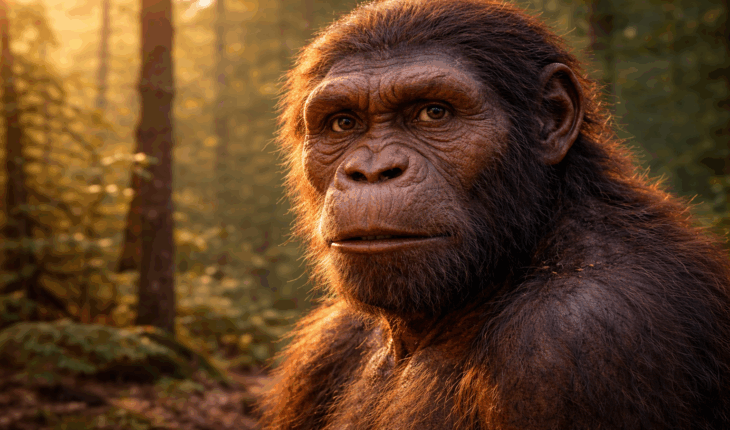
A plain-English guide to one of anthropology’s most misused words
The word hominid gets thrown around casually, usually as a stand-in for “ancient human” or “early ancestor.” In scientific usage, it means something broader and more precise.
A hominid is any member of the biological family Hominidae. That family includes modern humans, chimpanzees, bonobos, gorillas, and orangutans, plus their extinct relatives. So when anthropologists say humans are hominids, they are not saying humans are half-way to being apes. They are saying humans are one branch of the great ape family.
That matters because public discussion often treats humans as if we stand outside nature looking in. Taxonomy pulls us back into the primate story. It reminds us that human evolution did not begin with a blank slate. It unfolded inside a lineage that already had large brains relative to many mammals, flexible hands, long juvenile periods, complex social lives, and strong capacities for learning.
Where the word sits in classification
Biologists organize life into nested categories. For this topic, the important levels are:
- Family: Hominidae — the great apes
- Subfamily: Homininae — African great apes and humans
- Tribe: Hominini — humans and our closest extinct relatives after the split from the chimpanzee line
- Genus: Homo — our genus
- Species: Homo sapiens — modern humans
So if someone asks, “Are humans hominids?” yes. If they ask, “Are gorillas hominids?” yes again. Orangutans too.
This is exactly why the term confuses people. It sounds human-specific, but it is not.
Why older usage still causes trouble
Part of the problem is historical. Older textbooks and documentaries often used hominid in a narrower sense to mean humans and human ancestors. Classification changed as genetics and comparative anatomy made the great ape relationships clearer. Humans were not standing in a separate family after all. We belonged inside the ape family.
That shift was not cosmetic. It changed the framing. Once humans were placed firmly within Hominidae, the question stopped being “How did humans rise above the apes?” and became “How did one ape lineage become so unusual?”
That second question is scientifically better. It is also less flattering, which is part of why people resist it.
What hominids broadly share
At the family level, hominids share a cluster of traits common to great apes, though expressed differently across lineages. These include:
- relatively large bodies compared with monkeys
- no tail
- flexible shoulders and hands
- long developmental periods
- substantial parental investment
- complex social interaction
- strong capacities for learning and social transmission
Humans then push some of those trends much further. We are more dependent on culture, more committed to habitual bipedalism, more extreme in our childhood dependence, and more capable of cumulative technology and symbolic communication. But those specializations sit on an ape foundation.
Why the word matters for understanding human evolution
Calling humans hominids forces a useful discipline. It keeps human evolution comparative. If you want to understand the human hand, you compare it with other ape hands. If you want to understand coalition politics, you look at chimpanzees and bonobos as well as ethnography. If you want to understand long childhoods and heavy parenting demands, you start with primate life history.
That does not collapse humans into chimpanzees. It does the opposite. It shows more clearly which parts of our biology are shared inheritance and which parts are distinctive elaborations.
Hominid does not mean “primitive human”
This is one of the most common mistakes. A fossil hominin such as Australopithecus afarensis is a hominid, yes, but so is a gorilla. The word by itself does not tell you whether you are talking about a direct human-relative branch or a broader great ape category.
So when people use “hominid” as if it meant “something almost human,” the term has become too blurry to do real work. In practice, hominin is usually the more useful word for the specifically human-side branch.
The larger lesson
The importance of the term is not mainly taxonomic. It is philosophical in the best sense. It pushes against human exceptionalism without denying human distinctiveness. Humans are exceptional in some ways, but we are exceptional as apes, not outside them.
That is a harder and better starting point.
Key takeaways
A hominid is any member of the family Hominidae, the great apes. That includes humans, chimpanzees, bonobos, gorillas, orangutans, and extinct relatives within that family. The term is broader than “human ancestor.” It matters because it places humans back inside ape evolution, where the real story begins.
References & further reading
Foley, R. (1995). Humans Before Humanity: An Evolutionary Perspective. Oxford: Blackwell.
Foley, R. (1996). The adaptive legacy of human evolution: A search for the environment of evolutionary adaptedness. Evolutionary Anthropology, 4(6), 194–203.
Mayr, E. (2001). What Evolution Is. New York: Basic Books.
Stringer, C. (2012). Lone Survivors: How We Came to Be the Only Humans on Earth. New York: Times Books.
Wood, B., & Lonergan, N. (2008). The hominin fossil record: Taxa, grades and clades. Journal of Anatomy, 212(4), 354–376.